So Joseph went up to bury his father. With him went up all the servants of Pharaoh, the elders of his household, and all the elders of the land of Egypt,
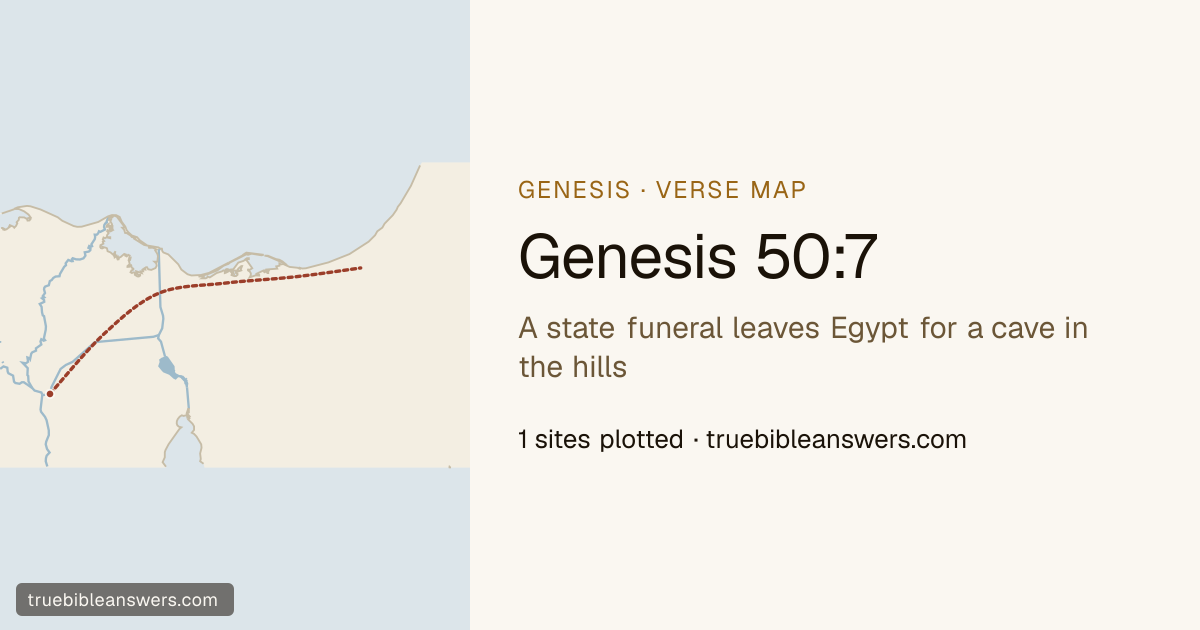 Open map →A state funeral leaves Egypt for a cave in the hillsGenesis 50:7 · 1 place plotted
Jacob dies in Egypt, but the funeral that follows heads for Canaan — and the whole Egyptian court travels with it. Why did so much of Egypt's greatness gather around one man's coffin? And why did that coffin not stay in the land that honoured it?
The Company That Went Up
The escort named here is a state escort. Commentators note how much bigger this burial was than any before it in the family. They see God's hand behind the honour.
L. M. GrantThis called for a huge funeral procession all the way from Egypt to Canaan. It included all the elders of the house of Pharaoh and the elders of the land of Egypt. Joseph's brothers and their families went too, except for their little ones. There was nothing like this at the funerals of Abraham or Isaac. But here God is showing us the sovereignty of His great power and grace in producing sympathy among the Gentiles for His people Israel.
Commentators differ on how far that escort went. One traces the Egyptians only part of the way.
J. N. DarbyThey went to Atad, and Joseph went on to Canaan… Verse 13 would show, I think, that Jacob's sons carried him and buried him in Machpelah. That was not Atad. In verse 10, "beyond Jordan" would mean east of the Jordan, so that the sons of Jacob crossed over, but not the Egyptians.
Asking Egypt's Permission
Joseph was a great man in Egypt. Yet asking to bury his father in Canaan was no small favour to ask. One writer explains why.
J. G. BellettWas it not a small thing for so great a man to do? Yes; but a request to be buried in Canaan was, in some sense, putting a reproach upon Egypt. It seemed to say, after all, the Canaan of degradation and poverty was better than the Egypt of honour and wealth.
Joseph made the request anyway. The same writer sees in him a lesson for us:
J. G. BellettFaith won again. In this way he is a witness to us. We should let the world learn clearly from us that it is nothing to us, for all its progress and promise. What belongs to Christ, weak as it looks, is our aim.
Why The Splendour Belonged To That Day
A splendid funeral fits Genesis in a way it would not fit now. The reason given is the difference between a pledge and a fulfilment.
J. G. BellettIn earlier days they were meant to be splendid. Resurrection was then only ahead of them. Funerals were a kind of pledge of the resurrection they expected. It was right that the pledge should be splendid, matching the glory of what it pledged. But resurrection has now become real in the person of the Lord Jesus, the Son of God. So the splendid funeral… is more of a reproach, as if the great mystery had not yet become real in substance and power. Grand funerals are not what pledges our coming resurrection now. The resurrection of the Lord is that pledge, the first-fruits of a promised harvest.
Honour In Egypt, A Grave In Canaan
One funeral tells two stories at once: how high Joseph had risen, and what his family still were.
F. B. HoleJacob's funeral showed the extraordinary place of power and influence Joseph had reached. Pharaoh gave his permission at once. People in Canaan saw it as a great mourning of the Egyptians. Still, they laid his body in the grave that showed these men of faith were strangers and pilgrims.
Two Kinds Of Mourner In One Procession
The place where Egypt mourned has a name with a meaning in it. One writer draws the lesson out.
F. W. GrantThis mourning of the Egyptians is specially marked at "the threshing floor of Atad, which is beyond the Jordan." Atad is the buckthorn. The thorn is the sign of the curse — what grows on barren soil. The threshing floor fits the lesson of Jacob's life of discipline… Only, the world can see the thorns as well as faith can; but faith alone can see the threshing floor. The world mourns the "few and evil days" — the blight and the poverty of life. Faith, smiling through her tears, accepts the needed discipline of a Father's love. Joseph and the Egyptians are not one, although the Canaanites may confuse them.
Summary
- Honour given. Pharaoh's servants and all Egypt's elders travel with Joseph. No earlier funeral in the family had anything like it. God was moving the nations to feel for His people.
- Honour risked. Asking for burial in Canaan told Egypt that poor Canaan beat rich Egypt. Joseph asked anyway, and faith won.
- Honour borrowed. The splendour suited a day when resurrection was still only ahead. Christ is risen, so the pledge is no longer needed. He is the first-fruits of the harvest.
- Honour limited. The Egyptians seem to have gone only as far as Atad. Jacob's sons crossed the Jordan and buried their father in the family cave.
- Honour outlived. The procession showed how high Joseph had climbed. The grave in Canaan showed his family were still strangers. The world sees only the thorns; faith sees the threshing floor too.