Then Jacob set out from Beersheba. The sons of Israel carried Jacob their father, their little ones, and their wives, in the wagons that Pharaoh had sent to carry him.
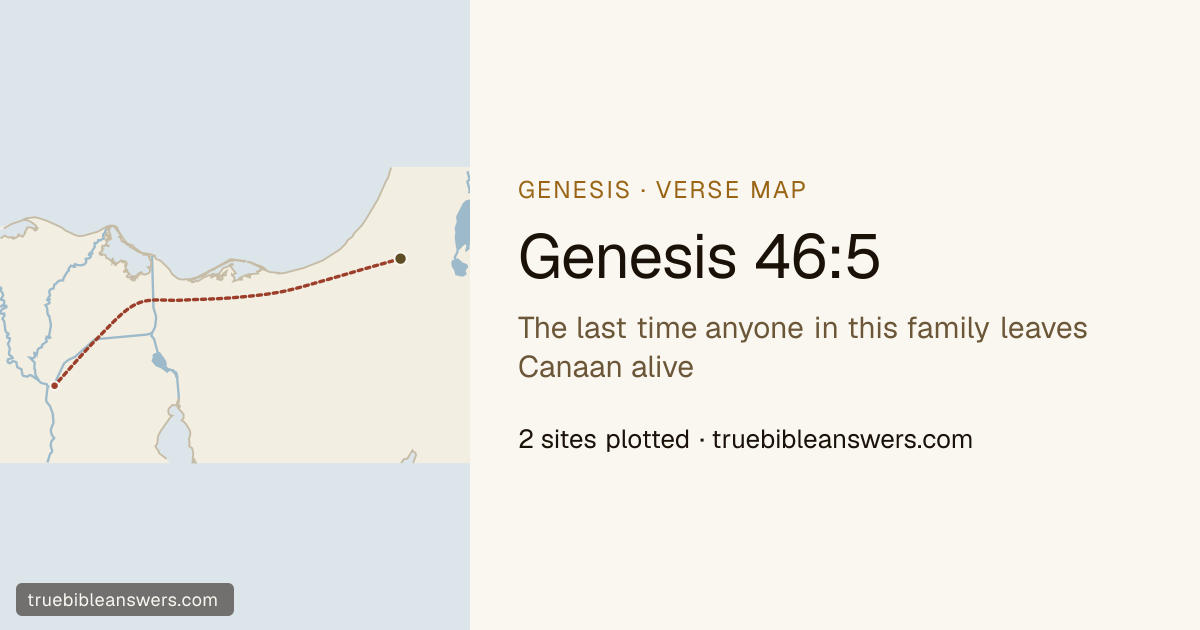 Open map →The last time anyone in this family leaves Canaan aliveGenesis 46:5 · 2 places plotted
Jacob is an old man at Beersheba, on the edge of Canaan, with Pharaoh's wagons waiting for him. Why does he leave the land of promise, and what carries him there?
Only after God speaks
Beersheba was not a random stop. Egypt had a bad history in this family, and God met Jacob's fear there before a single wheel turned.
William KellyBeersheba was a memorable spot to Isaac. He built an altar there and called on the name of the LORD, who had appeared to him there. This was some time after he had been forbidden to go down into Egypt, even under the pressure of famine, as Abraham had wrongly done. But now God spoke to Israel in a vision of the night. Jacob had offered sacrifices to his father's God, and God called him by his name of natural weakness and told him to go down into Egypt without fear... Jacob was not to hesitate. "I myself will go down with you to Egypt, and I will also bring you up again, and Joseph's hand shall close your eyes." God entered into the anxieties of His feeble servant. He knew how to strengthen his tried heart.
The name of the place spoke too:
L. M. GrantOn his way he stopped at Beersheba (the well of the oath), which shows he remembered the promise of God that he depended on.
Carried, not marching
The wagons matter because of who sent them.
A. J. PollockJoseph not only wants his brothers near him, he provides the means to bring them to himself. No exhausting march lay ahead of Jacob in his weakness and old age. There was no long journey for the little ones and their mothers. No — they were carried every step of the journey in the wagons. In other words, the power that carried them to Joseph came from Joseph.
His sons' report alone had not convinced him:
William KellyThe king suggested the wagons, and left Joseph to supply them. Those wagons played their part in persuading the father to believe the report that at first made his heart fail — that Joseph was still alive... there it was, in the means of going down into Egypt that his sons could not have provided.
Power from the risen Lord
One writer reads the wagons as a picture of how we travel to Christ.
A. J. PollockDoes all this not teach us that the power by which we make the pilgrimage to our Joseph — our heavenly Isaac — comes from the place where He is? Did He not, after His ascension, send us the Holy Spirit to live in our bodies? It would be a great gain if we believed this simple but deeply important fact, that ALL our power for life and journey comes from our risen Lord.
Wagons and words
Why did the sight of the carts change his mind?
The Bible TreasuryThose rough wooden carts were evidence of a brighter horizon and a new and glorious world, still unknown and unseen. Jacob could see them and touch them. The sight of them settled his wavering mind.
The same writer turns this on the reader:
The Bible TreasuryIt is not to our credit when some passing gift from God's hand, or an answer to prayer, encourages us more than the sacred words of Christ Himself. It shows a low spiritual condition. That is the difference between faith and gullibility. Faith rests on the strongest evidence in the universe — the word of God.
The whole household, with its goods
They did not travel to Egypt empty-handed.
William KellyBut they also took their livestock and the goods they had gained in Canaan, and came into Egypt. Jacob and his sons had no intention of entering that land as mere dependents of its ruler, whatever his wish to honour Joseph, and whatever the promise that the best of all Egypt would be theirs.
The journey follows something that has already happened:
J. G. BellettThe reconciliation, as we have now seen, is complete. Joseph has received his brothers, and so everything is ready for Israel's full blessing. Restoration must follow conversion... The aged father, with his household and flocks, is brought from Canaan.
Summary
- Word first. Jacob leaves Beersheba, the well of the oath, only after God meets his fear in the night and promises to go with him.
- Wagons second. The carts came from the son he was travelling to. His sons could never have supplied them.
- Power throughout. Old age and little children make no difference. The strength for the journey comes from the place you are going.
- Faith above sight. The carts settled his mind. But a believer who leans on visible gifts more than on God's word is in a low condition.
- Everyone arrives. Wives, children, livestock, goods — after Joseph receives his brothers, the whole family travels into blessing together.