So he said to him, “Go now, see if it is well with your brothers and with the flock, and bring me word.” So he sent him from the Valley of Hebron, and he came to Shechem.
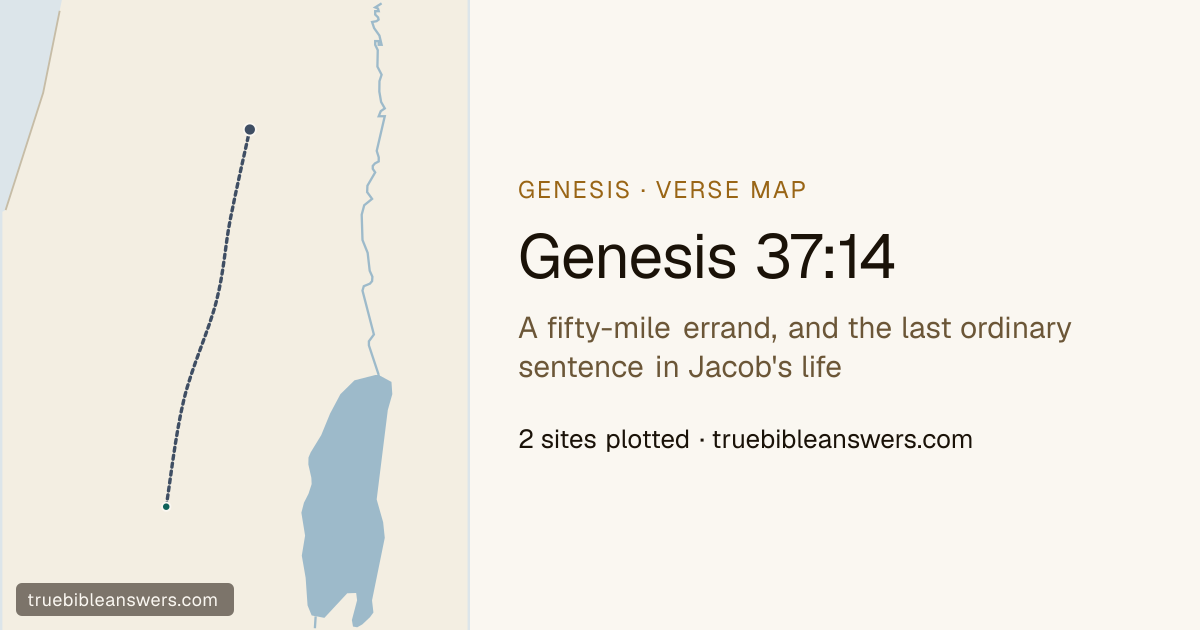 Open map →A fifty-mile errand, and the last ordinary sentence in Jacob's lifeGenesis 37:14 · 2 places plotted
Joseph's brothers are away with the flocks at Shechem, and his father sends him to check on them. But the place has a dark history, and his brothers already hate him. Commentators read this short journey as a picture of the Father sending His Son.
An errand into a risky place
Shechem was not safe ground for this family. One writer asks why the flocks were back there at all, and sees a trace of worry in the errand Jacob gives:
J. G. BellettWhy this return to Shechem? Was it because the purchased land, the family estate, was there? It was a dangerous place to be connected with. It had proved a snare to the whole family, and the Lord had called them away from it. Jacob should have been more watchful. If he had been, we might not be hearing again of Shechem, or of the flocks and the brothers there. But still, it is good to see signs of uneasiness in his mind about it. He sends Joseph to find out how the flocks and the brothers were doing there, as though he had some misgiving about them in so suspicious a place.
From Hebron to Shechem
The two place names mark the ends of the journey. One writer reads them as a map of what the Son left and where He came:
L. M. GrantShechem means "shoulder," and speaks of assuming responsibility, which Israel did under law. So the Father sent the Lord Jesus to the place where Israel was responsible to be, under the law God had given them. Joseph was sent "from the valley of Hebron" (v. 14). Hebron means "communion." This reminds us that the Father sent His Son from the place of close communion. That communion had been the portion of the Father and the Son from all past eternity.
Another sets the same two places side by side, then turns them on the reader:
G. C. WillisHebron, high on a mountain, makes us think of heaven; but Shechem, of sin, deception and murder. Jacob's sons left Hebron and their father to feed the sheep down at Shechem. Have we not all left our heavenly Father and chosen this bad world?
"Here I am"
Joseph agrees to go, knowing what kind of welcome waits at the other end of the road:
C. KnappJoseph would have had good reason to draw back from such an errand. He knew his brothers' wickedness and hatred. He knew the envy of their hearts against him. He could with reason have asked his father to excuse him from this undertaking. But no; "Here I am," he says, always ready to obey, and glad to seek his brothers' welfare.
The one who was sent
The word "sent" draws the New Testament parallel. The errand pictures a mission that met the same welcome:
W. T. P. WolstonJoseph first comes before you as a young man of seventeen (Gen. 37:2), and we find that his father sends him on a journey, saying, "Go now, see if it is well with your brothers… and bring me word" (v. 14). In the same way, of the blessed Lord we read, "The Father has sent His Son to be the Savior of the world" (1 John 4:14). Did the world know Him? Ah, no! "He was in the world, and the world was made through Him, yet the world did not know Him. He came to His own, and His own people did not receive Him" (John 1:10-11). So it was here. No sooner does Joseph appear among his brothers than they plot, as you know, for his death.
A pattern for service
Joseph reaches Shechem and cannot find his brothers. One writer draws out what he does next, and what it teaches anyone sent on an errand for God:
The Bible TreasuryResponding to the will of the father, he did not shrink from the post of danger which the father did not see for him. Suppose the One greater than we are, in love and in wisdom, appoints us a path of service that would be pleasing to Himself. He knows all, and He sees no danger for us. Then we may surely enter on it in simple confidence… Joseph's heart was set on finishing the errand. Instead of turning back when he could not find his brothers, he waits at his post until he gets news of them, and then follows them to Dothan.
Seeking the welfare of brothers
Asking after the welfare of others is a service anyone can take up:
F. A. HughesJoseph's service brought him reproach and misunderstanding. In the end he had the joy of fellowship with his brothers, and "Joseph provided… his brothers" with food (Genesis 47:12). Paul cared for all the churches. Timothy had genuine concern for the saints. Epaphras prayed fervently for them. These are a few of those who sought the welfare of their brothers — a happy service open to all.
Summary
- Sent — Joseph goes because his father sends him, and the New Testament uses that same word of the Father sending His Son into the world.
- From — he leaves Hebron, whose name means "communion" — a picture of the place the Son came from.
- To — he goes to Shechem, a place that speaks of sin and murder, and a snare the Lord had already called the family away from.
- Willing — knowing their hatred, he answers "Here I am." When he cannot find them at Shechem, he presses on to Dothan.
- For — the whole journey aims at the welfare of his brothers, and that service is still open to anyone.