Then Esau took his wives, his sons, his daughters, and all the members of his household, his livestock, all his beasts, and all his property that he had acquired in the land of Canaan. He went into a land away from his brother Jacob.
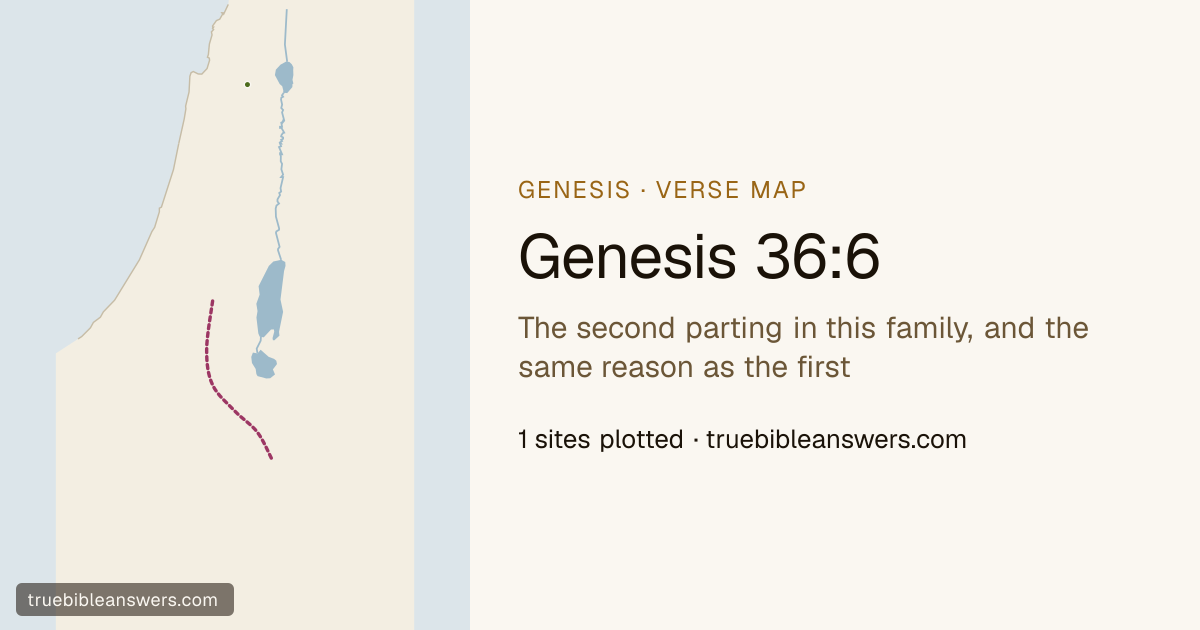 Open map →The second parting in this family, and the same reason as the firstGenesis 36:6 · 1 place plotted
Genesis 36 pauses the story of Jacob to record the line of Esau. Verse 6 is the moment the brothers part for good, and it raises the question of why they could not share one land.
A parting that never healed
This move was the end of a long story between the brothers. The nation that came from Esau later turned against Jacob's descendants.
Arno Clemens GaebeleinIn verse 6 we read that Esau went into the country away from the face of his brother Jacob. In the end it came to a clear and complete separation between Esau and Jacob. Jacob lived in the land where his father was a stranger. And Edom became the treacherous enemy of the people of Israel.
Why they could not share a land
The verse names a departure but no reason for it. One writer traces the reason to the two men themselves, and reads the chapter's long list of names as God's full accounting of everything that line produced.
L. M. GrantThe man "after the flesh" cannot live together with the one God has chosen… Esau's family shows the usual history of the flesh, which always exalts itself. So the long list of names is there to impress on us that God has taken full account of the flesh and all its activities, finding it only vanity.
Esau's choice and God's purpose
Esau moved for his own reasons. No one forced him out. Yet in going he left Canaan to the brother God had chosen. One writer sees God's purpose at work in that.
Frederick W. GrantThen follows a long list of Esau's generations, ripening too early into chiefs and kings. The world must have its day. Yet in the middle of it all we see a significant sign that God is fulfilling His purpose — the purpose that is "not because of works but because of him who calls." For we read that Esau "went into a land away from his brother Jacob."
What each brother ended up holding
Esau leaves with everything he owns. Jacob stays in a land where he is a stranger, holding only a promise, and his children inherit that same unsettled life.
J. G. BellettBut Jacob was "a quiet man," a man of the tent. He took after his fathers. Like Abraham and Isaac, he was a stranger here, living on the surface of the earth for a time, with his eye on the promise. Esau's children were chiefs, settled in their own territories, enjoying their honours and wealth. Jacob's children had to wander from one nation to another. They had to suffer the hardships and wrongs of cruel Egypt, or to cross the trackless, wasted desert as pilgrims.
Fast growth and slow growth
Esau's line rises fast after this move — chiefs, then kings, long before Israel had either. The speed itself is the lesson.
William KellyWe see at once what remarkable maturity there was here. It is always so — first what is natural, afterwards what is spiritual. Even then we find a rapid development of power in the family of Esau. They were all great people, of course — chief this and chief that, right to the end of the chapter. Even kings, we are told, reigned before there were any in Israel. I have no doubt this is given to us as an important sign of how rapidly what is not of God shoots up. Growth according to God is slower, but then it is more lasting.
The land God gave Esau
Esau's new home was not just his own taking. Long after this move, God's earlier word about Seir still stood, and it limited what Israel could claim.
Arno Clemens GaebeleinEdom had harassed Israel greatly and shown an arrogant pride. Still the Lord would not give Edom's possession to Israel. He remembered His word: "I have given Mount Seir to Esau as a possession" (Gen. 32:3; 36:6-8; Josh. 24:4). They were, therefore, not to seek what the Lord had not given them. And this is obedience and a lesson of faith. What happy contentment there would be among God's people if this rule were followed.
Summary
- Parting. The move was no temporary arrangement. It was a complete and lasting split, and Edom later became Israel's treacherous enemy.
- Cause. The man after the flesh and the man God chose could not share one land.
- Purpose. Esau left Canaan by his own choice. That choice served a purpose resting on God's call, not on works.
- Contrast. Esau's sons gained territories and quick honours. Jacob's family held a land they owned nothing in, and wandered as pilgrims.
- Result. What shoots up fast is not what lasts. Growth according to God is slower and more lasting — and even Esau's land stayed a gift God protected.