Mearah in the Bible
"The cave that belongs to the Sidonians" — one verse, five proposed sites, and no agreement
Mearah is named once in the Bible and nowhere else. Joshua 13:4 lists it among the land Israel had not yet taken, as the survey moves north out of Philistia along the Phoenician coast: "all the land of the Canaanites, and Mearah that belongs to the Sidonians, to Aphek, to the boundary of the Amorites". That is the whole of the evidence. The name is the ordinary Hebrew word for a cave, me'arah, and three translations render it Arah instead, dividing the consonants differently; one strand of scholarship holds that it is not a name at all but a description — the cave, or the cave country, of the Sidonians. Sidon's territory ran east off its beach and straight up into the limestone of the Lebanon range, and the identification more works support than any other puts Mearah at Jezzine, a mountain town about 20 km inland at the head of the Bisri gorge, in a district known for its caves. Three other proposals leave Lebanon altogether and look 125 km south, to the Wadi Ara, where the name ‘Ara still sits on a wadi, a village and a ruin. None is held with confidence. This page draws all of them.
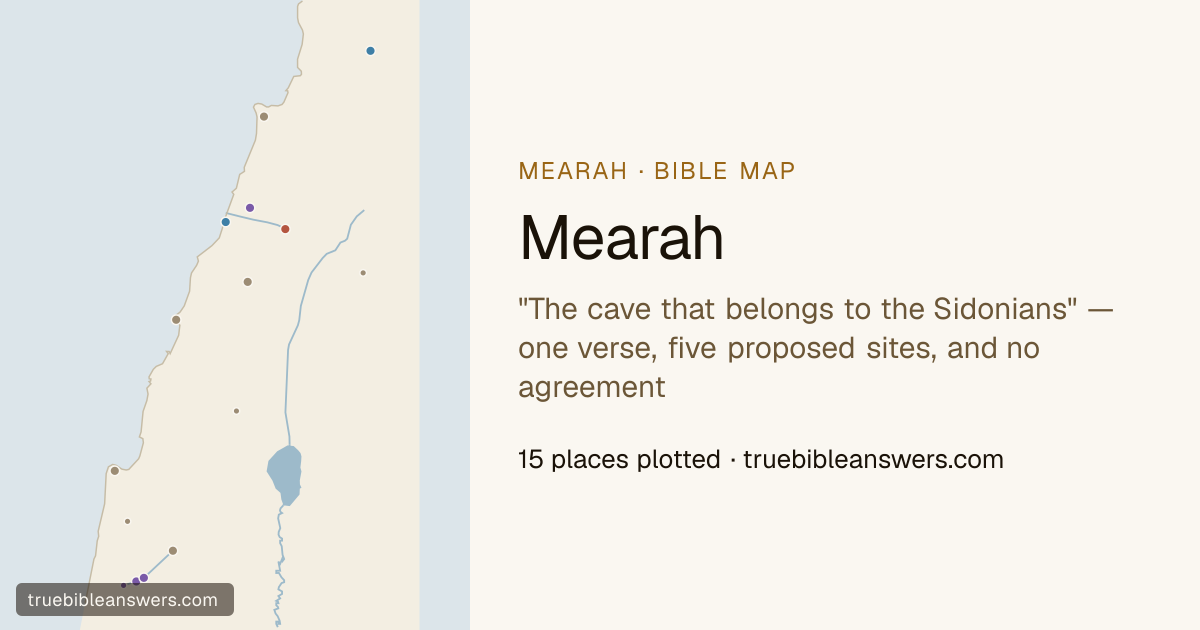
The ground it sits in
The ground is the Lebanese coastal hinterland behind Sidon. The coast road runs Beirut–Sidon–Tyre along a narrow shelf; a few kilometres inland the Lebanon range begins and climbs hard, and the Awali river comes down out of it to reach the sea just north of Sidon. Jezzine sits at the head of that valley, high on the western scarp, with Nabatieh on the plateau to the south and Mount Hermon 29 km east. The three southern candidates are in another country and another landscape: the Wadi Ara, the gap between the Carmel ridge and the hills of Umm al-Fahm that carries the road from the coastal plain into the Jezreel valley past Megiddo.
Lebanon's capital, 37 km up the coast from Sidon and 38 km from Jezzine. Nothing in Joshua 13 happens here; it is on the map because it is the point a modern reader finds first.
Today: Beirut
Sidon's sister city, 36 km down the same coast. The Phoenician shore verse 4 is describing runs between the two and back into the hills behind them.
Today: Tyre (Sour)
The market town of the Jabal Amel hills, 21 km south of Jezzine on the plateau above the Litani — the nearest thing to a neighbour the Jezzine proposal has.
Today: Nabatieh
2,814 m and snow-capped into the summer, 29 km east of Jezzine. It closes the eastern side of this frame and is the one summit in it a reader is likely to know.
Today: Mount Hermon (Jabal ash-Shaykh)
1,208 m, the high point of Upper Galilee — the next range south once the Lebanon runs out, and the ground between the two groups of candidates.
Today: Mount Meron
The ridge that drops into the sea at Haifa. The three southern candidates sit in the gap at its south-eastern end, which is the only reason the pass there was ever worth a name.
Today: Mount Carmel
The bay at the foot of Carmel, and the nearest large modern city to the Wadi Ara sites, 98 km south of Jezzine.
Today: Haifa
The mound at the northern mouth of the Wadi Ara pass, 16 km from the wadi's midpoint. It is why the pass mattered, and why its name is so well recorded.
Today: Tel Megiddo
Where Mearah has been placed
The rival identifications. A name nobody can fix gets every proposal drawn rather than one confident pin.
76 votes
The best-supported identification, and the only one with more than a handful of works behind it: Jezzine, high on the western scarp of the Lebanon range about 20 km east of Sidon, at the head of the Bisri gorge. It is inside Sidonian country, it is cave country, and it is close enough to the coast for a Sidonian claim to make sense. Nothing there has ever been excavated as Mearah — the case is the geography and the name, not the ground.
Today: Jezzine, Lebanon — proposed, not established
33.5400°N, 35.5836°E · disputed · 9 scholarly sources · also proposed: El Mghairiye, Wadi Ara, Khirbet ‘Ara, En Iron
40 votes
A village in the hills of Iqlim al-Kharrub, 9 km north-east of Sidon and 14 km from Jezzine. Its Arabic name carries the same root as maghara, "cave", and that is the whole of the argument for it: a surviving name rather than an excavated site.
Today: El Mghairiye
33.6031°N, 35.4582°E · disputed · 4 scholarly sources
30 votes
Read the name as Arah rather than Mearah — taking the opening mem as the preposition "from" — and the search moves 125 km south to the Wadi Ara, the pass the Via Maris used to cross the Carmel ridge into the Jezreel valley. The name ‘Ara survives there on the wadi itself. Against it: verse 4 is describing Sidonian country, and this is nowhere near Sidon. The gazetteer records this proposal as a stretch of wadi rather than a point, so the pin is a representative point on it.
Today: Wadi Ara (representative point)
32.4941°N, 35.0545°E · disputed · 3 scholarly sources
30 votes
The ruin that carries the name ‘Ara itself, 3 km up the pass from the wadi's midpoint. One work backs it outright — the only unqualified yes anywhere in this file — and it is an old one; nothing since has followed.
Today: Khirbet ‘Ara
32.5048°N, 35.0814°E · disputed · 1 scholarly sources
10 votes
One work declines to treat the word as a name. Me'arah is the ordinary Hebrew noun for a cave, and Joshua 13:4 can be read "and the cave that belongs to the Sidonians" — a stretch of country, not a town. If that is right, every pin on this map is in the wrong place, and the honest answer to "where is Mearah" is that the question is malformed.
no site: the word is read as a common noun
10 votes
A spring site at the western mouth of the same pass, 4 km from the wadi's midpoint. Proposed once, and by no-one else.
Today: En Iron
32.4824°N, 35.0093°E · disputed · 1 scholarly sources
Named in the same verses
The other places the Bible names in the verses that name this one.
The northern Aphek, at the source of the Adonis high in the Lebanon range, 65 km north of Jezzine. It is the next name in verse 4 and the far end of the stretch Mearah sits somewhere inside.
Today: Afqa, Lebanon
34.0692°N, 35.8861°E · likely · 21 scholarly sources
The Phoenician city Mearah is said to belong to. It is the city's territory, not its walls, that verse 4 is measuring — which is what sends every Lebanese proposal inland rather than along the beach.
Today: Sidon (Saida), Lebanon
33.5610°N, 35.3719°E · widely agreed · OpenBible.info
Mearah, verse by verse
- Josh 13:4in the south, all the land of the Canaanites, and that belongs to the , to , to the boundary of the Amorites,