Numbers 25:1: The last camp before the Jordan, and the curse Balaam could not speak done another way
Read it →Commentary on Numbers 25:1
Numbers 25 opens with Israel camped east of the Jordan. God had just stopped the prophet Balaam from cursing His people, and made him bless them instead. The blessing held — and then Israel fell, not to an army, but to an invitation from the women of Moab.
From God's view of Israel to Israel's actual state
The chapter marks a sharp drop in perspective. Before this, we hear how God sees His people. Here we see what they were doing.
As we start reading Numbers 25, we come down from Israel as God's purpose views them. We come to Israel as they really were at that time: fleshly and unbelieving. Balaam is not mentioned in the chapter but, as we have noted, he was at the bottom of the evil, urging Balak to promote it. The result was that Israel joined himself to Baal-peor. They no doubt committed this immorality in honour of Baal, and that disguised its wickedness in their minds. Not all the people took part, but enough did to make it an act of apostasy. It deserved severe and immediate judgment, and it got one.
The enemy changes tactics
Balaam had been powerless to curse. So the attack switched from outside pressure to inside seduction.
Balaam could not succeed in enchantment against Israel... The aim was to get the Lord to curse His people. He could not, and he was forced only to bless. There is no possibility of using Satan's power against the people of God. God held the lips of Balaam, and made him bless despite himself. "Resist the devil, and he will flee from you." He has no power as an adversary. It is as a tempter that he has power. The enemy could not bring a curse on the people. So he sought to seduce them into wickedness — and then how could God bring them in? (Num. 25).
The snare arrived as friendliness
Nothing in the invitation looked like an attack. That was the point of it.
What was the next step for Israel? While they were living there, Balaam's counsel is, "Let us all be together; let us be social." And oh, what a subtle delusion of the enemy this is — this plea of friendship!
"Israel lived in Shittim"
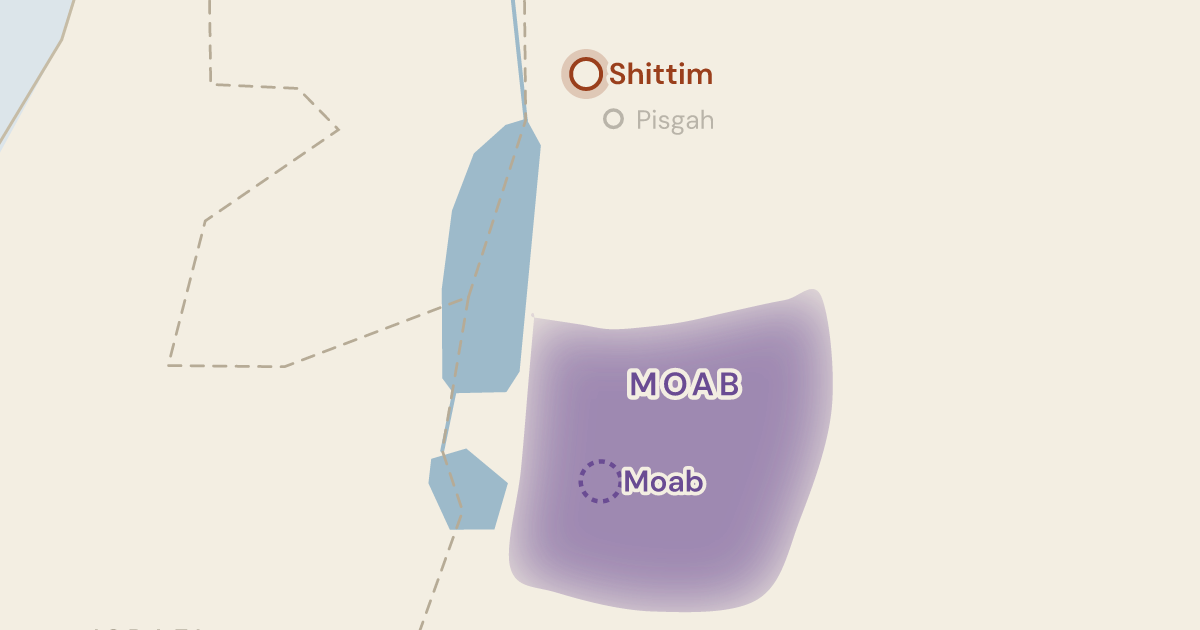
The verse names where this happened. Israel was camped on the doorstep of the land.
A plain on the east of the Jordan, where the Israelites camped before they crossed the Jordan. The name means 'acacias.'
Older translations read "abode" where the ESV has "lived." The word describes more than pitching a tent for the night.
One key is the word "abode." It suggests a settled state of mind, not a temporary one. Further, immorality and idolatry have both become common practice. (Immorality's spiritual counterpart is idolatry.) Here we reach a different degree of sin: a state of established idolatry, which resulted in Israel joining himself to Baal-Peor.
Immorality and idolatry arrive together
The two sins in this chapter are not separate incidents. One writer sums up Balaam's teaching and treats them as a pair.
Here we get a summary of Balaam's teaching. For the full details we have to turn to Numbers 25:1-9 together with 31:16. Balaam stayed in the background, but he prompted Balak to put the stumbling block in place. It enticed Israel to idolatry and immorality — two things that are always joined together in the pagan world. The first is the most basic of all sins against God. The second is against mankind as well as God.
The lasting warning
One writer names the Moabites at the head of a list of nations that drew Israel away, and turns it into a warning.
At the head of this humiliating list we find the Moabites. They had led Israel astray into the idolatry of Baal-Peor, gaining control of them through the lust of the flesh (Num. 25:1-5)... We are in danger of going to the world, or of letting it come in to us. Perhaps the second possibility is even more dangerous than the first. Out of conscience towards God, a Christian may hold back from an act of self-will or disobedience that would take him out to the world. But the world can seduce him more easily by coming to him. Little by little it works its way into our homes and into our lives. Often when we open our eyes to the danger, it is already too late.
Summary
- Joined, not conquered — no enemy defeated Israel. Israel joined itself to Baal-peor.
- Curse failed, temptation worked — as an adversary the enemy has no power over God's people. His power is as a tempter, so he turned to that when the blessing stood.
- The bait was friendship — the call was simply to be together, to be social. That plea of friendship is the enemy's subtle trick.
- Settling preceded sinning — the older word "abode" points to a settled state, not a passing lapse. Immorality and idolatry came in together.
- The danger runs both ways — we may go out to the world, or let it come in to us. Writers warn that the second creeps in unnoticed until it is too late.