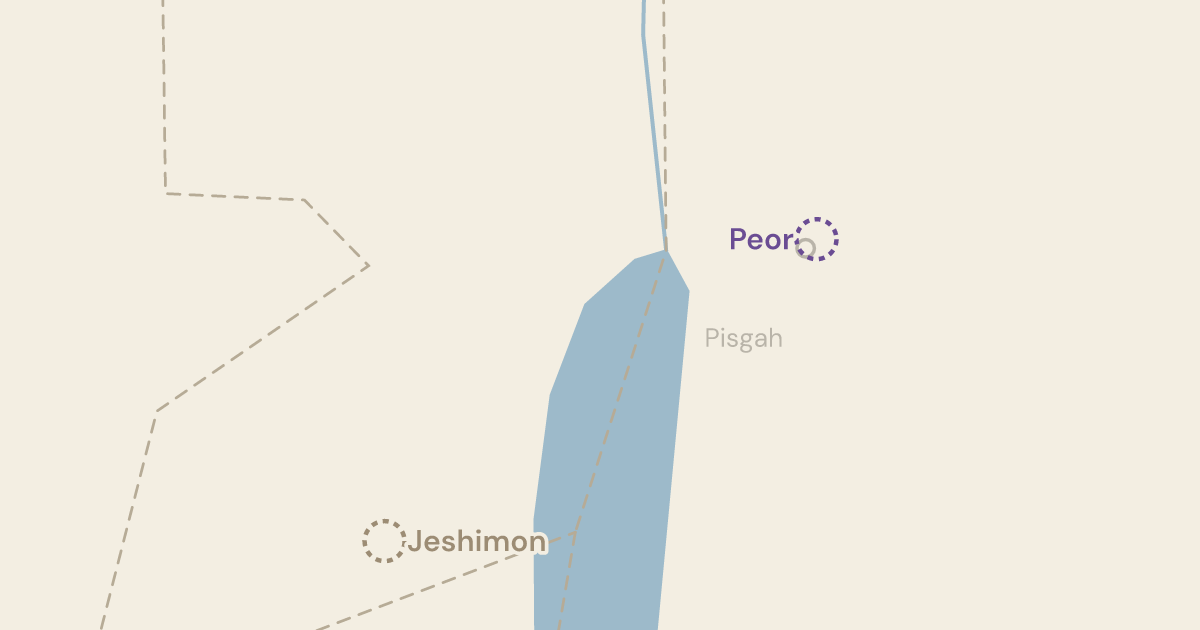
Numbers 23:28: The third summit, and the last: the whole camp below, and the wilderness beyond it
Read it →Commentary on Numbers 23:28
Balak has already heard Israel blessed twice. Instead of giving up, he moves the prophet a third time — now to the top of Peor, a hill facing the wasteland where Israel camped. If God has spoken twice, what can a change of scenery achieve?
Persistence Against A Settled Word
God had just spoken through Balaam, and His word stood. Balak's reply was to suggest one more vantage point.
It is amazing to see Balak still trying to curse God's people after all that God had said to him through the lips of Balaam. God had just said, "God is not man… that He should change His mind." Yet Balak said to Balaam, "Please come to another place; perhaps it will please God that you may curse them for me from there." Such is man in his self-will and ignorance of God. By opposing God's will, he brings God's just judgment on himself. To get what he wanted, Balak takes Balaam to the top of Peor, named after his god, Baal-Peor.
Why A Change Of Place Seemed Worth Trying
Moving the prophet only makes sense if a god's power stops at the edge of his own land.
Yet again Balak picks another place (v. 27). He does not know the God of heaven and earth. To his dark idolatrous soul, was the Jehovah of Israel any more than the local god of one people, or of one small area? There He might be supreme, while in another place another god would rule. The idolatry of every land and age never went beyond this. Each nation had its own god… Long afterwards the Syrians said the God of Israel was the god of the hills, and not of the valleys.
The Hill That Looks Toward The Waste
Balaam now looked out over a region whose name described where Israel still stood.
The new point of view was "the top of Peor, that looks towards Jeshimon" (meaning, "the waste"). This time Balaam was forced to give a truly delightful description of the people as God saw them. But the people were not yet in Canaan, resting in possession of every promised blessing. They were still in the desert wastes. In the New Testament letters we find wonderful descriptions of God's saints. They show us not only how they will be in heavenly glory forever, but how they are today, in this evil world! God sees His saints as "in Christ," and faith says with joy, "as He is, so we are in this world" (1 John 4:17).
Closer With Each Move
Balak's three viewpoints were not the same distance from Israel.
But now he comes nearer still. From the top of Peor, Balaam sees the people staying in their tents, tribe by tribe. The nearer he gets, the deeper the impression made on him. Now he says, "How lovely are your tents, O Jacob!" The nearer vision you have of the people of God, the more fully you will realise the wonder of their blessing.
Opposition That Backfires
Balak's motive for shifting ground was fear of what he had seen. The outcome was the opposite of what he wanted.
Hatred and unbelief think of circumstances. The sight of Israel had frightened Balak, and in the folly of unbelief he tries to draw Balaam away from the influence of what he dreaded himself. Unbelief never thinks of the thoughts of the Lord, and the people were not hidden from Him. His persistence in seeking the curse enlarged the blessing; it is always so. He does not know God. And God could not simply repeat the blessing already given, so it grows fuller each time.
The Real Danger At Peor
The curse failed on that hilltop. Two chapters later, the same name reappears — this time as the scene of Israel's fall.
The effort was to get Jehovah to curse Israel, but they could not. God held Balaam's lips and forced him to speak blessings instead of curses, despite himself. "Resist the devil, and he will flee from you." When the devil comes as an adversary, he has no power. The secret of his power lies in coming in as a tempter and seducer. Satan could not get Jehovah to curse Israel. So he seduced them into wickedness, leading them "to eat things sacrificed to idols, and to commit sexual immorality." Then how could the holy God bring them in? (See Numbers 25.)
Summary
- Place. Balak's third move assumed God's favour changes with the scenery. That is how a man thinks who knows only local gods.
- Peor. The hill carried the name of Balak's own god. It faced Jeshimon, "the waste" — God's people seen as He sees them, still in the desert.
- Nearer. Each new viewpoint brought Balaam closer to the camp. The closer he looked at God's people, the greater the blessing he had to speak.
- Enlarged. Pressing for a curse never repeated the old blessing — it drew out a fuller one. Opposition to God's people develops what God has to say about them.
- Tempter. As an accuser the enemy achieved nothing at Peor; as a seducer he later succeeded there. The danger to guard against is not the curse but the bait.