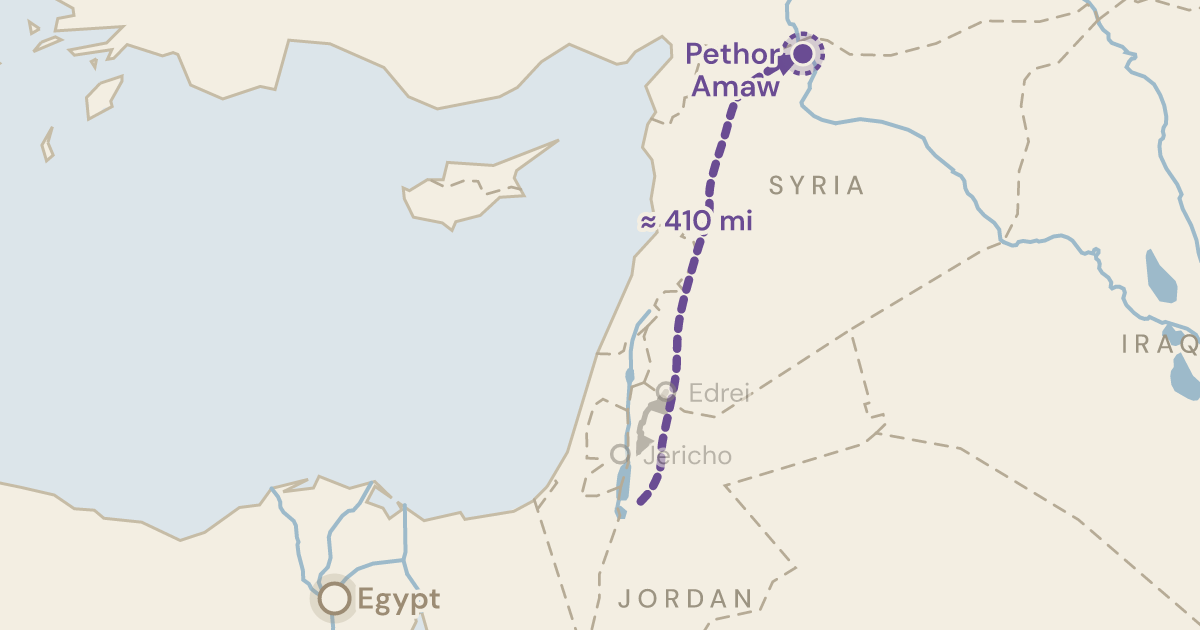
Numbers 22:5: Moab sends four hundred miles up the Euphrates road for a man to curse a camp
Read it →Commentary on Numbers 22:5
Balak, king of Moab, has watched Israel destroy the armies in front of him. Now he sends messengers to a distant land to hire one man. Two questions follow: why does a frightened king hire a soothsayer instead of praying, and what does it mean that Israel never knew about the plot?
A king ruled by fear
One writer counts the camp, then weighs Balak's fear against what he should have done with it:
The King of Moab and his people saw Jehovah's travelling host camped on their border. In the camp of Israel there were 601,730 men able to carry arms. With women and children there were probably at least three million people. Balak was alarmed. He was all the more alarmed because Israel had just destroyed three military powers that dared to oppose their march: the King of Arad, Sihon King of Heshbon, and Og King of Bashan. Sihon had earlier fought a successful war with Moab and taken some of her land. How then could Balak hope to stand against a nation which had destroyed his powerful neighbour? When men are in trouble, the proper thing is to turn to God in prayer. He cares about the affairs of nations as much as He cares about the troubles and sorrows of individual men and women. But Balak knew nothing of God.
Why send so far for one man
Balak did not look for help nearby. He sent to Mesopotamia, and one writer explains the thinking behind it:
He was not satisfied that military power would be enough to withstand the conquerors of Sihon and Og. So he sent messengers to a well-known soothsayer — Balaam the son of Beor, who lived in Mesopotamia. Outsiders were already crediting Israel's victories to divine power... In sending for Balaam, Balak sought to oppose the supernatural by the supernatural. People said this Mesopotamian prophet had influence with the invisible world.
Two men matched by name
The names in this verse carry meaning. One writer sets Balak's name against his parentage, and Balaam's against his trade:
"Balak" seems to mean "waster." The name looks like a deliberate contrast with his family line, since he is only ben-Zippor, "son of a sparrow." What grand titles men take to cover how small they are! Balaam the son of Beor matches this Balak in every way. He is a "devourer of the people," son of the "consumer." Men sought him out for his skill in cursing, and he was ready to take a bribe and destroy a whole nation. No doubt he claims loyalty to Jehovah, but he has no real knowledge of Him, as his actions show. In his efforts to destroy the people of God, you cannot even say he hates them. He would destroy them in cold blood, for money.
"A people has come out of Egypt"
Balak's message never names Israel. He describes them by where they came from and how many they are. One writer sees the same fear and hatred repeating long after Balak:
He knew that the people had come out of Egypt. He was very afraid. The fate of the Egyptians and Amorites seemed to foretell his own. So fear and hatred fill his heart, and he wanted to oppose and curse Israel. It is nothing less than the history of anti-Semitism in a nutshell. Nations that call themselves Christian still hate and fear this people, whom no Pharaoh and no soothsayer could overcome — a people disobedient, judged and suffering, yet always conquering.
The man who was for sale
Balaam did not send a quick refusal. One writer explains the delay:
If Balaam's heart had been right with God, he would have dealt with Balak's message at once. It would not have cost him a moment's thought to send a reply. But Balaam's heart was all wrong... His heart was set on going, because it was set on the silver and gold. But at the same time he made some reference to God — an appearance of religion put on as a cloak to cover his greed. He longed for the money; but he wanted to get hold of it in a religious way.
A danger the camp never saw
Israel knew nothing about any of this. One writer draws out what that silence means:
The people of Jehovah were now in grave danger. They had been ungrateful and disobedient all through their wilderness journey. They did not know about the danger, so they did not pray to God about it. But Jehovah Himself took the matter up, and there we are reminded of His unchanging favour. He loved the people, despite all that they were, and He would not allow the enemy to harm them.
Summary
- Fear sends. Balak watched Israel destroy three kingdoms. Trouble should drive a man to prayer. Balak knew nothing of God, so he sent for a man.
- Fear buys. Armies had not stopped Israel, so Balak fought the supernatural with the supernatural. He hired a far-off soothsayer said to have influence with the invisible world.
- Fear hates. His message names no nation, only "a people has come out of Egypt" — the fear and hatred one writer calls anti-Semitism in a nutshell.
- The hireling. Balaam's heart was set on the silver and gold. He wrapped that greed in religion, wanting the money in a religious way.
- The unseen defence. Israel never learned of the danger and never prayed. God took the matter up Himself, because He loved them.