Numbers 22:41: The first height, and from it only the edge of the camp he was paid to curse
Read it →Commentary on Numbers 22:41
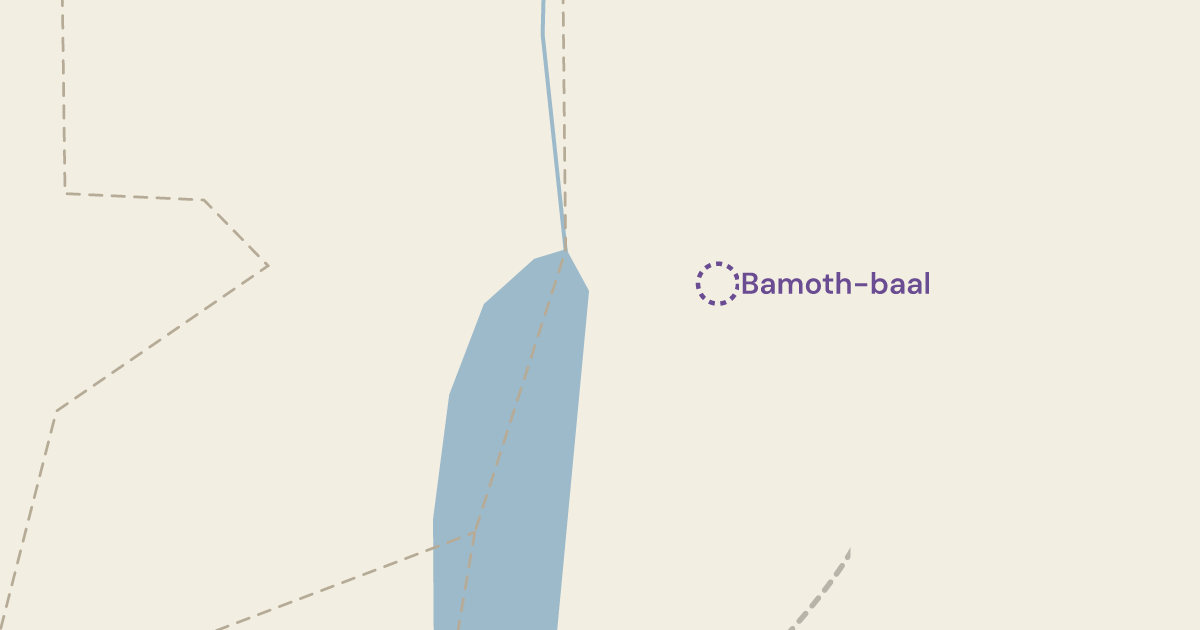
In the morning the king of Moab takes Balaam up to Bamoth-baal — the high places of Baal — and lets him see only the far edge of Israel's camp. Balak chose the hill, and Balak chose how much of Israel his prophet would see.
The High Places of Baal
The hill carries the name of a god whose worship would later cost Israel the land.
This is the first mention of Baal in the Word of God. Baal was the chief male god of the Phoenicians and the Canaanites, and Ashtoreth was the chief female god. This form of idolatry gained a footing in Israel in the days of the judges. It was cast out in the time of Samuel. It became firmly established in the kingdom of the ten tribes in the reign of Ahab. Then Jezebel's daughter Athaliah introduced it into the kingdom of Judah. This great evil was one of the causes of the expulsion of all twelve tribes from the land of promise.
Why choose that particular hill? One writer reads it as home advantage — Balak picking the ground where his own god should be strongest.
Balak's aim in taking Balaam to the high places of Baal was probably this: a stronghold of his false worship would help the work in hand. Surely at such a spot Baal would help him! But he reckoned without God, and in a short time he was forced to listen to the gospel of God from the devil's own platform! What a defeat!
The next chapter opens with Balaam calling for seven altars. Where he stood puts that request in a new light.
The last verse of chapter 22 sheds light on the evil power that drove Moab and Balak their king. They had among them the "high places of Baal." So in the first verse of our chapter we read that Balaam said, "Build me here seven altars." We see at once that this man, who claimed to be a prophet of the Lord, was really in league with the powers of darkness.
Only the Edge of the Camp
Balaam is shown the outermost section of Israel, not the whole. Commentators read this as deliberate management of the prophet's impressions.
Chapter 22:41 tells us that Balak brought Balaam to the high places of Baal in order to prophesy against Israel. Here he saw only "a portion of the people," for Balak wanted to give Balaam the impression that Israel was not a large nation, so that he might more safely curse them.
The plan backfired at the first word out of Balaam's mouth.
Balak's first effort is to make them look small in Balaam's eyes — he would not have him see too much. This gives force to what Balaam says: "Who can count the dust of Jacob, and number the fourth part of Israel?" The end camp was just the fourth part. The partial view does not make the people seem smaller. It moves him to say, "If only the end is so much, what must the whole be?"
Three Vantage Points
This hill is the first of three lookout points.
He speaks these prophecies from three points, all mountain tops. The first from the high places of Baal, the second from the summit of Pisgah, and the last from Peor. Each of the three points is nearer to the camp, and each gives a fuller view.
A Contest Israel Never Saw
The people in the camp below knew nothing of the exchange going on above them.
It is gripping to watch the scene played out on the high places of Baal. We see the great question at stake. We listen to the speakers. We get to look behind the scenes at such an important moment. How little Israel knew or imagined what was going on between Jehovah and the enemy. They may have been grumbling in their tents at that very moment. Meanwhile God was declaring their perfection through the mouth of the greedy prophet.
And the answer God gives the accuser is not measured by the people's behaviour.
So the moment any enemy or accuser comes on the scene, Jehovah places Himself in front to receive and answer the accusation. His answer is never based on what His people are in themselves. It is based on what He has made them through the perfection of His own work.
The Exposed Edge
One writer presses the phrase itself — the outskirts are the vulnerable side of a camp.
Would it be possible to curse part of them? "You shall see only the outermost part of them," says Balak, "and shall not see them all." The "outermost part" is a place exposed to danger. It was there that the fire of the Lord burned at Taberah. Nearness is always a safe place, while being at a distance leaves us open to attack. Could the power of the enemy prevail there?
Summary
- Place. Balak picked the high places of Baal. It is the first mention of Baal in the Bible, and it was the stronghold of his own worship.
- Platform. The choice backfired. Balak had to hear the gospel of God from the devil's own platform. The seven altars showed whose side the prophet was on.
- Portion. Balak showed Balaam only the outer edge, to shrink Israel in his eyes.
- Proportion. It produced the opposite: if the fourth part is beyond counting, what must the whole be?
- Protection. Israel's conduct did not settle the matter. God answered the accuser on the ground of His own work, while the people sat unaware in their tents.