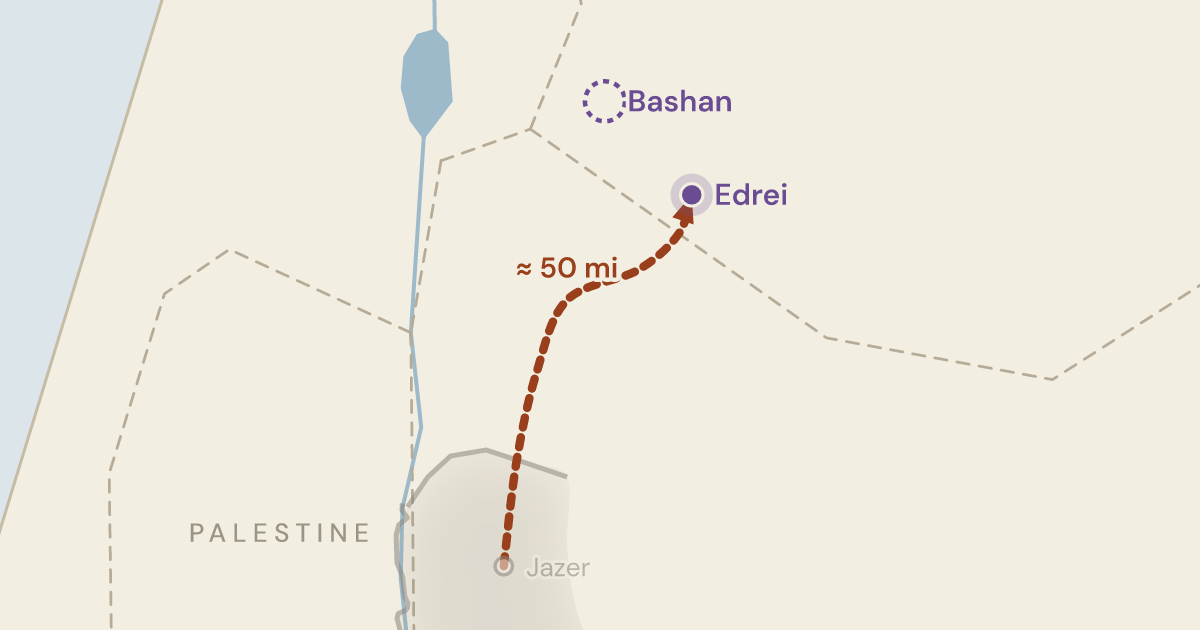
Numbers 21:33: North out of Sihon's land to the second king, and a battle at the edge of his plain
Read it →Commentary on Numbers 21:33
Israel's years in the wilderness are nearly over. Turning north into Bashan, they meet a giant king with walled cities, and two questions come with him: why does God tell Moses not to fear before the fight starts, and why is a whole kingdom wiped out?
The outcome settled before the battle
God's word to Moses was not a promise of help. It reported something already done.
Then they went to Bashan, another Amorite city, and King Og came out with his people to fight them. The Lord had told them not to fear Og, because God had already given him into their hand. So Israel defeated him easily and took his land. In Deuteronomy 3:11 we read that Og was a giant. His bed was nine cubits long and four cubits wide, which is over thirteen feet by six feet. Some of the spies had once been afraid of the giants in the land. Now Israel attacked without fear and fully subdued the Amorites.
Strength that could not save him
Og had every advantage a king of his day could have. The fight still cost Israel nothing.
It had been a war of extermination. Every man, woman and child was killed, and as far as we read, not one Israelite was wounded (Deuteronomy 2:33-34; 3:6). And Og, one of the Rephaim, an ancient and very powerful race, found that his walled cities, with their high walls, gates and bars, could give him no protection against the invading army. Israel swept over his land like a flood that carries everything before it. They took all his cities.
Why the destruction was total
Why such severity? One writer answers by separating two ways God acts, and warns that the difference is easy to miss.
God's instructions about Og king of Bashan were exactly like those He gave in the previous chapter about Sihon the Amorite. To understand either one, we must look at them only in the light of the government of God. Few people understand this subject, though it is deeply interesting and very practical. We must carefully distinguish between grace and government. When we look at God in government, we see Him using His power in the way of righteousness, punishing evildoers.
The enemy Og pictures
Commentators differ over how far to read the details as a picture. One takes the names in the verse — Bashan and Edrei — and finds in Og a danger that is not brute force.
He is king of Bashan, or the Bashan, which means "the fertile." His strong city is Edrei, "plenty of pasture," and he lives in Ashtaroth, a city named after the Phoenician goddess Venus, whose worship involved shameful acts. Add to this that the only thing left of him is a monstrous bed, and that is perhaps all that can be said of him. It may be enough to identify him with the spirit of luxury and soft living, the second enemy of the church at Corinth. That this Og is a giant we know only too well: he has brought down many a strong man.
Another writer reads the two defeated kings as a pattern for Christian experience.
Sihon had struck Moab, but now he falls before Israel. So does Og the king of Bashan, though he was a giant, as we learn in Deuteronomy 3:11. The events that picture victory over the flesh within come first, and then comes the record of victory over the enemies outside. And this is indeed the way things work in our spiritual experience.
Measuring the enemy against God
One writer draws the practical lesson: what God has already done settles what is still to come.
He had given His people such a victory over the Amorites. He had destroyed a fearsome enemy like Og king of Bashan, and handed them the whole land of the giants. What could He not do for them? In all the land of Canaan they were unlikely to meet any enemy stronger than Og, whose bed was so huge that Moses gave it special mention. But what was he in the presence of his Almighty Creator? Dwarfs and giants are all alike to Him. The great thing is to keep God Himself always before our eyes. Then difficulties vanish.
Summary
- Given — God handed Og and his land over before a sword was drawn. Israel fought a battle God had already settled.
- Given past walls — High walls, gates and bars gave an ancient and powerful race no protection at all.
- Given in government — God's severity toward Og is God acting as ruler and judge of evildoers. That is not the same as His grace.
- Given against giants — One writer reads Og as the pull of luxury and soft living, a giant that has brought down many strong men.
- Given as a pledge — What God has already done answers the fear of what comes next. Dwarfs and giants are alike to Him.