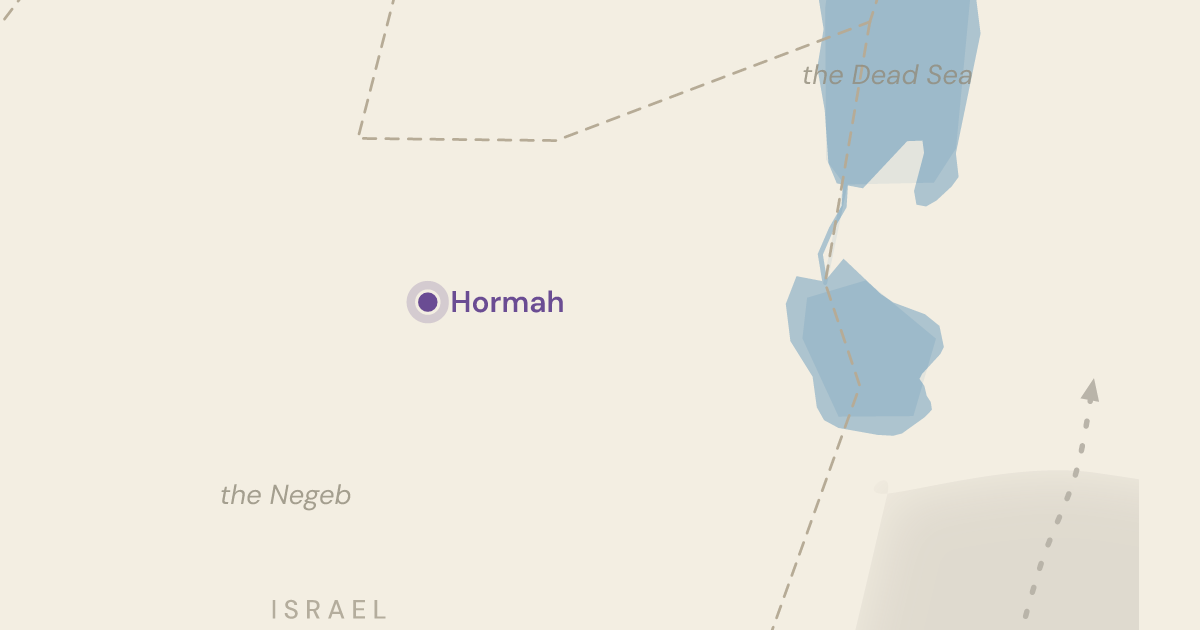
Numbers 21:3: The ground of the rout at 14:45, taken this time, and named for what was done there
Read it →Commentary on Numbers 21:3
Israel's years in the wilderness end with a fight they did not start: a Canaanite king attacks and takes captives. Israel answers with a vow, and this verse gives the Lord's reply.
The attack, the vow, and the answer
Israel was back near the land their fathers had scouted a generation earlier. One writer traces what happened, and gives the meaning of the name that closes the verse:
The king of Arad was a Canaanite. He heard that Israel was in the same area from which they had sent the spies into the south of Canaan. He therefore took the initiative to attack Israel, and was able to take some Israelites captive (v.1). This seems to have stirred the people to strike back. They vowed to the Lord that if He would support their attack, they would utterly destroy the cities of these Canaanites (v.2). The Lord fully opened the way for them and they destroyed the Canaanites and their cities (v.3). The place was called Hormah, meaning "destruction."
The "if" in Israel's vow
Israel's vow began with an "if." One writer traces where that weakness came from, and what God did anyway:
As before, when they were first brought to the land, they put human foresight in the place of dependence on God... It is a sharp lesson, but it brings them back to their right position. They cry to Jehovah, "If You will deliver this people into my hand." Not much faith in the promise yet. To say "if," after God had so repeatedly said that He would drive out the Canaanite before them, is not faith. Even with no faith, or only a little — the Calebs and the Joshuas were very few — they cast aside caution and say, "If You will deliver." Jehovah listened to their voice, and the cities of Arad are utterly destroyed.
Hormah: the place of an old defeat
The name Hormah is not new. Earlier, the people who had refused to go up changed their minds and went without God:
If the later part of the chapter shows a burst of courage, it was only of the flesh, and Jehovah rebuked it. The people, up to now so unwilling to go, are now too eager. But they went without Jehovah, and the Amalekites and Canaanites turned on them and beat them badly. They were driven back as far as Hormah.
A victory that points forward
The same ground and the same enemy gave this victory a larger meaning:
An earlier generation had lost on this very battleground, and it seems to this very people — at any rate, to Canaanites. The final battles for the land would be fought against them, and Arad lay inside that land. So Israel's victory now was more than a sign of recovery from their former state. It was also a pledge that they would conquer the land. These Canaanites stand for those "spiritual forces of evil in the heavenly places" (Eph. 6:12) who now try to keep us from taking hold by faith of what is ours in heaven... The book of Joshua opens up this conflict in full. According to God, it is a conflict without compromise.
Why total destruction
Many object to the wiping out of a whole people. One writer answers:
In saying this, men are really challenging God, for He authorised Israel's action and gave them the power to carry it out. God has the right to judge men and take their lives when they carry their sin to unbearable heights. He did it by the flood of waters, when the people before the flood had filled the earth with violence and corruption. When the sin of Sodom and Gomorrah had become very grievous, He did it by an eruption of some kind. In the days of Abraham the iniquity of the Amorites was not yet full. Now it was full. God chose to destroy them, not by flood or fire, but by the armies of Israel.
What the Canaanites picture
The same writer draws out what this enemy pictures, and what that asks of us:
The meaning of Canaanites is "traffickers." They were holding the land of promise. But they picture unbelievers who use the things of God to make material gain. They are like the men the Lord threw out of the temple, who were selling oxen, sheep and doves and changing money for profit. He told them, "Do not make my Father's house a house of trade" (John 2:16)... Believers are called on to refuse this Canaanite habit completely.
Summary
- Attacked — Arad struck first and took captives. Israel's fight began as a defence.
- Vowed — Their "if You will deliver" was weak faith, but they cried out anyway, and the Lord listened to their voice.
- Delivered — The Lord opened the way fully; the win was His gift, not Israel's improved strength.
- Reversed — At this same Hormah the earlier generation went up without the Lord and lost. This time Israel asked first, and won.
- Devoted — The total destruction was God's own judgment on sin grown full, and a pledge of the whole land to come.