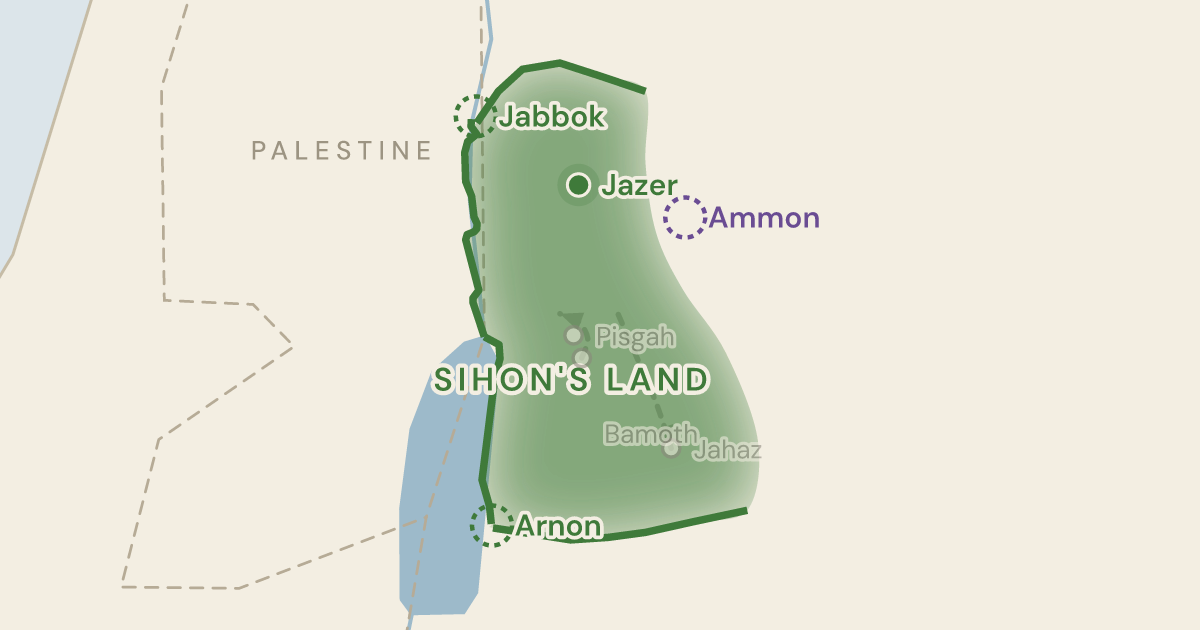
Numbers 21:24: The first land Israel holds, given by two rivers and stopped at Ammon's border
Read it →Commentary on Numbers 21:24
Israel asked Sihon for safe passage and got a war instead — and with it their first land, from the Arnon to the Jabbok. Why this land, and what does a victory east of the Jordan have to do with the promise of Canaan?
A foretaste of the promise
Israel did not want this war.
We meet people we do not wish to fight, but they will not let us pass peaceably. Our warfare is with those who hold our inheritance beyond Jordan. If we are attacked, we must defend ourselves; but we are not to be the aggressors. Israel wants to pass quietly through the land of the Amorites. But the Amorites will not allow it. They suffer the consequences of the war they had sought against the people of God. Israel takes their cities. Already on this side of Jordan they begin to enjoy, ahead of time, the possession of the promise.
Given first, then possessed
God had signed this land over to Israel before a sword was drawn.
So two things are quite definite. First, God had given. Second, He had also begun to give. A superficial reader might object to this. He might demand the reverse order, if we are to accept both statements: first, He began to give; second, He had fully given. But the Scriptural order is the right one. First He gives, so that the title deeds are ours. Then He begins to give practically and in detail, as we begin to possess.
Because the title was real, taking the land was not theft:
Both of these kings — Sihon and Og — hold land that God has given to Israel. Israel may seize it and keep it — indeed, should do so… Whatever God has given, we may take from His hand without suspicion, if it really is from His hand.
Borders God would not let them cross
The land stopped at Ammon's border, and that limit was deliberate. Later a king of Ammon claimed Israel had stolen this same strip.
The answer was not true. The king of Ammon did not speak honestly. Israel had not taken those lands, as he pretended. The Ammonites had lost them before Israel ever took them from others. Those others Israel was free to attack and plunder. But God had forbidden Israel to plunder Ammon, Moab, or Edom. God held even to a distant tie of connection. That is a striking proof and witness of the ways of our God… The lands might be good pasture. The temptation might be great. Moab or Ammon might give real provocation. On human grounds there might be a just right of conquest; but all this would not do.
A sentence carried out, not a land grab
Israel's appetite does not explain what happened to Sihon's people. God's verdict on the Amorites does.
Moses stresses here that God gave Sihon into their hand. Even the stubbornness that refused passage to the advancing army came from Him, since the iniquity of the Amorites was now full… Neither greed for land nor love of destroying brought this on Sihon and his people. The mercy was for the world, in rooting a deadly evil out of it.
Asking permission: faith or hesitation
Commentators differ on Israel's opening move. Darby reads it as restraint. Others ask whether it showed doubt about God's promise.
God's original gift to Israel included the land of the Amorite. So why send messengers asking permission to pass through it, as they did to Edom?… They asked to pass quietly through a land God had given them. Was that the obedience of faith? On the Amorite there was righteous retribution. They had taken that land from Moab, and now Israel, by the will of God, takes it from them.
Training for Canaan
Whatever the hesitation at the start, the fight itself steadied them.
When Sihon and his army attacked, Israel did not meet him with talk, but with decided action. By the grace and power of God they defeated this proud enemy and took possession of his cities. So Israel showed something of the courage of faith before they entered the land of Canaan. In this way God was preparing them for the conquest of the land.
Land on both sides of the river
This eastern territory was never an accident or an afterthought.
So the land of Israel's inheritance lay on both sides of the Jordan, just as God had determined beforehand… This is a picture of the full inheritance of the heavenly saints, which takes in heaven and earth. In symbolic language, it takes in what is east of Jordan as well as what is west, for Jordan is a picture of death.
Summary
- Given. The title deeds came before the battle — God gave the land, then began to give it in practice as Israel moved in.
- Bounded. God handed Sihon's land over, yet forbade touching Edom, Moab and Ammon. Old ties still counted with Him.
- Judged. Sihon's fall was a sentence carried out on a full measure of evil, not a land grab.
- Grasped. Faith had to act. Asking to pass through land already promised raises a question: did Israel trust the gift?
- Enlarged. East and west of Jordan together picture an inheritance that spans earth and heaven.