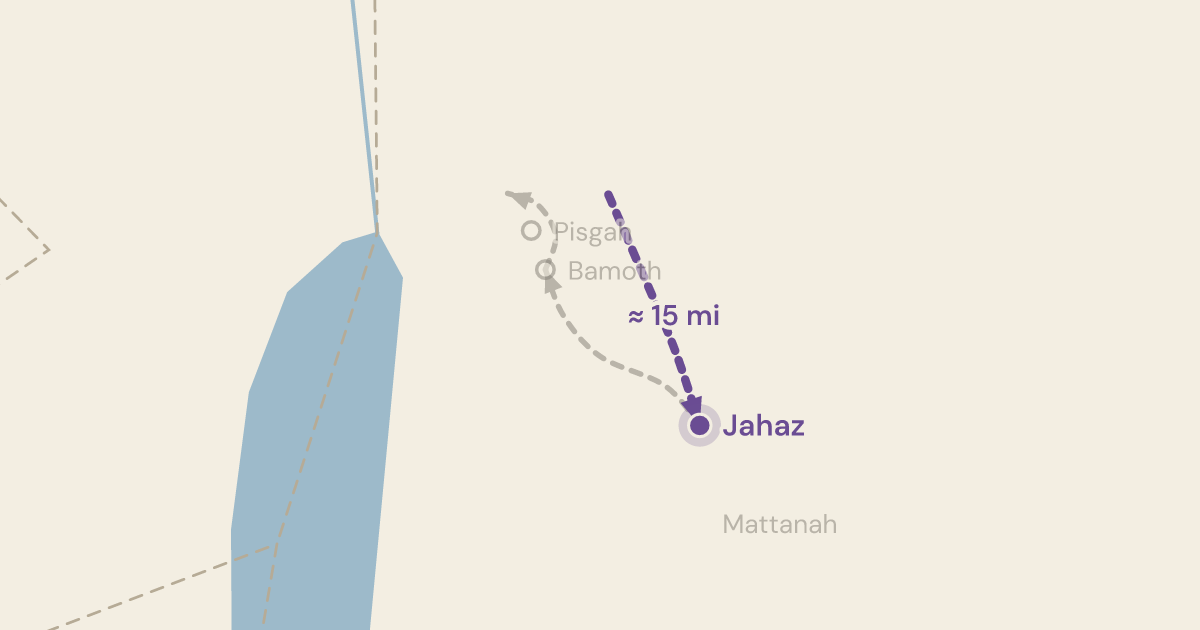
Numbers 21:23: Asked for a road, Sihon brings an army out of Heshbon instead
Read it →Commentary on Numbers 21:23
Israel asked Sihon for safe passage through his land. His answer was an army. This verse turns a peaceful appeal into Israel's first real conquest, and it raises a hard question: why did God let the refusal happen?
The path Israel kept
Commentators note the restraint in how Israel approached this king.
In this case let us see the principles of the Lord's discipline. Did He authorise Israel to force Sihon with threats of vengeance, or to win him by flattery? … Nothing of the sort… Israel kept the path of right and courtesy. Sihon rushed on them to his own ruin; and only so did Israel strike down and drive out the king of Heshbon.
Another writer turns the same restraint into a rule for believers who meet people blocking their way:
We meet people we do not want to fight, but they will not let us pass in peace… If they attack us, we must defend ourselves. But we are not to be the aggressors. Israel wants to pass quietly through the land of the Amorites. The Amorites will not allow it. So they suffer the consequences of the war they had sought against the people of God.
Why the refusal came
Sihon's stubbornness was no accident. Writers trace it back to God's own purpose.
God Himself had ordered things so. He knew well that the presence of the Amorites on their borders would be a constant snare and evil. He allowed the Amorites to have no confidence in Israel's peaceful intentions, for the very purpose of putting Israel in possession of the land.
That purpose also clears Israel of greed or bloodlust:
What is emphasised here… is that God gave him into their hand. Even the stubbornness that refused passage to the advancing army came from Him, since the wickedness of the Amorites was now full… Neither greed for land nor love of destruction drove Israel to bring this merciless removal on Sihon and his people. The mercy was for the world, in rooting out of it a deadly evil.
Whether Israel should have asked at all
Commentators differ here. Kelly and Darby see courtesy. Another writer asks whether it was faith to ask at all, since God had already given this land to Israel.
God's original gift to Israel included the land of the Amorite. So the question arises: why send messengers asking permission to pass through it, as they did to Edom? The lands of Edom and Moab were no part of Israel's promised possession, and God had commanded that they should not be driven out. The land of the Amorite was given. Was it faith to ask only to pass through it? The asking did bring out their hatred and their effort to stop Israel. Their destruction was the result. But the question remains — should Israel not have taken possession at once?
The names on the battlefield
One writer finds a picture in the names themselves — the king's, his city's, and the battlefield at Jahaz.
There is not much agreement about his name… It may be, actively, "sweeping away," as pride of intellect would sweep away the things of God. He is always called king of Heshbon, where he lived. The common version only translates that word as "account," "device," or "reason." It certainly gives the thought of mental work. He comes out to meet Israel at Jahatz, which Gesenius gives, from the Arabic, as "a place trodden down" — probably a "threshing-floor."
Talk met by action
Another writer reads the king's name the same way, and draws a lesson about answering words with deeds.
Sihon's name means "sweeping away," for mere talk tends to sweep away all that is good, since it is empty vanity. On this occasion, then, when Sihon and his army attacked, Israel did not meet him with talk but with decided action. By the grace and power of God they defeated this proud enemy and took his cities… So Israel showed something of the courage of faith before they ever entered the land of Canaan.
What opposition means for us
One writer brings this home to the Christian life. What God has given us, we still have to take hold of.
As soon as we begin to possess, opposition springs up. The old powers do not yield without a struggle. It is a hard business… It means exercise and conflict and trouble. But it is well worth it. Then comes the joy of victory — the joy of really holding a little more of what is ours by an unquestionable title, given to us by God.
Summary
- Ask first. Israel asked to pass through. They did not threaten or flatter. They struck only after Sihon attacked.
- Refusal served God. The refusal itself came from God. He used it to sweep away a people whose wickedness was full and to put Israel in the land.
- A question left open. Was it courtesy to ask permission for land God had already given, or a lack of faith? Commentators differ.
- Talk meets action. The names picture a king of words and reasoning. Israel answered him not with talk but with action.
- Possession costs conflict. You keep what God gives only through struggle. Opposition rises the moment you take hold. Then comes the joy of victory.