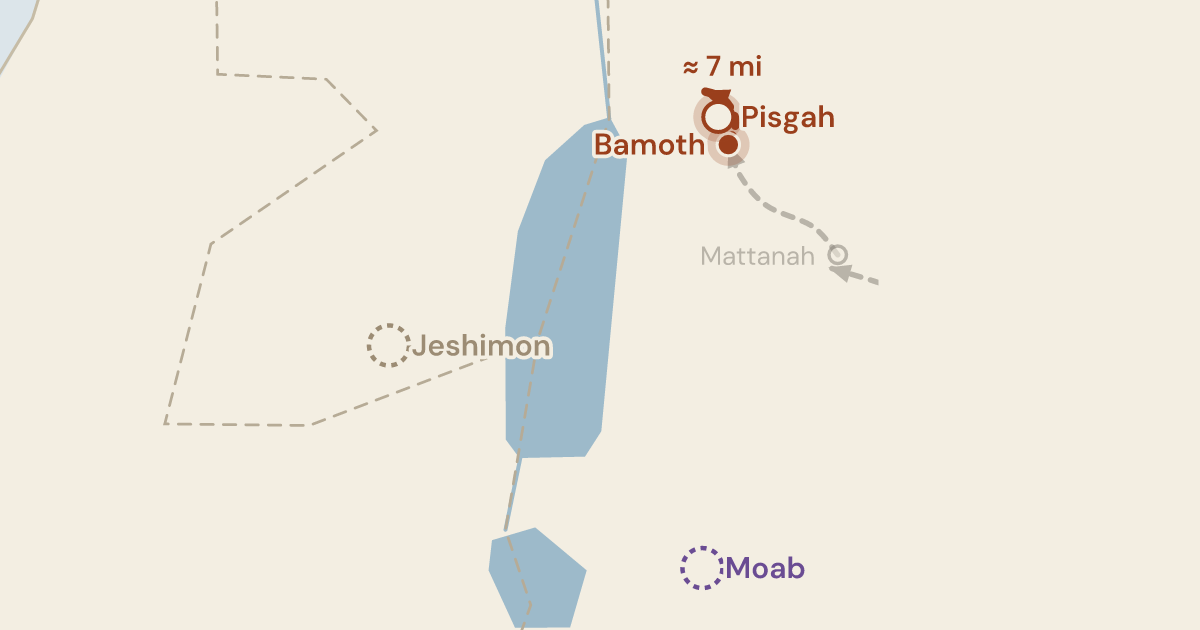
Numbers 21:20: The last camp of the walk, under the summit Moses will climb to see the land
Read it →Commentary on Numbers 21:20
Numbers 21 closes its travel record with a short list of camp sites. The journey ends on high ground in Moab, with the land in view and a wasteland spread out below — and these last names carry more weight than a map suggests.
Stages with meaning
One writer lists the last camp names with their meanings, and finds more in them than geography.
These camp sites surely give us stages of true progress, though — to our shame — we can tell little about them. They are nine in number (3 x 3), the number of divine manifestation intensified. One day they will speak gloriously for God, as the history of our lives will… For all but two we have little beside the names. I give them with their meanings, though even here people will judge differently: Beer: "the well." Mattanah: "gift." Nahaliel: "the inheritance of God (El)." Ramoth: "heights." Pisgah: "survey."
Whatever is uncertain about the individual stops, the same writer insists the destination is not in doubt.
The end, at least, is clear: — thank God, the end is clear! — they reach the spot where the land, their own land, stretches before them; and they are able to look back, too, over the desert passed.
Pisgah, the place of survey
Pisgah turns up again later in Israel's story, and for very different reasons.
Mountain on the east of the Jordan. Balaam offered sacrifices there, and it was the spot from which Moses viewed the promised land, and near to which he died. It was linked with Nebo, and said to face Jericho.
One writer takes the name itself as a picture of what faith does with a promise not yet in hand.
Pisgah must speak of faith's "survey" of the future inheritance; Beth-jeshimoth, the "house of the wastes," of provision for the wilderness. These together imply God's sovereignty over the future and the present.
The waste below
The ESV's "the desert" translates the word Jeshimon. Commentators differ on whether it is a place name at all.
Plain or desert seen from the tops of Pisgah and Peor. Num. 21:20; Num. 23:28… Some do not treat Jeshimon as a proper name, but translate it "the waste" in all places.
Balaam later looked out over the same waste from a nearby height. One writer draws out what he saw.
The new point of view was "the top of Peor, that looks towards Jeshimon" (meaning, "the waste"). This time Balaam had to give a delightful description of the people as God saw them. But the people were not yet in Canaan, resting in possession of every promised blessing. They were still in the desert wastes.
Through Moab, unopposed
Israel had avoided Edom earlier. Moab was different.
Though they had turned away from Edom, and had gone round it by this time, they did not avoid Moab. They came into a valley in that land, and even to the top of Mount Pisgah (v.20). Not much later, God gave Moses a view from there of all the land that Israel was to live in (Deut. 34:1-4). They did not even ask permission to pass through Moab, and it seems Moab had no power to stop them.
Singing again
By this stage the mood of the journey has changed.
And now we see them journeying on, healed and victorious. Nine places are mentioned. The last is Pisgah, from which they get a vision of the land and can look back over the desert lands which are now forever behind them. Two songs are recorded. Israel begins now to sing again. There were no songs in the wilderness, nothing but murmurings.
Seeing without possessing
A view from the top can become a substitute for going in. One writer names the danger.
People often do a great deal of looking from far off, a great deal of mere admiration — and the admiration is not untrue. The view from Pisgah captures the heart. They see the land that the Lord our God cares for, and on which His eyes rest continually, but they never enter it or live in it. They see it in a way that spoils everything else for them, yet gives them nothing better to possess.
Summary
- Well — The climb begins at Beer, "the well." Israel moves on healed and victorious, and songs replace the murmuring.
- Gift — Mattanah means "gift," and Nahaliel "the inheritance of God." The names move from one gift received to a whole inheritance.
- Heights — The stop before Pisgah means "heights." Israel is climbing now, not just walking.
- Survey — Pisgah means "survey." Faith looks ahead to the inheritance, and back over the desert now behind.
- Waste — Below lies Jeshimon, "the waste." The view from the top does not remove the wilderness. Admiring a land is not the same as living in it.