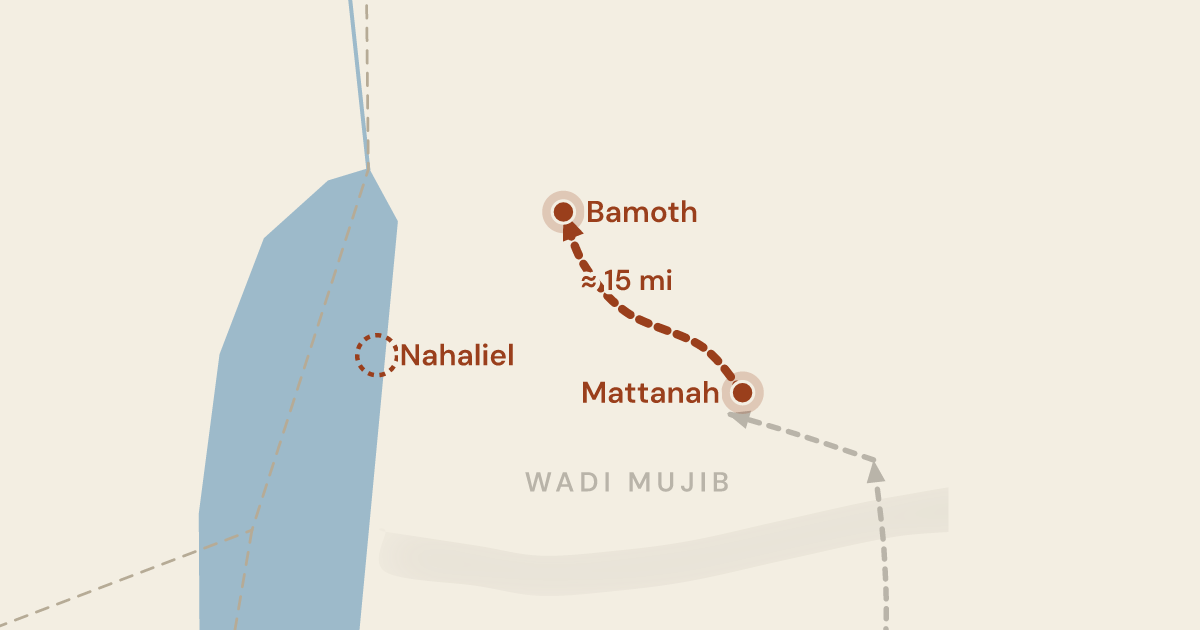
Numbers 21:19: Three stages in one breath, up from the wells onto the tableland below Nebo
Read it →Commentary on Numbers 21:19
After the well at Beer, the account turns into a bare list of camps — one name after another, with no events attached. Commentators ask why God recorded these stops at all, and what the names themselves mean.
A march, not a wandering
Something has changed by this point in the book.
These journeys of Israel are no longer simply wanderings. They are journeys that bring them nearer to the place from which they are to enter the land of Canaan. Various names mark the stages of the journey, and all of them, without doubt, have meanings that point to some spiritual significance — even though we can see so little of it.
Real places on a real map
Nahaliel was a real camp, not just a symbol. Reference works still try to place it.
One of the stations of the Israelites. Numbers 21:19. Some identify it with the ravine of the Zerka Main.
Bamoth, the last name in the verse, is the final camp before the mountain that overlooks the land:
The stopping place of the Israelites before they reached Pisgah, Numbers 21:19-20.
What the names mean
One writer gives the meanings of the stops along this stretch, while admitting that they are open to debate.
As to all but two, we have little besides the names, which I give with their meanings, though even about these there will be differences of judgment: —
Oboth: either "hollows" or "[water-] skins."
Ije-Abarim: "heaps of the passages."
Zared: "willow."
Arnon: "continual stream."
Beer: "the well."
Mattanah: "gift."
Nahaliel: "the inheritance of God (El)."
Ramoth: "heights."
Pisgah: "survey."
Heights once held by idols
The meanings in this verse run from a gift, to the inheritance of God, to the heights. The heights had a history. The same writer treats a name like this verse's last stop as ground where idols were adored.
Bamoth-Baal, the "heights" where men adore their idols, fall into the hands of faith; as does Beth-baal-meon, the "house of the Baal of the dwelling," the home of idolatry in the house and heart.
Stages that will speak for God
Why keep a record of ordinary stopping places? And why does this list differ from the longer one later in the book?
Now we come to the account of the journeying. Only certain stages are marked out, and the list, with few exceptions, differs from the one in Numbers 33, which has a different purpose. Here the camps give us, no doubt, stages of true progress, although — and it is to our shame — we can tell little about them. There are nine of them (3 x 3), the number of God showing Himself, intensified. One day they will speak for God in glory, as the history of our lives will. Meanwhile we have been busier fixing their places on the map (and failing) than looking in them for any spiritual meaning.
Where the list is heading
Whatever stays uncertain about the middle names, the end of the road is not in doubt.
And now we see them journeying on, healed and victorious. Nine places are mentioned. The last is Pisgah. From there they see the land, and they can look back over the desert lands that are now forever behind them.
The writer who could tell little about the middle stops had no such trouble with the last one:
The end, at least, is clear: — thank God, the end is clear!
Summary
- Well. The stretch begins at Beer, "the well" — the stop just before this verse, where wandering has turned into a march.
- Gift. The next camp is Mattanah, "gift" — the journey moves on by what God gives.
- Inheritance. Nahaliel means "the inheritance of God" — commentators note the meanings are debated, but the road now runs toward what belongs to God.
- Heights. Bamoth is the last stop before Pisgah. A name like it belongs to ground where idols were once adored — high places that pass into the hands of faith.
- Survey. Pisgah means "survey". The desert lies behind forever, and the land lies open in front. So a string of plain camp names turns out to be a record of progress — one that will speak for God one day, as the history of our own lives will.