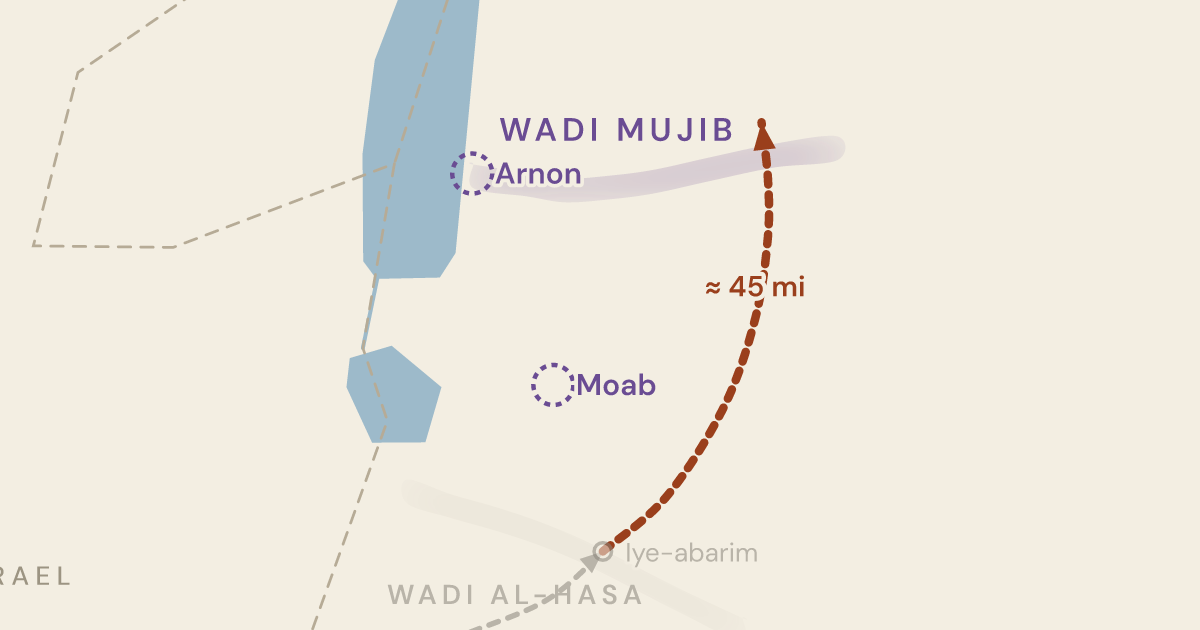
Numbers 21:13: Round Moab's desert side and over its northern border, into the Amorites' country
Read it →Commentary on Numbers 21:13
This verse is a travel note with a legal edge. Israel camps beyond the Arnon, and the text stops to record whose land lay on each side. Why did one valley matter so much, and why was Israel free to cross it?
From wandering to advance
The stages listed here mark a change in Israel's story. The camp is no longer going in circles. It is moving toward a destination.
Here we are given an account of Israel's journeys. They are no longer simple wanderings. They bring the people nearer to the place from which they are to enter the land of Canaan. Each stage has its own name, and all those names carry some spiritual significance, little as we may be able to see it.
The name of the river itself carries a picture:
Arnon: probably "continual stream." Literally, "the stream that renews itself."
A line drawn by God, not by armies
The verse marks the Arnon as the line between Moab and the Amorites. That line decided what Israel could touch. Moab was off limits; God gave Israel the land on the far bank.
So Israel was not allowed to touch what belonged to any of these three nations: the Edomites, Ammonites and Moabites. But the very next sentence shows something completely different with the Amorites: "Rise up, take your journey, and pass over the river Arnon: behold, I have given into your hand Sihon the Amorite, king of Heshbon, and his land; begin to possess it, and contend with him in battle."
The choice was not Israel's to make. The same writer gives the rule behind it:
The great principle, in all these varied instructions to Israel, is that God's word must settle everything for His people. Israel was not to ask why they should leave the lands of Esau and Lot untouched and take those of Sihon. They were just to do what they were told. God can do as He pleases. He has His eye upon the whole scene. He sees it all.
Proof the enemies could not deny
The careful wording about the border reads like a land title. Later in the chapter, Israel's record quotes outside sources, and one writer explains why:
These foreign traditions, written and spoken, are quoted on purpose, for one special reason. They prove, from witnesses that Israel's most zealous opponents could not question, that the land in debate did not belong to Ammon or Moab when Israel took it by conquest. It belonged to the doomed peoples of Canaan and the area around it… The Amorite had taken it from Moab, and Israel from the Amorite… A Jewish record of the land's previous owners and of Israel's own victories might be dismissed as self-serving by an enemy. But a quotation from the enemies' own popular songs of that day settled the matter.
Years later a leader of Israel named Jephthah had to defend that claim, and the same evidence held:
This is so clearly the case that the Ammonites claimed this very territory in the time of Jephthah (Judges 11). Jephthah goes over all this same ground as the reason Israel was right to keep the country. It was not Ammon's nor Moab's either. Nor did Balak, king of Moab, claim it then.
The valley itself
The Arnon itself is no gentle stream:
A ravine or valley with its mountain torrent… Its sources lie both north and south, and they join. The stream then runs almost east to west. It rushes through a deep ravine and falls into the Dead Sea about halfway along the sea's north-to-south length.
Grace at the crossing
Something happened at these streams that Scripture remembers but never describes.
A few stages bring them to the brooks of Arnon. God did some wonderful act of power and grace there. We know that, because Scripture links it with the Red Sea as one of the marvellous scenes where God stepped in. So the book of the wars of the LORD records "what He did in the Red Sea and in the brooks of Arnon." We are not told what He did. But we know it was the beginning of blessing, for from the stream of brooks they came to Beer.
Summary
- Progress. The camps of this chapter are no longer aimless circling; they are stages that bring Israel to the edge of the land.
- Boundary. The verse names the Arnon as the line between Moab and the Amorites. That line fixed what Israel could take and what it had to leave alone.
- Obedience. God never told Israel why Moab was spared and Sihon given up. His word settled it, and that was enough.
- Title. The record fixes the border so exactly that the enemies' own songs proved Israel's claim. Jephthah later won the argument on that very ground.
- Grace. What God did at the brooks of Arnon ranks with the Red Sea. Scripture never says what it was, yet it began the blessing that carried Israel on.