Numbers 21:12: The gorge between Edom and Moab, where the thirty-eight years run out
Read it →Commentary on Numbers 21:12
The verse reads like a line from a travel log: one camp struck, another pitched in a ravine on the edge of Moab. Yet Deuteronomy marks this crossing as a dividing line in Israel's whole history. Why should one dry stream bed matter so much? The writers quoted below call it the brook Zered.
The Boundary of the Wilderness
One writer divides Israel's route into three stages and puts the Zered at the end of the middle one. The distances show how much time the people lost.
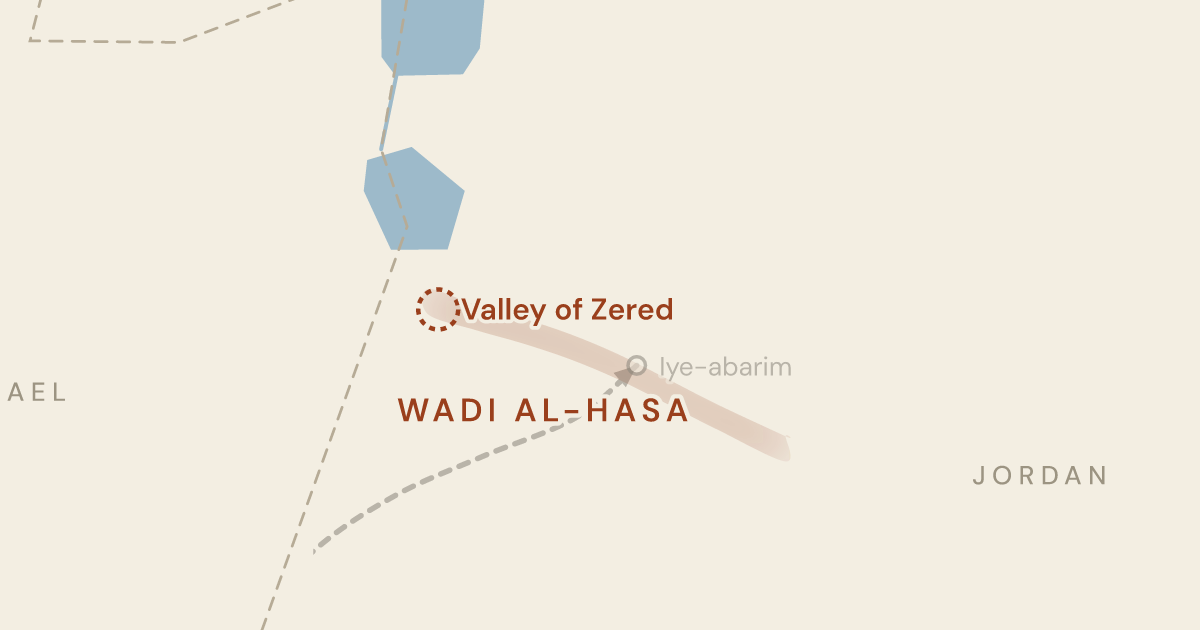
Their arrival at Sinai was, in a way, the end of the first stage of the journey. The second stage was Kadesh Barnea. The people reached it before the end of the second year after the Exodus. The third was the plains of Moab. They had left the wilderness for ever when they crossed the brook Zered (Deut. 2:13-14). Between Sinai and Kadesh is eleven days' journey (Deut. 1:2). Between Kadesh and the brook Zered, thirty-eight years went by.
What Filled the Silent Years
The record says almost nothing about those thirty-eight years. One writer finds that silence itself significant. The people who move on now are not the people who left Kadesh.
From the first arrival in Kadesh to the point we now reach, almost the whole forty years have passed. The people brought those years on themselves by refusing, at that time, to enter Canaan. The near-total silence about this time in the history is significant. It is the time of the dying out of the generation under sentence... But they pass to make room for those who now in the power of God are to take possession of the land of promise.
From Wandering to Journeying
From this point the list of camps changes character.
Now we are given an account of Israel's journeys. They are no longer mere wanderings. They are journeys that bring the people nearer to the place from which they are to enter the land of Canaan.
The Names of the Stages
Zered stands third in a chain of nine named camps. One writer lists what the names mean, and admits how little we know.
Here the camps surely give us stages of real progress, though — to our shame — we can say little about them. They are, however, nine in number (3 x 3)... Meanwhile we have been busier pinning their places on the map (and failing) than looking for any spiritual meaning in them. For all but two, we have little more than the names, which I give with their meanings... Oboth: either "hollows" or "[water-] skins." Ije-Abarim: "heaps of the passages." Zared: "willow." Arnon: "continual stream"... Beer: "the well." Mattanah: "gift." Nahaliel: "the inheritance of God (El)." Ramoth: "heights." Pisgah: "survey."
Why They Could Move Forward
One writer traces this fresh start to the loss of two of Israel's leaders.
Israel had now reached a new stage in their history — a stage of transition. That is to say, their wanderings in the wilderness had come to an end. Miriam, the prophetess, has died. Aaron, God's priest and Miriam's brother, also lays aside his official garments and leaves the scene (Numbers 20). So Israel are set free to go forward and make real progress towards their goal, the land of promise, with nothing to hold them back.
Travellers, Not Settlers
With the testing behind them, Israel asked the nations for nothing but the right of way. That, one writer says, is the shape of a life aimed at heaven.
When they crossed the brook Zered, the wilderness testing was over, and they were really bound for Canaan. In picture, the judgment of sinful flesh in the bronze serpent, and the power of life in the springing well, made them able to be companions of the heavenly calling. They simply want to pass through the enemy's country in peace, for they are going to Canaan. They want nothing of theirs, only permission to pass on. So it is with us. If our hearts are true to the heavenly calling, we want nothing of the world except to pass on in peace, for we are going to heaven.
Summary
- Sentence. A journey of eleven days took thirty-eight years. The people had refused to enter at Kadesh.
- Silence. Scripture says almost nothing about those years. In them the generation under sentence died out.
- Freedom. With sinful flesh judged in the bronze serpent and Aaron's garments laid aside, nothing held the camp back.
- Progress. Zered means "willow." After it come "continual stream," "the well," "gift," "the inheritance of God," "heights," "survey" — each a stage toward the land.
- Passage. Past this valley Israel wanted nothing from the nations but the road through. The same marks a life headed for heaven.