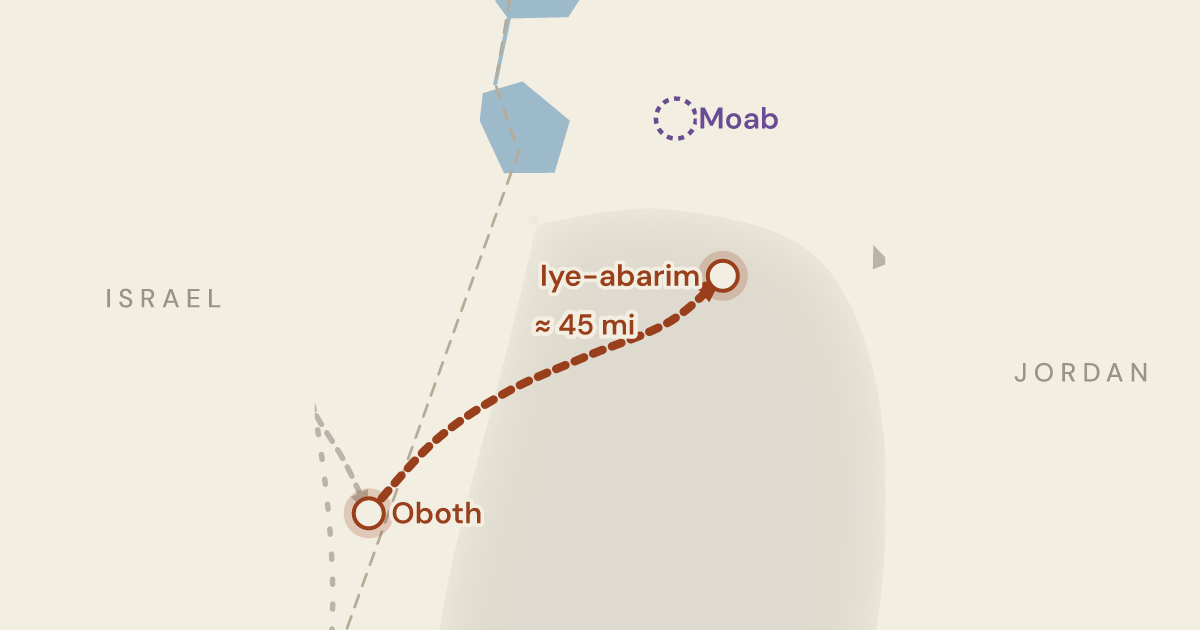
Numbers 21:11: Out of the Arabah and round the north end of Edom, to the desert on Moab's east side
Read it →Commentary on Numbers 21:11
After the bronze serpent healed the dying camp, the complaints stop and a travel list begins. This verse names one halt on that list. So why record a bare campsite, and what does "toward the sunrise" say about where Israel now stood?
From wandering to advance
One writer reads this camp against the thirty-eight years behind it.
From this statement we learn that Israel "set out," and began to make real advance in their journeys. Israel had now arrived at a new stage in their history — a transition stage. Their wanderings in the wilderness had come to an end… They are now on the border of Moab, "toward the sunrise." They had wandered with no aim for no less than thirty-eight years in mid-wilderness. Now there are only a few months left for them to finish the fortieth year and enter into their possessions.
Another commentator makes the same distinction in a single line — these are travels with a destination.
Now we are given an account of journeys of Israel that are no longer simply wanderings, but journeys that bring them nearer to the place from which they are to enter the land of Canaan.
What moved them forward
Another writer traces this new pace back to grace, and to God's promise to end Israel's murmuring.
Israel now set forward under the full efficacy of grace (Num. 21:10). God had said that He would completely take away their murmuring… He dealt with this last outburst of murmuring in the wilderness in a way that shows us how the incurable evil of the flesh must be overcome. Once that lesson was given, the power of the living rod showed at once: the murmurs cease, not through judgment, but by the fullness of blessing.
Another writer ties the fast march to the death of Aaron and to the priest who followed him.
The death of Aaron and the succession of Eleazar are clearly the central points… In Eleazar, Aaron's priesthood carries on despite his death, and in the power of resurrection. This matters for what follows: the people now advance fast, pressing on through all opposition in triumph, right to the border of the land. Our great High Priest, His work finished, and risen out of death, can lead His people on like this.
The name itself
A reference work places the camp, explains its name, and admits nobody has found the site.
This is one of the later stopping places of the Israelites, on the south-east border of Moab. The margin translates it "Heaps of Abarim" (Num. 21:11; Num. 33:44). It is shortened to Iim in Num. 33:45. The site has never been identified.
"Abarim" itself names a mountain range, and Moses would later die on one of its peaks.
This is probably the chain of mountains that lie "beyond" or to the east of the Dead Sea and the lower Jordan (Num. 33:47-48). Deut. 32:49-50 links Mount Nebo with Abarim, places it "opposite Jericho," and shows it was where Moses viewed the land and died. Deut. 3:27 connects this with Pisgah. So Pisgah and Nebo seem to have formed part of Abarim, in the land of Moab.
Stages worth studying
One writer lists the camp names with their meanings, and faults us for treating them only as map points.
Here the camps give us, no doubt, stages of true progress, although (to our shame) we can tell little about them… One day they will speak gloriously for God, as the history of our lives will. Meanwhile we have been busier fixing their places on the map (and failing) than looking in them for any spiritual meaning. For all but two we have little more than the names. I give them with their meanings, though even here judgments will differ: Oboth: "hollows" or "water-skins." Ije-Abarim: "heaps of the passages." Zared: "willow."… Beer: "the well." Mattanah: "gift." Nahaliel: "the inheritance of God."… Pisgah: "survey."
God's record of every halt
That God keeps a list of campsites at all is itself the lesson.
Think of Him keeping such a record of the journeys of His poor people, from the moment they marched out of Egypt until they crossed the Jordan… "He knows your going through this great wilderness. These forty years the LORD your God has been with you. You have lacked nothing." He went before them every step of the way. He travelled over every stage of the wilderness… And here He retraces the whole way His hand had led them, noting down each stage of that marvellous journey, and every spot in the desert where they had halted.
Where the road ends
Follow the stages a little further and the mood of the march changes.
Next, Israel goes forward, but they are not yet in the land. God relieves and refreshes them out of His own free grace, with no murmuring from them… At the end of their journey, life is no longer the question. It is salvation from the deadly wound of the serpent. They are healed. They walk and drink with joy and songs of praise.
- Healed, then moving. The camp at Iye-abarim follows the healing at the bronze serpent. Grace, not judgment, silenced the murmuring and started the march.
- Wandering ends. These are no longer aimless circles but journeys aimed at the land, with only months of the forty years left.
- A real place. "Heaps of Abarim" sat on Moab's south-east border, in the range that holds Nebo and Pisgah. There Moses would view the land and die.
- Stages, not scenery. The camps mark real progress. Their names run from "the well" to "gift" to "inheritance of God" to "survey."
- Nothing unrecorded. God writes down every halting place. He travelled every stage with His people and led them the whole way home.