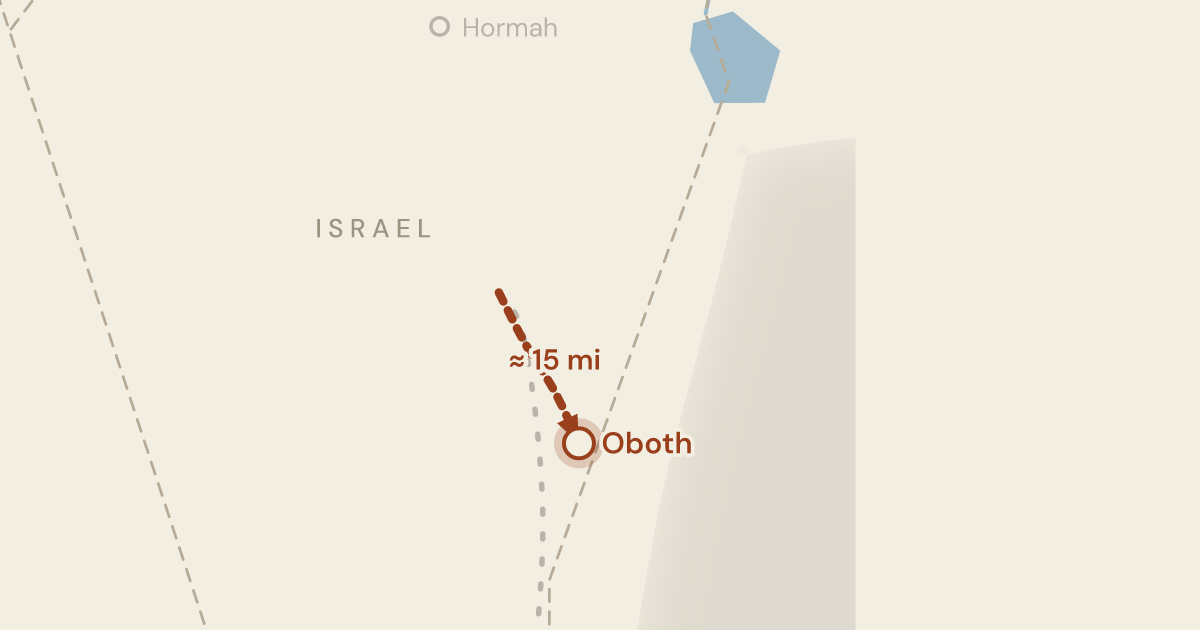
Numbers 21:10: The first camp after the bronze serpent, placed in the Arabah rather than beyond Edom
Read it →Commentary on Numbers 21:10
This one line of travel log comes right after Moses lifted the bronze serpent and Israel looked and lived. From here the tone changes: aimless circling gives way to steady advance.
Wandering Ends, Journeying Begins
The camp had spent decades going nowhere. From this verse the record reads differently:
Now we get an account of Israel's journeys. These are no longer just wanderings. They are journeys that bring them nearer to the place from which they are to enter the land of Canaan.
One writer marks the turn here and checks it against the calendar. (Older translations read "set forward" where the ESV has "set out.")
Israel "set forward," and began to make a real advance in their journeys... Israel had now arrived at a new stage in their history — a transition stage — that is to say, their wanderings in the wilderness had come to an end... They wandered aimlessly for no less than thirty-eight years in the middle of the wilderness. They went backward and forward to Kadesh-Barnea two or three times. Now there are only a few months left for them to finish up the fortieth year to enter into their possessions.
What Set Them Moving
Better morale did not start the march. The order of events is the point:
From this point the people "set forward," as verse 10 tells us. And there can be no doubt about what begins a forward movement of a spiritual sort in a Christian. It begins when he grasps the death of Christ, in that aspect of it pictured by the bronze serpent. But before they really started for the promised land, there came the episode of the well. God's mercy led them to it, and they had not asked for it. Now here we have a picture of the gift of the Holy Spirit, as we see from the Lord's words recorded in John 4:14 and John 7:37-39.
after_note: DELETE
Something else had changed as well, and the same writer points to it:
Miriam the prophetess has died, and Aaron, God's priest and Miriam's brother, also lays aside his official garments and leaves the scene (Numbers 20). So Israel is set free to go forward and to make real progress towards their goal, the land of promise, with nothing to hinder or hold them back.
Setting Out Under Grace
The march changes more than their direction. The complaining stops as well, and not through judgment:
Israel now set forward under the full power of grace (Num. 21:10). God had said that He would completely take away their murmuring, and Aaron's rod, bearing buds, blossoms and almonds, was the pledge of it... God dealt with this last outburst of murmuring in the wilderness so that we might know how the incurable evil of the flesh must be overcome. Once that lesson was given, the power of the living rod shows itself at once. The murmuring stops, not through judgment, but by the fullness of blessing.
At an earlier stop God waited to be asked. Now He does not:
Here God does not wait to be asked; He promises beforehand and tells Moses that the well is at Beer. And God is still before them, He is ready before they are, waiting to be gracious.
The Names of the Stages
Oboth is the first of a short list that runs to the end of the chapter. The names themselves carry meaning:
And now we come to the account of the journeying, which marks out only certain stages. The list is different, with few exceptions, from the one in Numbers 33, which has a different purpose. Here the encampments give us, no doubt, stages of true progress, although — to our shame — we can tell little about them. For all but two, we have little more than the names. I give them with their meanings, though people will differ even about these: — Oboth: either "hollows" or "[water-]skins."... Beer: "the well." Mattanah: "gift." Nahaliel: "the inheritance of God (El)."... Pisgah: "survey."
Healed People Sing
The march that starts at Oboth ends in music:
And now we see them journeying on, healed and victorious. Nine places are mentioned. The last is Pisgah, from which they get a vision of the land and can look back over the desert lands which are now forever behind them. Two songs are recorded. Israel begins now to sing again. There were no songs in the wilderness, nothing but murmurings... The first is a battle song, which speaks of victory. The second is about the water from the wells they dug. The princes dug the well. It was not hard work — they did it with their staves. It is a sweet picture of grace supplying the need.
Summary
- Look. The bronze serpent comes first. The camp only moves after Israel looked and lived. Grasping the death of Christ starts real forward movement.
- Set forward. Thirty-eight years of circling end at this verse. Wandering gives way to journeys that close the distance to the land.
- Grace. They march under grace, not under threat. Murmuring ends "by the fullness of blessing," and God leads them to a well they never asked for — a picture of the gift of the Holy Spirit.
- Stages. Oboth ("hollows" or "water-skins") opens a list of camps that mark real progress: the well, the gift, the inheritance of God, the survey from Pisgah. Writers differ over what the names mean.
- Song. The road runs from Oboth to Pisgah. Israel arrives healed, victorious and singing, with the desert behind them and the land in view.