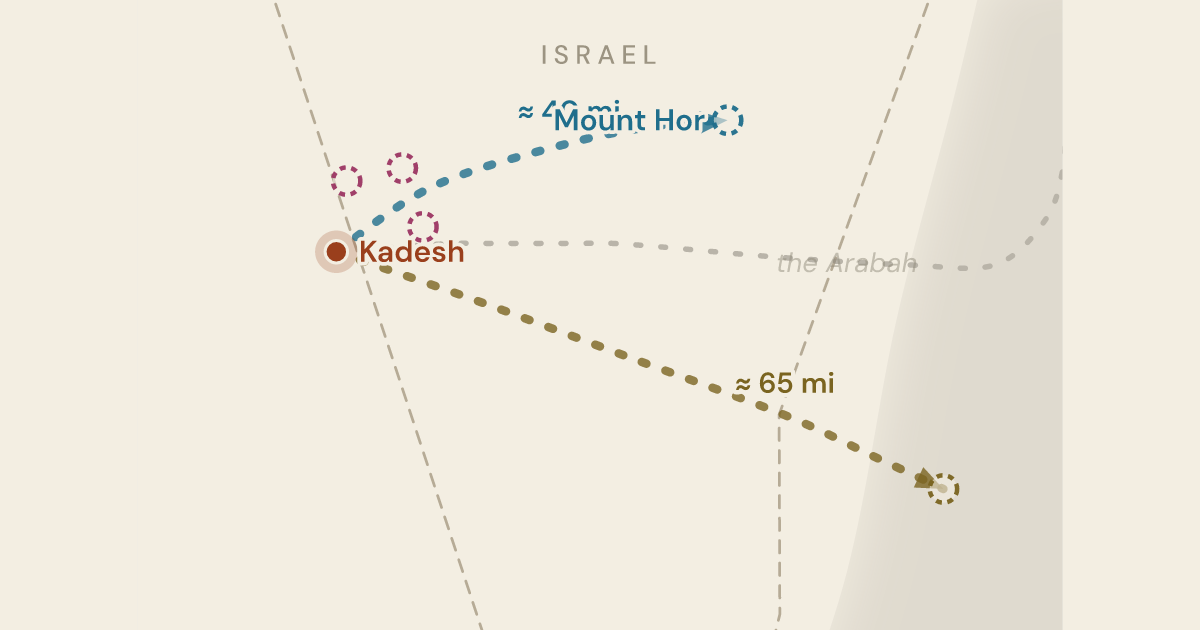
Numbers 20:22: The last march out of Kadesh, to a mountain the sources put in three places
Read it →Commentary on Numbers 20:22
Israel leaves Kadesh, and the whole nation moves on to Mount Hor. The verse reads like a bare travel note, yet this is the mountain where Aaron dies and where his robes pass to his son.
The route
The march is short, and the mountain at the end of it is known for a grave.
From Kadesh they travelled to Mount Hor. No stopping place is mentioned between them, unless Beeroth in Deuteronomy 10:6 comes in here. At Mount Hor Aaron died and was buried. Numbers 33:37-38.
Where was this mountain, and when did Israel reach it?
The mountain on which Aaron died when the Israelites were near the end of their wanderings. Numbers 20:22-28; Numbers 21:4; Numbers 33:37-41; Deuteronomy 32:50. It is the range of mountains on the eastern side of the wady Arabah.
A new stage of the journey
This verse also marks a dividing line in the journey.
And now in Numbers 20:22 they begin the fourth and last stage of their journey, which took about a year or so.
Why they turned aside
They reached Hor by a longer road. Edom would not let them pass, and Israel turned aside instead of fighting. That restraint becomes a rule for dealing with opponents who are also relations.
Edom, full of jealousy, will not let the way be shortened; Israel turns away from him. Some people oppose us, and it is right to turn away from them. The reason is some outward relationship between them and ourselves. They may be driven by relentless hatred. Still, we must know how to tell them apart. God will judge them in His own time. Our hand must not be on them. The enemies of God must be our enemies. Where the enemy's power is clear, the war is God's. But on the road we meet people who came from the line of promise, though only in a natural way, and who are marked by the flesh. We leave them to God. It is His right to judge them.
The whole congregation as witnesses
The verse stresses that the whole congregation came. They were there as witnesses: the high priest's office passed from father to son in front of them.
The time had now come for Aaron to disappear. As happened with Moses a little later, his death was announced in advance. He had no period of weakness and no sickbed, for he could climb to the top of a mountain in full view of the people. There, stripped of his garments, which were placed on his son, he died. The Aaronic priesthood was for earth, so it could be handed on, "because they were prevented by death from continuing in office" (Hebrews 7:23). This was the first time the priesthood had to be handed on. By God's appointment it happened in a very public way, so that no one could challenge Eleazar's new position.
Two servants shut out of the land
Aaron does not simply die of old age. He and Moses were both kept out of the land. This march brings him to the place where he dies.
Aaron dies, and the time is not far off when Moses too must die. It is a solemn thought that these two honoured servants of God had to die in the wilderness like the generation God said would not enter His rest. God is righteous, and He maintains His government according to His righteousness.
Contrast with a priest who never dies
The garments moved to another man because the wearer died. Writers read that as the very thing that sets Christ's priesthood apart.
At Mount Hor Aaron was stripped of his priestly garments, and they were put on his son Eleazar, for Aaron had to die. Death removed high priest after high priest of the Levitical order. But Christ's priesthood cannot be handed on. And "he is able to save to the uttermost those who draw near to God through him, since he always lives to make intercession for them" (Hebrews 7:24-25).
Commentators differ over Eleazar himself. Some see him as a picture of Christ:
His priestly garments of glory and beauty are transferred to his son Eleazar. Eleazar is a type of Christ in resurrection, the only power for true priesthood. It is the risen Lord who is our Priest.
Others hold back: "The priestly robes are put on Eleazar, but he is never presented like Aaron as a type of Christ's priesthood" (The Bible Treasury).
Summary
- Leave. The people set out from Kadesh, with no recorded stop before Mount Hor.
- Turn. Edom's refusal made the road longer. Israel turned aside instead of striking a hostile relative, and left the judging to God.
- Arrive. Mount Hor lies at the end of that road, and the whole congregation came there as witnesses.
- Strip. In full view of the people, Aaron's garments passed to Eleazar. He died under God's righteous government, and the handover was public.
- Abide. Aaron's robes passed on because he died. Christ's priesthood passes to no one, because He always lives to intercede.