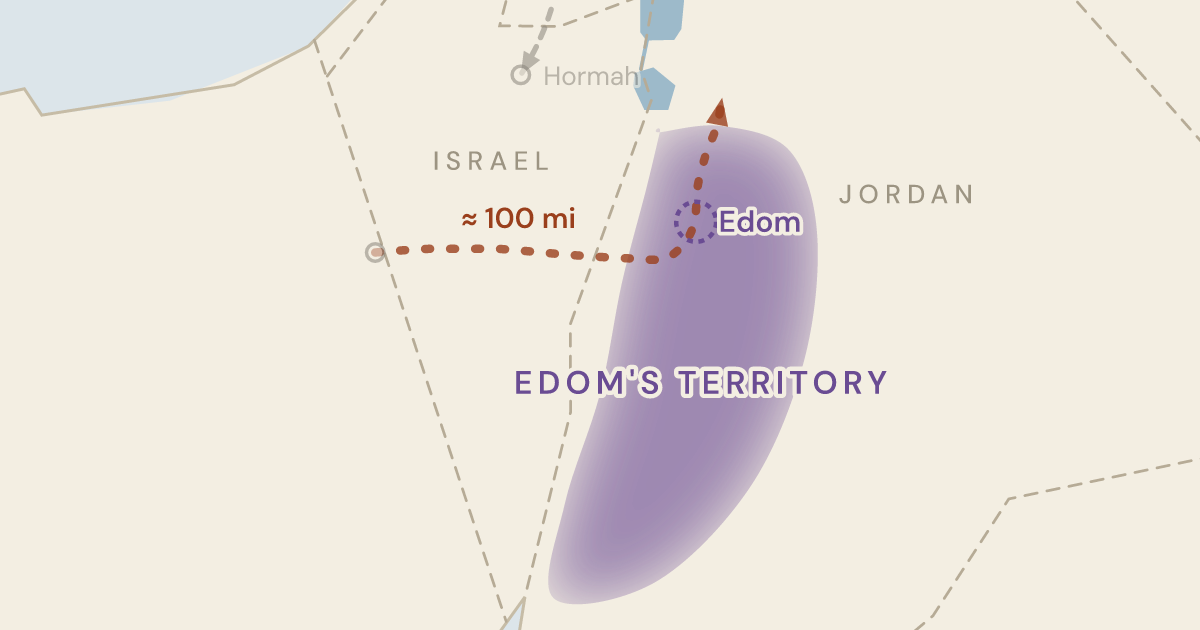
Numbers 20:21: The road through Edom refused, and the King's Highway left untaken
Read it →Commentary on Numbers 20:21
Israel's forty years in the wilderness are nearly over, and the road into the land of promise runs through Edom — a nation descended from Esau, Jacob's brother. Moses asks for passage as a brother; Edom answers with an army, and Israel steps aside.
A brother's refusal
One writer sets this refusal against the old quarrel between the two brothers:
Satan's opposition is seen at this stage of the journey (Num. 20:14), not in the hatred of foreigners, nor in Israel's own rebellion, but in the open hostility of relatives. Here, as in the gospel, family ties are no guarantee against hatred when the question lies between God and the world. "And a person's enemies will be those of his own household" (Matt. 10:36). Moses sent to the king of Edom saying, "your brother Israel," and Edom's answer is a threat. Once before, their fathers had met. Then, as now, Jacob was the one asking; but God turned aside Esau's hatred, and Jacob went on his way. The hatred remained and breaks out in Edom's refusal to let Israel pass through his land.
Why Israel turned away
Israel did not fight for the road. One writer explains why turning away was right:
Israel turned away here, for Edom's land was no part of Israel's possession. It was not God's purpose to lead them through it; their time in the wilderness was not yet finished.
Another writer draws a rule from Israel's restraint:
Edom, full of jealousy, will not let the way be shortened; Israel turns away from him. Some people oppose us with a hatred that never gives way. Yet because of an outward relationship between them and us, it is right to turn away from them. We must know how to tell such people apart. God will judge them in His own time; our hand must not be on them. As for the enemies of God, they must be our enemies; where the power of the enemy is plain, it is God's war.
Edom and the flesh
Several writers read Edom as a picture of something inside the Christian. The next writer starts with the map:
In the way they now travel, Edom is clearly the great barrier. Less than twenty miles across, it is more than six times that distance to go round. This way even had a king's highway and wells of water — a pleasant alternative to the trackless desert route! But Edom is there in force, and he will not permit it. Nor can you turn this enmity into friendship. It is the same with the flesh: "the mind that is set on the flesh is hostile to God, for it does not submit to God's law; indeed, it cannot" (Rom. 8:7). So the barrier stands. Many refuse to believe there is any old nature inside the Christian that cannot be redeemed. They claim kinship, and would gladly make a brother out of Edom. It cannot be.
Another writer asks what a Christian is to do with such an enemy:
Edom is a type of the flesh. Its name is the same as Adam, only with the vowels changed. However the flesh may disguise itself, it does not change: "those who are in the flesh cannot please God" (Rom. 8:8). But how are we to deal with this deceitful enemy inside us? It is no use fighting it, for we can never win a battle like this, as Romans 7 shows us. We are to count self as dead (Gal. 5:24), and turn away from it as we would from a corpse. Instead we "put on the Lord Jesus Christ, and make no provision for the flesh, to gratify its desires" (Rom. 13:14).
The cost of the detour
Turning away was not free:
How often the opposition of the flesh causes a long detour in what should be a straight course from earth to heaven.
Refused here, permitted later
One writer answers a charge of contradiction here:
People set Deuteronomy 2:29 against this passage, either out of ill-will or out of carelessness. Edom did refuse to let Israel pass through, yet in the end they did pass through. The two occasions were quite distinct. The refusal recorded here happened at a different time and place from Israel's later passage through their land. Moses sent the messengers from Kadesh — the city on the farthest border, not the district in general — and this was before Aaron died. Israel made the passage some time after his death, south of Edom, by way of the Red Sea, as we may learn from Numbers 21.
Edom's final reckoning
Israel dropped the matter; God did not:
Edom is the only one of all the nations reappearing at the time of the end for judgment that will have no "remnant" preserved. God will judge the Edomites without mercy because of the way they treated His people. They were the most wicked, and the most eager to destroy Israel. Had they not once "refused to give Israel passage through his territory" to enter the land of Canaan (Num. 20:21)?
Summary
- Brother. Relatives, not strangers, blocked the road; family ties are no guarantee against hatred once God's people are on the move.
- Barrier. No one could talk Edom's hatred into friendship. Edom is Adam with the vowels changed — a picture of the flesh, which cannot please God and cannot change.
- Turn. Israel did not fight for the pass. The answer to this enemy is to count self dead, turn away, and put on Christ.
- Detour. Turning away cost Israel a long march around the mountain. The flesh often stretches a straight course into a weary detour.
- Reckoning. What Israel let go, God remembered; Edom's refusal is still on the record when judgment falls.