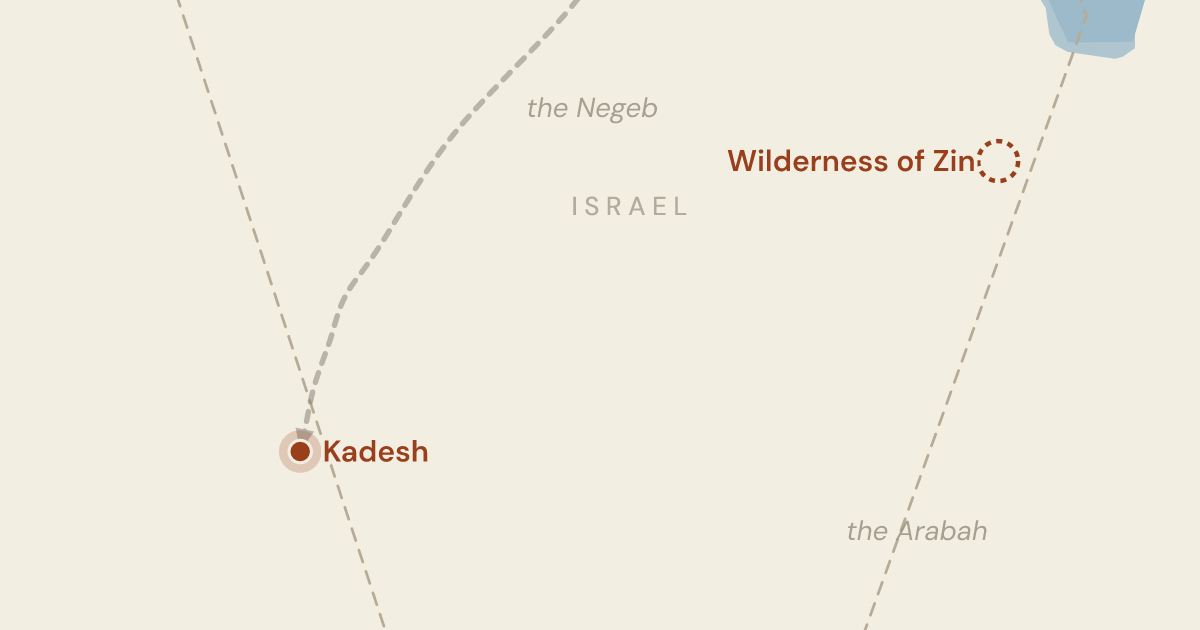
Numbers 20:1: The same camp thirty-eight years on, and Miriam buried at Kadesh
Read it →Commentary on Numbers 20:1
Numbers 20 opens with Israel back at Kadesh, and it opens with a grave. Two questions sit inside the verse. What did all those years of wandering achieve? And what happens to a people when the voice that led their singing falls silent?
Back Where They Started
The place name carries the sting. Israel is standing where Israel had already stood.
And now, in the third stage, the Lord makes them wander for thirty-eight years in the wilderness. When you come to the twentieth chapter, you find that they are back again at Kadesh. Trace their journeys and you find aimless wandering up and down the peninsula of Arabia, from Kadesh to Kadesh, with no real progress made. What a picture of many a believer now, who has rebelled against God, and never really got on in his soul.
The Buried Song
Miriam had led Israel's singing. Her death takes that sound out of the camp.
In this chapter we see Moses, the servant of God, passing through some of the most trying scenes of his eventful life. First of all, Miriam dies. Her voice was heard in the brilliant scenes of Exodus 15, chanting a hymn of victory. Now she passes away, and her ashes are laid in the wilderness of Kadesh. The timbrel is laid aside. The voice of song is hushed in the silence of death. She can no longer lead in the dance. She had sung sweetly in her day. She had caught the keynote of that magnificent song of praise, the song sung on the far side of the Red Sea, the side of resurrection.
Escape, But Never Entry
Commentators read Miriam's own life in the place of her grave.
Miriam is a picture of a soul that never gets beyond the thought of escape. She has not a note about getting into the land. She rejoices in what had been done in destroying the foe, but breathes not a word about getting into the land. It is very striking; she never got in. She died in the wilderness. In the history of her soul, she never got over Jordan.
A Chapter Bounded by Graves
Miriam's grave is not the only grave in the chapter.
It is very remarkable that Numbers 20 begins with death and ends with death. It is more remarkable still that at both the beginning and the end it is death in the same family. Miriam, the sister of Aaron, closes her eyes in death at the start of it; and Aaron the priest, her brother, lays aside his official robes and closes his eyes on the scene at the end of it. It is a perfect chapter of wilderness history. It is truly the beginning and end of the wilderness; it began with death, it ends with death. The brightest day the wilderness ever saw is shadowed by the dark clouds of death. Death separates the musician from the timbrel.
What the Desert Draws Out
Thirst and complaint follow the funeral at once.
But now the prophetess passes off the scene, and the voice of melody is exchanged for the voice of murmuring. Wilderness life is becoming wearisome. The trials of the desert put nature to the test; they bring out what is in the heart. Forty years' toil and travail make a great change in people.
Another writer reads the same death as the ageing of a whole nation.
Miriam the prophetess dies; this character of testimony is closed. Israel grows old, so to speak, in the wilderness. The voice that sang songs of triumph when they came up from the depths of the Red Sea is now silent in the tomb. Also they lacked water. The journey was still prolonged. The resources were far from increasing.
The One Who Does Not Die
The verse takes a leader away. It does not take God away.
Come what may, He will prove Himself equal to every emergency. His faithfulness never fails. Friends fail or pass away. This cold, heartless world snaps the links of fond friendship. Fellow workers part company. Miriams and Aarons die; but God remains. Here lies the deep secret of all true and solid blessedness.
Summary
- Place — Israel comes back to Kadesh. Thirty-eight years of walking, and no real progress.
- Person — Miriam's grave silences the timbrel that led the song at the Red Sea. She sang of escape, never of the land, and she never entered it.
- Pattern — the chapter opens with Miriam's death and closes with Aaron's. The wilderness begins and ends in a grave.
- Test — thirst and murmuring follow the funeral. The desert brings out what is already in the heart.
- Constant — leaders die, songs stop, resources thin. God remains.