Numbers 14:45: Up into the hills without the ark or Moses, and chased back down as far as Hormah
Read it →Commentary on Numbers 14:45
Israel had just been told that the generation who refused Canaan would die in the wilderness. They marched up the hill anyway, and this verse records what met them there.
One will, two opposite sins
The refusal at Kadesh and the charge at Hormah look like opposites. Commentators trace both to one root.
We must be brought right down to the bottom of all that is in self, so as to prove how worthless it is. And it is the wilderness, with all its different scenes and its countless trials, that leads to this result. There we learn what flesh is. There nature comes fully out in all its forms. Sometimes it is full of cowardly unbelief, at other times full of false confidence. At Kadesh, refusing to go up when told to go; at Hormah, insisting on going when told not to.
Whose fight was it?
Unbelief had already changed the shape of the war.
They, by their unbelief, had shut God out; and so it was obviously a question between Israel and the Canaanites. Faith would have made it a question between God and the Canaanites. Joshua and Caleb saw the matter this way. They said, "If the Lord delights in us, He will bring us into this land and give it to us. Only do not rebel against the Lord, and do not fear the people of the land, for they are bread for us. The Lord is with us; do not fear them."
The ark that stayed behind
The previous verse notes that the ark and Moses never left the camp. That detail explains the defeat in this one.
But the people presumed. They pretended to be something when they were nothing. And how miserable it is to presume to move in our own strength! What defeat and confusion! They abandoned God in their unbelief, and He abandoned them in their empty presumption. They would not go with Him in faith, and He would not go with them in their unbelief. "Yet the ark of the covenant of the Lord and Moses did not depart out of the camp." They went without God, and so they fled before their enemies.
Sin that sounds like repentance
They had admitted their sin and quoted God's promise back to Him. One writer calls this the special danger of God's own people.
Israel presumed on the promise of the Lord and on their own confession of sins, and at the same time rebelled against the commandment of the Lord. Presumptuous sin appears to be especially the danger of God's own recognised people. It is doing what makes for our own credit, rather than what is for the honour of Christ. There may be nothing in it that the natural conscience can detect as wrong. There may even be an apparent confession of sin. There may be boldness in pleading the promise of God, with humility and dignity on the outside — and yet God not acknowledged at all.
The name on the battlefield
The place where the rout ended carried its own verdict.
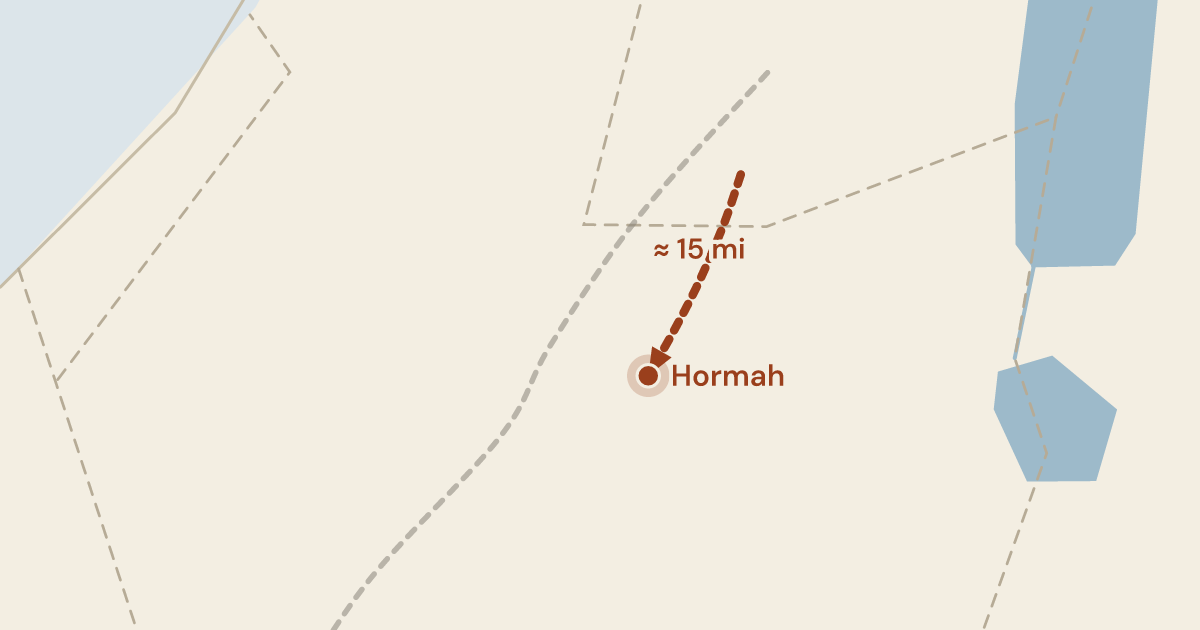
Hormah is the name, meaning "utter destruction", given to Zephath in the far south when Judah and Simeon conquered it.
The same name appears twice in Numbers, with the losing side reversed each time.
Notice that there are two Hormahs in the book of Numbers. Both involve the Canaanites. In the first case the Israelites went against them on their own initiative. So the Hormah of Numbers 14:45 refers to their own bitter disappointment and defeat. In the second case they first placed themselves in the Lord's hands, and He sent them. So the Hormah of Numbers 21:3 was the defeat of the enemy.
What the defeat settled
Moses had warned them, and they went anyway.
They acted on their own proud presumption that they could win despite Moses' warning. This one decisive defeat was enough. Israel tried no other invasion until God ordered it after forty long years in the wilderness.
The road they refused
Retreat was the one thing they would not accept.
They could not bear to lose so much ground and to cross the wilderness again. They would go up from where they were, but it could not succeed; it was not the Lord's way, and He was not with them. The Lord will have us back at the cross, so that we may start again with Him. We must learn that, after all our progress, we are nothing better than sinners saved by grace. We allow that we have sinned, but we want to go on as if we had not. That is not obedience but presumption.
Summary
- Self-will — the refusal at Kadesh and the charge at Hormah came from one nature: unbelief one day, false confidence the next.
- Without Him — faith would have made the fight God's quarrel with Canaan. Unbelief left it as Israel against Canaan, and the ark stayed in the camp.
- Words — they confessed sin and quoted God's promise, then disobeyed His command. That is presumption dressed as repentance.
- Hormah — the name means utter destruction. In Numbers 21 it marks the enemy's defeat instead, because there Israel went only when God sent them.
- Back — one defeat closed the door for forty years. The way on was the way back: bowing to God's discipline instead of holding the ground we chose.