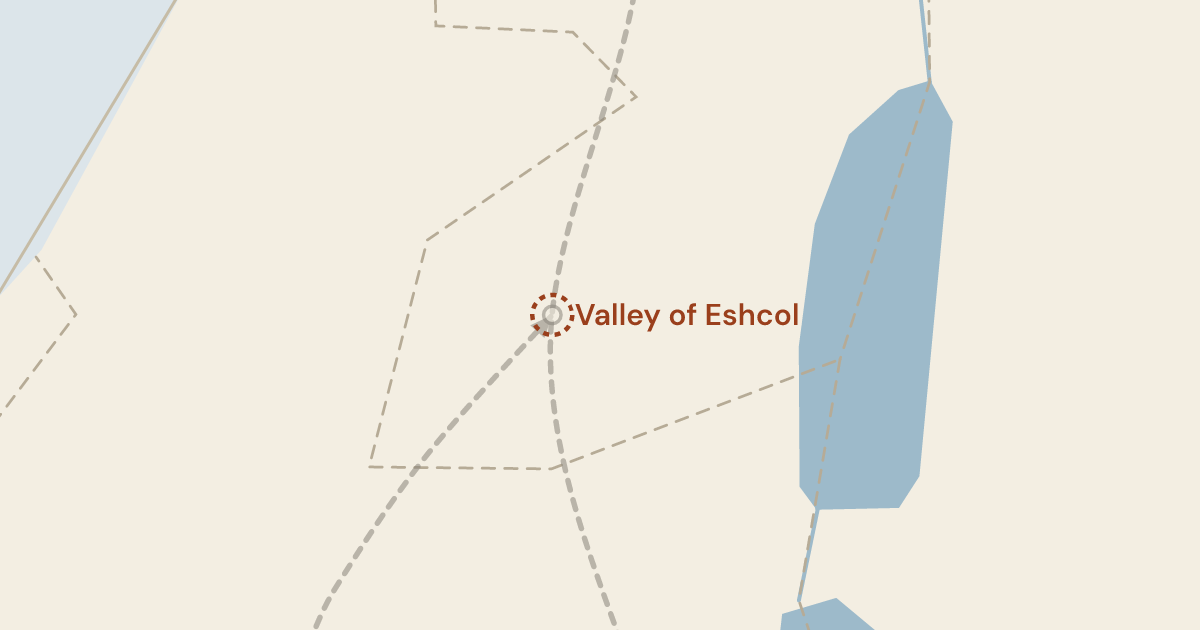
Numbers 13:23: One cluster of grapes on a pole, cut in a valley the sources place only near Hebron
Read it →Commentary on Numbers 13:23
Two men carried one cluster of grapes on a pole. The spies brought it back from a valley near Hebron, with pomegranates and figs. It was real fruit from a land Israel had never entered, and the whole story turns on what they did with it.
Eshcol, the Valley of the Cluster
The valley got its name from the cluster cut there. One reference work places it and notes that the area still grows what it was famous for:
It is called both a brook and a valley, because the one ran in the other. Today it is called a Wady, and there are many of these in Palestine. It was near Hebron, the place explored by the spies, and from where they carried the huge bunch of grapes. Num. 13:23-24; Num. 32:9; Deut. 1:24. In the district around Beersheba there are still miles of grape vines.
Fruit that confirmed what God had said
Israel already had God's word about the land. The cluster added the evidence of their own eyes and hands:
Here, then, was the fullest confirmation of all that the Lord had said about the land. Twelve men testified that the land flowed with milk and honey. Their own senses testified to the quality of the fruit of the land. On top of that, there was the telling fact. Twelve men had been in the land. They had spent forty days travelling up and down in it. They had drunk from its springs and eaten its fruit. And what, in the judgement of faith, would have been the plain conclusion to draw from such a fact? Just this: the same hand that brought twelve men into the land could bring the whole congregation.
An earnest, not only a report
The spies did something Moses had never done. He had described the land. They set a sample of it in front of the people:
They did this extra service for the camp. The report of Canaan had reached them through Moses long before this. The spies also bring a report of it. They said it was truly a good land, flowing with milk and honey. But they did more, something their redeemer from Egypt had never done: they presented a cluster of grapes and said, this is the fruit of it. They offered a sample, a first-fruits... He gives an earnest as well as a report... It is part of the divine plan of the great purpose to give earnests as well as reports. This is essential and not accidental.
The taste that reaches the wilderness
Commentators read the cluster as a picture of the Holy Spirit's work now. It is fruit of a country not yet entered, tasted by people still in the desert:
I speak of practical things. It is not only about having been saved. It is about having tasted the "grapes of Eshcol," fruit of the land of promise, of that true Canaan which faith calls my country. You remember, dear friends, that Moses sent spies to search the country into which God would bring Israel. They brought back magnificent grapes, fruits typical of that desirable country; Num. 13. This is the mark that sets faith apart: it makes real, it holds by the Spirit the "earnest of the inheritance."
An earnest is a part payment of the same kind as the full payment. One writer applies that to the sample:
So now the Spirit is the foretaste, here in this wilderness world, of the joys and delights of heaven. Every view of the love of God, every unfolding of His grace, every showing of the beauties of Christ, all the sweetness of "the fellowship of kindred minds" — these are foretastes of the coming feast. So is everything else in the precious witness of that Holy One. These Eshcol grapes are only a cluster of fruit from the tree of life in the middle of the Paradise of God.
Where the picture stops short
Commentators differ on how far this picture goes. One warns that the grapes only go part of the way:
The grapes of Eshcol were only in part a picture of the earnest. They were the very fruit of Canaan itself and therefore a true foretaste. But they did not involve the certainty, for the individual concerned, of entering the land. In this respect they fall short of being a true picture of the earnest.
The cluster becomes a test
Nobody argued with the fruit. The argument started at once, over what stood between them and the land:
Nobody denied the goodness of the land. How could they, with the earnest in front of their eyes? But between where they were and having this good land there were difficulties. Unbelief mapped them all out with great accuracy.
Summary
- Report — Moses had told Israel what the land was like. The cluster from Eshcol turned that description into something they could see and taste.
- Sample — the spies gave the camp a first taste of Canaan in the middle of the desert. God's way is to give an earnest as well as a report.
- Proof — twelve men walked the land and ate its fruit. The hand that brought twelve in could bring the whole nation in.
- Foretaste — writers read the grapes as a picture of the Spirit's work now. One adds a caution: the fruit gave no individual a guarantee of entry.
- Test — nobody disputed the goodness of the land. Unbelief just listed the obstacles in the way, and that list cost them the land.