Numbers 13:21: The whole land in one sentence, from the southern wilderness to the pass of Hamath
Read it →Commentary on Numbers 13:21
One verse covers a huge distance. The spies crossed the whole land, from the far south to the far north, before they came back to report. Why search a land God had already promised? And why did forty days of walking end in forty years of wandering?
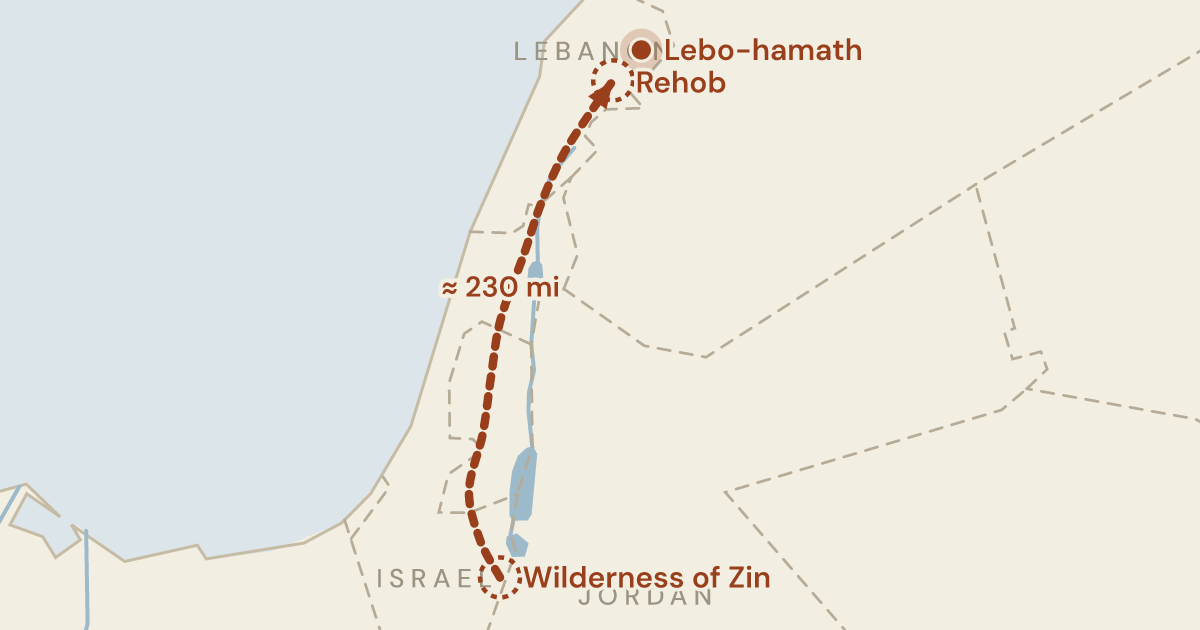
The Route They Covered
The verse names both ends of the journey. The southern start lay well below Judah:
A district far south of Judah, lying between the Dead Sea and the Gulf of Akaba. Kadesh stood in it, and much of Israel's wandering took place there.
Rehob marks the far end: it was "the northern limit of the exploration by the spies" (Morrish Bible Dictionary). One writer explains why the spies began by heading south:
The answer seems to be this. They were camped close to where the hill country in the south of Judah begins. So the spies had to start by going south, and then climb into the mountain region south-east of the Dead Sea. They travelled up the east side of the Jordan to the far north, near Hamath. Then they turned south and came back through Hebron on the west side. That way they raised no suspicion about who they were. They looked like ordinary travellers.
Who Asked For The Search
Numbers says God told Moses to send men. Another account of the same event says the people asked first. Both are true, in order:
This seems to clash with Numbers 13:1-2, where the Lord tells Moses to send men to spy out the land of Canaan. Put together, the two passages show that the people proposed it, Moses agreed (he says in Deuteronomy that it pleased him well), and God commanded it. God's first message was to go up and take the land. But the people hesitated and said they would send the spies (Deuteronomy 1:21-23). Their rebellion and their wandering were the result.
So the journey of verse 21 began in doubt, not in obedience. Yet God did not refuse it:
Still, as we have seen, the Lord lets them test the principle out. He lays down what agrees with His own mind. In His gracious care for His people He may also go beyond that. And He may even allow people to carry out something that did not start with Him, and still secure His own glory at every point.
What The Search Proved
The spies walked through enemy country for forty days. Nobody harmed them, and nothing they saw contradicted God's word. They "searched it for forty days without anyone troubling them" (The Bible Treasury). That fact alone carried an argument the people missed:
On top of that came a telling fact: twelve men had really been in the land. They had spent forty days travelling up and down it. They had drunk from its springs and eaten its fruit. What, in the judgement of faith, was the plain conclusion to draw from that? Simply this: the same hand that had brought twelve men into the land could bring the whole congregation.
The Land We Are Searching
Canaan pictures something Christians enter now, not only later:
Now Canaan is not a picture of heaven, where Christ is. When we enter that happy place, all conflict and fighting will be over for ever. It is a picture of the realm of heavenly blessing that is ours in Christ. We enter that blessing now, and we enter it through spiritual conflict.
If the land is ours in Christ, who shows it to us now?
The Spirit of God Himself lives in us as a present witness. He takes the glory of the Lord Jesus, and the things of the promised land — the true Canaan, which faith calls my land — and so shows us our portion.
Forty Days, Forty Years
The length of the search set the length of the sentence: a year for every day. Even those years were not wasted:
During those forty years, those who had said they wished to die in the wilderness would die there. God would bring their little ones into the land — the very children they had mourned over as prey for the enemy. In the meantime those children carried the consequences of their fathers' sin, as children of such fathers needed to: a year in the wilderness for each day of fruitless search. Thank God, though, that because He Himself appointed these years, we cannot call them fruitless. Will we say that at the end of any of the Lord's ways with us here? No — the more painful, the more profitable.
Summary
- Cause: the search began with the people's doubt. They proposed it, Moses agreed, and God commanded it.
- Permission: God may let a thing go forward that did not begin with Him, and still secure His own glory through it.
- Reach: the men crossed the whole land, far south to far north, and travelled unharmed the entire forty days.
- Evidence: the hand that carried twelve men through the land could carry the whole nation.
- Result: each day of searching cost a year of wandering. Yet God wastes nothing He appoints, however painful.