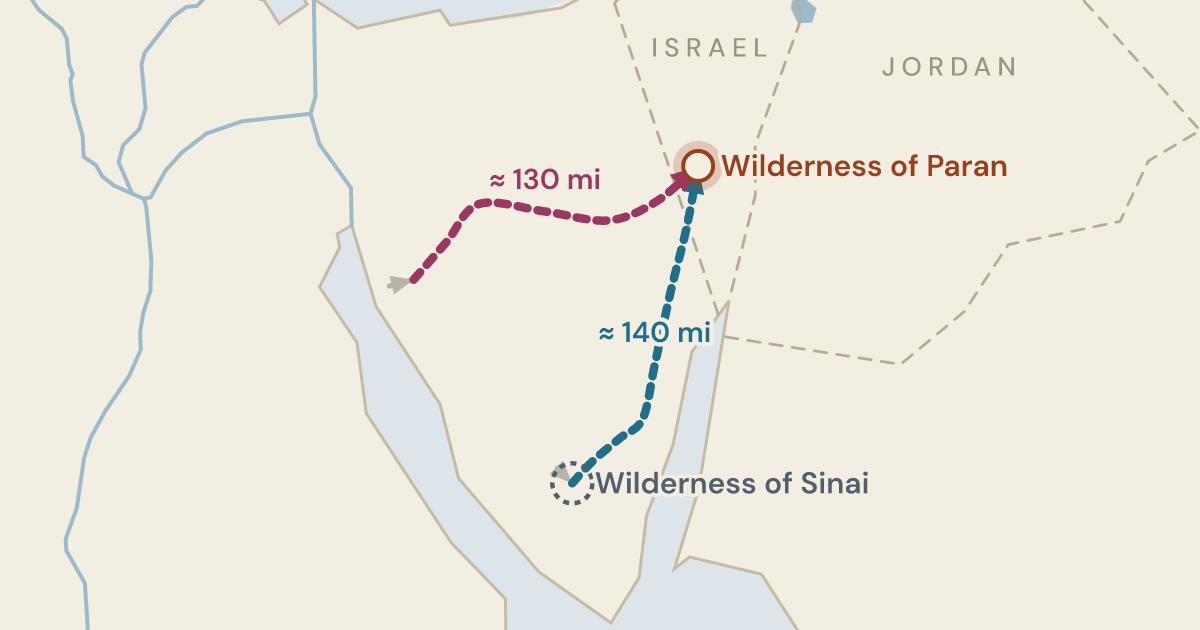
Numbers 10:12: After eleven months at the mountain the cloud lifts, and settles again in Paran
Read it →Commentary on Numbers 10:12
The cloud lifts from the tabernacle, and for the first time Israel moves as a nation toward the land God promised. They leave one desert only to enter another, and where the cloud stops — Paran — will shape the next forty years.
Ready to Move
Everything up to this point has been preparation. Nothing was missing when the signal came.
Everything was now in its right place, and everyone knew for certain what he had to do, both when the cloud moved and when it rested. The tabernacle set up — the priests consecrated — the people numbered; they were now to leave Horeb. "The LORD our God said to us in Horeb, 'You have stayed long enough at this mountain.'"
Everything a travelling people could need had already been supplied by the God who was travelling with them.
All is duly ordered, according to that grand regulator — "the commandment of the LORD." Each man according to his pedigree, and each tribe according to its standard, is in the divinely appointed place... A vigilant eye, a powerful hand, and a loving heart have provided for every possible contingency, so that the whole congregation in the wilderness, and each member in particular, might be thoroughly furnished.
Out of One Desert, Into Another
The verse marks a shift in the book. Up to here God has been arranging His people; from here on we watch how they behave.
The preparations taking place at Sinai, the giving of the law, the building of the tabernacle, instructions as to offerings, the setting in place of priests and Levites, and so on have now been completed, so what follows is the history of the wilderness journey of Israel. Before this, God had made preparations of grace and government for them; now we are to see how the people respond to this in their wilderness history.
They left Sinai, but they did not arrive anywhere better. One writer reads that as a picture of the believer's life in the world.
They left the wilderness of Sinai only to enter the wilderness of Paran. Egypt stands for the world in its proud independence of God, boasting that it needs nothing. But the wilderness is the world as a believer finds it in experience, a place barren and empty of true blessing. For the believer has a new nature that desires things the world cannot provide.
The Name Paran
Sinai and Paran were both deserts. The meaning of the second name may say something about Israel's heart.
If "Paran" is to have its natural meaning in Hebrew, it would mean "adornment," not "opening" or "abounding in caverns," as others have taken it. So they went from the wilderness of thorn, or barrenness, to the wilderness of decoration. That would mean exchanging barrenness for a place that was still a desert, yet had somehow become attractive in the people's mind. This might foreshadow what in fact took place. Israel, on the very borders of the land God was bringing them to, turned their backs on it and chose the desert instead of what God had made their own.
Moving at His Word Alone
Israel did not choose the route or the timing. The cloud was more than a signal. It carried the authority of a spoken command.
In this way the Lord placed Himself at the head of His redeemed people, and in His patient grace led them through the stages of their wilderness journey. The movement of the cloud carried the force of the Lord's word. If it rose from off the tabernacle, that was equivalent to His command; and the same was true if it stayed on the tabernacle... He made His presence known to them through the cloud, and His will by the movements of the cloud.
Order on the March
Israel travelled in a set order, tribe by tribe. One writer draws a lesson from that for believers today.
All of this shows that God is a God of order. In the Church of God there is no physical order like this at all. Yet God's instructions in Scripture, for instance in 1 Corinthians, are plain enough. We have no excuse if we do not do all things decently and in order (1 Cor. 14:40). Not that any man is in charge to control the saints, but the Lord is in authority.
Eleven Days, Thirty-Eight Years
The road to the land fell into stages. Compare the distance with the time it took.
Their arrival at Sinai was, in a sense, the completion of the first stage of the journey. The second stage was Kadesh Barnea, which they reached before the end of the second year after they left Egypt. The third was the plains of Moab; they left the wilderness for ever when they crossed the brook Zered (Deut. 2:13-14). Between Sinai and Kadesh are eleven days' journey (Deut. 1:2). Between Kadesh and the brook Zered thirty-eight years ran by.
What happened there left its mark in the place names.
But they leave there the record of their sin and of the judgment of God in the names Taberah and Kibroth-hattaavah, "the burning" of the fire of the LORD, and "the graves of lust." It is from Paran that the spies are sent to search the land and bring back some of its fruit.
Summary
- Prepared. Before the cloud lifted, the tabernacle was set up, the priests consecrated and the people numbered. Everyone knew what he had to do.
- Commanded. When the cloud rose or rested, that was the Lord speaking. Israel moved and camped at His command, not by their own planning.
- Ordered. The tribes moved in the places God assigned, a picture that God is a God of order among His people.
- Barren. Sinai gave way to Paran, one desert for another. The world has nothing the believer's new nature wants.
- Wasted. Sinai to Kadesh was an eleven-day road. Paran became instead the place of Taberah, Kibroth-hattaavah and the spies, and thirty-eight years of wandering followed.