Exodus 3:1: The far side of the wilderness, and a shepherd at the mountain of God
Read it →Commentary on Exodus 3:1
Moses grew up in Egypt's royal court; forty years later he is minding another man's sheep in the desert. Why does God move a gifted man out of sight before He uses him?
From Egypt's Court to the Back of a Mountain
One commentator sets Moses' two worlds side by side.
Here we see an amazing change of circumstances. In Genesis 46:31 we read that "every shepherd is an abomination to the Egyptians." Yet God takes Moses, who had learned all the wisdom of the Egyptians, from the Egyptian court to the back of a mountain, to mind a flock of sheep and to be trained for God's service… To find such a man, with such gifts, called away from such a position to mind sheep at the back of a mountain, is far beyond what human thought or feeling can reach.
The Desert as God's School
Those years in Midian were not wasted. They were a training course with two subjects.
Forty is the number of testing. You see it in Israel's forty years in the wilderness, and in the forty days of our blessed Lord's temptation. So this was a time of testing. It tested what Moses was, and it gave him time to prove what God was. We must always learn both before we are fit for service. So God always sends His servants into the wilderness before He uses them… There, alone with Him, we discover how empty our own resources are, and how completely we depend on Him.
Egypt trained Moses well, but something was still missing.
If any educated man in his natural state could expect success in God's service, Moses could have counted on it. He was grown up, he was learned, he was mighty in word and deed. Yet at the back of the desert he had to learn something Egypt's schools could never have taught him. Paul learned more in Arabia than he ever learned at the feet of his teacher Gamaliel. No one can teach like God, and everyone who will learn from Him must be alone with Him.
Why Sheep
The job itself was part of the shaping, and it points beyond Moses.
Moses had become a shepherd, the job the Egyptians despised (Gen. 46:34). It was part of God's training, and through it he became "very meek, more than all people who were on the face of the earth" (Num. 12:3). As a shepherd he is a picture of Christ.
Horeb — the Mountain of God
The place matters. God met him at the very spot the story would come back to.
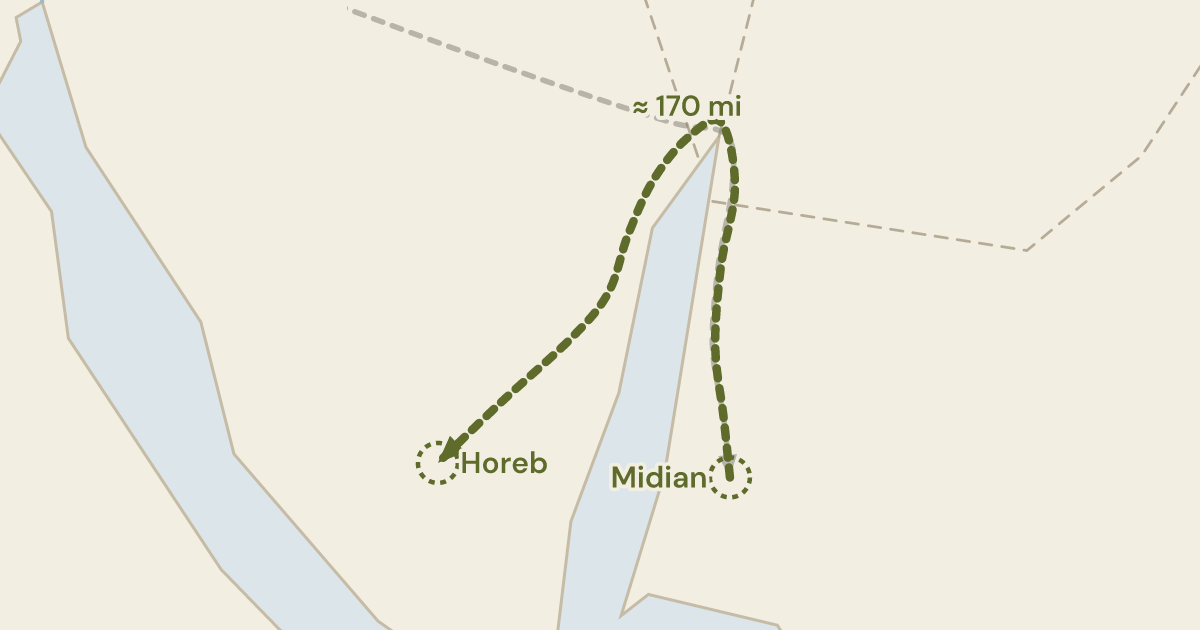
At the end of the 40 years in Midian, Moses had led Jethro's flock close to Horeb. Horeb seems to be the wider name for a group of mountains, and Sinai was its chief peak. God appeared to him at that spot. So he received his commission at the very place where he would bring the people after he led them out of Egypt, and where God would give the law that is for ever linked with his name.
One commentator notes that the name itself looks ahead.
The scene is at Horeb, called the mountain of God here, a name given ahead of time.
Faithful in Ordinary Work
Moses was doing his ordinary job that day. That routine is where God's call reached him.
In the ordinary run of his work, he leads the flock to the far side of the desert and comes to Horeb, the mountain of God. No doubt he had no idea that his years of exile were about to end… Then something catches Moses' attention. His everyday duties did not stop him recognising the Lord when He showed Himself. They never need to… One of the greatest proofs that a man is subject to God is this: he does his daily work with care and patience, and still keeps his eye ready to watch the ways of God.
Sent, Not Self-Appointed
Moses had once tried to act on his own. Here is where his real authority came from.
Horeb is the starting post for everyone God sends out to act for Him… Forty years earlier he had gone to work, but he moved too soon… Here was real authority. There is a huge difference between God sending a man and a man running unsent.
Summary
- Court — Egypt gave Moses learning and status. None of it could fit him for God's service.
- Desert — Forty years alone tested what Moses was and showed him what God is. Nowhere else do we learn to depend on Him.
- Flock — The Egyptians despised shepherds. That despised work made Moses the meekest of men, and in it he pictures Christ.
- Mountain — God called him at Horeb, and to Horeb he would bring the people he led out.
- Commission — Moses did his daily work with his eye open to God. Then God sent him. Being sent is what separates real service from running unsent.