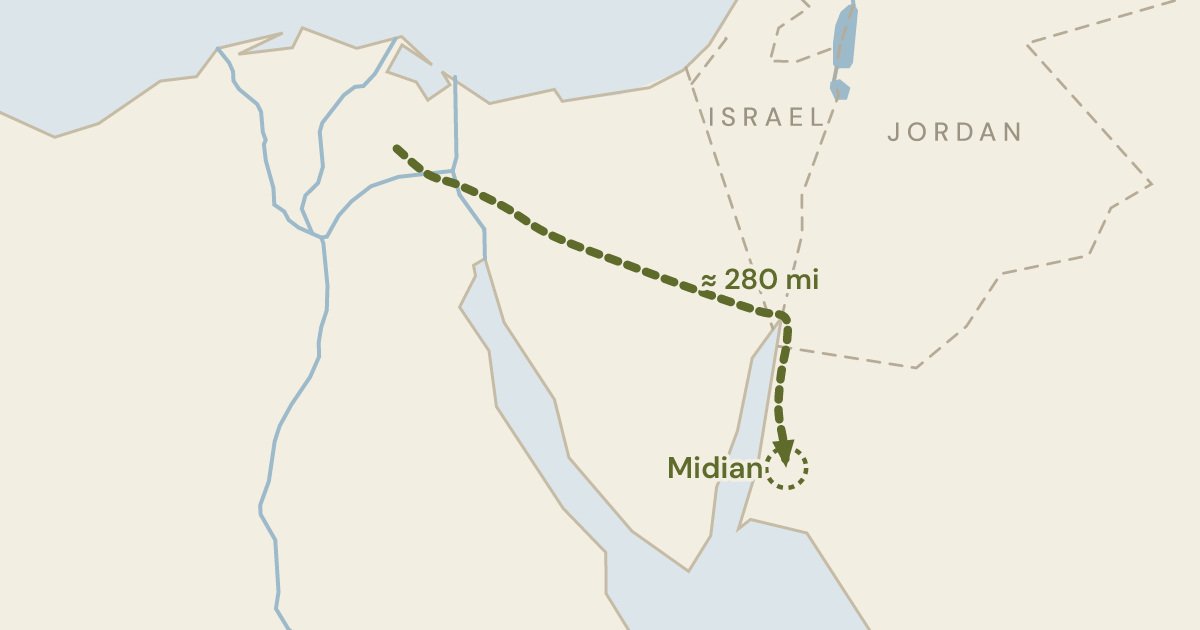
Exodus 2:15: A prince of Egypt runs for his life, and sits down by a well in Midian
Read it →Commentary on Exodus 2:15
One sentence carries Moses from the palace of Egypt to a stranger's well in the desert. It raises a hard question: what does it mean when a sincere attempt to help ends in flight?
Why He Ran
The verse names Pharaoh as the danger, but the trouble started closer to home.
It does say that Moses fled from Pharaoh (v.15), but the context brings out something more: his own people had rejected him. Moses saw two Hebrew men quarrelling and corrected the one in the wrong. The man answered him: "Who made you a prince and a judge over us? Do you mean to kill me as you killed the Egyptian?" In fact, it was this opposition from his own people that put him in danger with Pharaoh.
Fear In Exodus, Faith In Hebrews
Exodus tells us that Moses was afraid and ran. The New Testament looks at the same man and calls it faith.
Hebrews gives a most gracious view of what Moses did. This is how the Holy Spirit deals with the history of Old Testament saints. When He writes a man's history, He presents him as he is, and faithfully sets out all his failures and imperfections. But when He comments on that history in the New Testament, He gives only the real principle and main result of the man's life. So in Exodus we read that Moses "looked this way and that way," that "he was afraid and said, Surely the thing is known," and last of all that "Moses fled from Pharaoh." Yet Hebrews teaches that what he did, he did "by faith" — that he did not fear "the wrath of the king" — that "he endured as seeing him who is invisible."
Commentators differ over which departure Hebrews describes. Some tie it to this flight. Others tie it to the exodus out of Egypt.
Doubtless this refers to the second time that he left Egypt. On the first occasion, we read, "Moses fled from Pharaoh" (Ex. 2:15). On the second occasion he stood up to Pharaoh face to face. Under the mighty hand of God he brought the children of Israel out of Egypt in triumph.
Postponed, Not Cancelled
Sitting by that well, Moses could have counted his whole life wasted. Commentators see the opposite.
What anguish for a faithful heart, blocked like this while sincerely trying to serve his own people! All his sacrifices and his surrender of the glories of Egypt may now have looked useless to others and of no profit to himself. He sat there, a wanderer and exile, like a withered, fruitless tree in the desert. But if these were Moses' thoughts, they were not God's. The mission was not forfeited, only postponed. God's time to deliver His people had not come, and the people themselves were not ready for that deliverance... And already, as he sits by the well in the land of Midian, he is under the discipline that will shape him. It is preparing him for the great service God has planned for him.
The forty years that follow do a specific work — not adding to Moses, but subtracting from him.
Moses needed forty years far out in the desert to fit him to lead God's people out of Egypt and through the wilderness. No doubt God used his education in Egypt to form the vessel for His service. But the forty years were needed to empty that vessel of all that had filled it during its making.
The Well
The flight looks like defeat. But God chose where Moses landed.
What could he do but leave Egypt altogether? He took a long journey to Midian, possibly nearly a hundred miles, which cut him off completely from his own people Israel as well as from Egypt. How intense his loneliness must have been! But it was God who had led him there. Sitting down to rest by a well, he saw a scene that again stirred his concern for the oppressed.
A Picture Of Christ
Commentators read the whole chapter as a prophecy in outline, with Midian standing for the Gentiles — the nations outside Israel.
Moses sees his own people oppressed and steps in to save them from their enemies, with temporary effect (Ex. 2:11-12). But when he goes further and tries to save them from themselves (Ex. 2:13-14), they reject him with scorn. So he withdraws into Midian among the Gentiles. There he finds others suffering injustice and oppression, and defends them. The earlier setbacks do not stop him. He opens to them the resources of the well, and wins Zipporah as his wife. Then he returns again to redeem Israel — and this time they receive him. All this is clearly a picture of the rejection of the Messiah by the Jews, and of His work since then among the Gentiles. There He receives the church as His bride... and afterwards He returns with her to save His Jewish people.
The same pattern appeared earlier with Joseph, but the two rejections are not identical:
In Joseph's case we have open hatred against his person. In Moses it is the rejection of his mission... Joseph was hated as a person; Moses was refused as a leader.
Summary
- Rejected. Pharaoh's sword was the visible threat. But his own people's refusal — "Who made you a prince and a judge over us?" — is what drove Moses out.
- Removed. Exodus records his fear; Hebrews records his faith. Scripture records the failure, then names the principle underneath it.
- Refined. The mission was postponed, not forfeited. Midian was not a gap in the story but the discipline that emptied the vessel Egypt had filled.
- Redirected. Alone and a hundred miles from his own people, Moses still defended strangers in Midian. Exile did not change his character.
- Returning. A deliverer refused by his own people takes a bride among outsiders, then comes back to redeem them. That is the shape of Christ's rejection, His church, and His return.