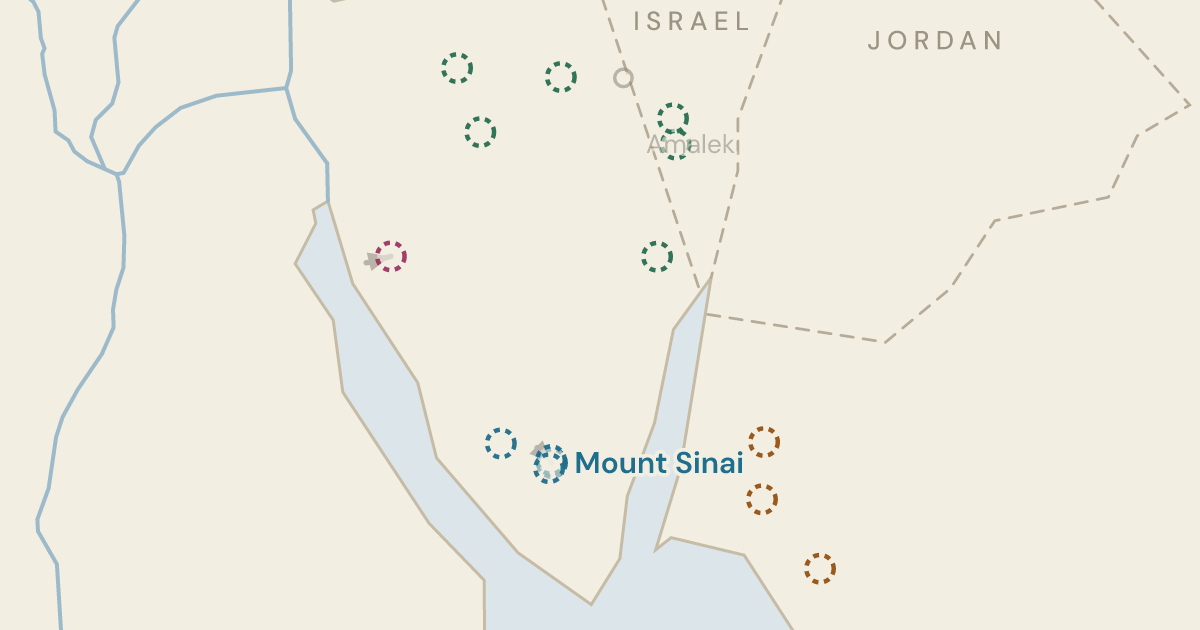
Exodus 19:20: Fourteen summits proposed for the mountain Moses went up
Read it →Commentary on Exodus 19:20
The Lord comes down onto the top of Sinai in fire and cloud. From there He calls one man up, while the rest of the nation stands fenced off below. God has come near, yet no one may approach Him. Why are the people He rescued now held at arm's length?
Why God Came Down in Fire
The descent follows Israel's promise to obey. One writer traces the whole change of tone to that promise:
Notice the result. The moment Israel made their vow, the moment they undertook to "do," the whole look of things changed... This was a very marked change. The One who had just said, "I bore you on eagles' wings and brought you to Myself" now wraps Himself "in a thick cloud." He says, "Set limits for the people all around." The sweet tones of grace and mercy give way to the thunder and lightning of the burning mountain. Man had dared to talk about his miserable doings in the presence of God's magnificent grace. Israel had said, "we will do," so God put them at a distance, to show fully what they were able to do.
Holiness That Cannot Be Approached
The barriers taught a lesson about what happens when a sinner meets God on the basis of his own record:
All these details are deeply solemn. They show that man is quite unable to stand before God on his own merits. They also teach that if the sinner dares to come into contact with Him on such a footing, it can only end in his own destruction. Apart from atonement, God cannot meet the sinner on the ground of righteousness without destroying him.
Even touching the edge of the mountain carried the death penalty:
The plain truth set out at Sinai was that no sinner could stand there before God. There He told Israel not to go up the mountain or touch its edge: "Whoever touches the mountain shall be put to death." No wonder the whole people in the camp trembled.
One Man Called Up
Out of a whole nation, only Moses climbs. Writers see something larger in that single figure:
And this is shown from the start: the people, even through their representatives, cannot draw near. He has come down to dwell among them, yet He must still hold them at a distance. God calls Moses alone to approach, as a picture of a greater Mediator.
Called Up, Then Sent Straight Down
At the top Moses receives a warning to carry straight back down:
Moses spoke and God answered by a voice, calling him to come to the top of the mountain to which God had come down. We do not know how His presence was shown there. But God at once sent Moses back down. He was to warn the people solemnly not to break through the boundaries around the mountain to see what they could, and so die. The priests were clearly allowed to come closer. Even they had to make themselves clean from all defilement, or suffer judgment from the Lord.
This arrangement shows what the law could and could not do:
Only Moses and Aaron were allowed on the mountain. The priests and the people had to stay at a distance. This shows that the law did not bring men near to God. There was a mediator and a priest between them and God, but the people were kept away from God. How different it is in Christianity! Our Mediator has brought God near to us in grace, and we come into His presence with God's great High Priest.
From Sinai to Zion
Commentators set Sinai against a second mountain:
Israel had come to Sinai, and that was the mountain that marked their whole course from beginning to end. And what was the result? As it began with darkness and distance, so it ended with misery and death. Being what they were, and Sinai being what it was, they could not help shrinking back from God. There God stood in His majesty of judgment. He was not there in the love that comes down, takes the burden on itself, and carries it away... "But you have come," says the Spirit, "to Mount Zion." Zion is the mountain where God steps in with grace. Sinai was the mountain of man's responsibility.
Summary
- Descent — God came down to the top of Sinai. But coming down is not the same as coming near: He wrapped Himself in a thick cloud and fenced the people off.
- Distance — the change came when Israel promised to obey. Once they said "we will do," God put them at a distance to show what they could really do.
- Danger — apart from atonement, God can only destroy the sinner who meets Him on the ground of righteousness. That is why touching the mountain meant death.
- Mediator — God called up one man alone, a picture of a greater Mediator. The law gave Israel a go-between, but never gave them access.
- Destination — Sinai began in darkness and distance, and ended in death. Zion is the other mountain, where God steps in with grace and takes the burden away.