Exodus 19:2: The camp before the mountain, and four answers to which mountain
Read it →Commentary on Exodus 19:2
The journey out of Egypt has an address. The whole nation halts in front of one mountain, and from that spot God will speak the law and the covenant.
The mountain God had named in advance
The stop at Sinai was not a chance halt. At the burning bush God named this very mountain to Moses as the proof that He had sent him. One writer reads the arrival as that promise kept.
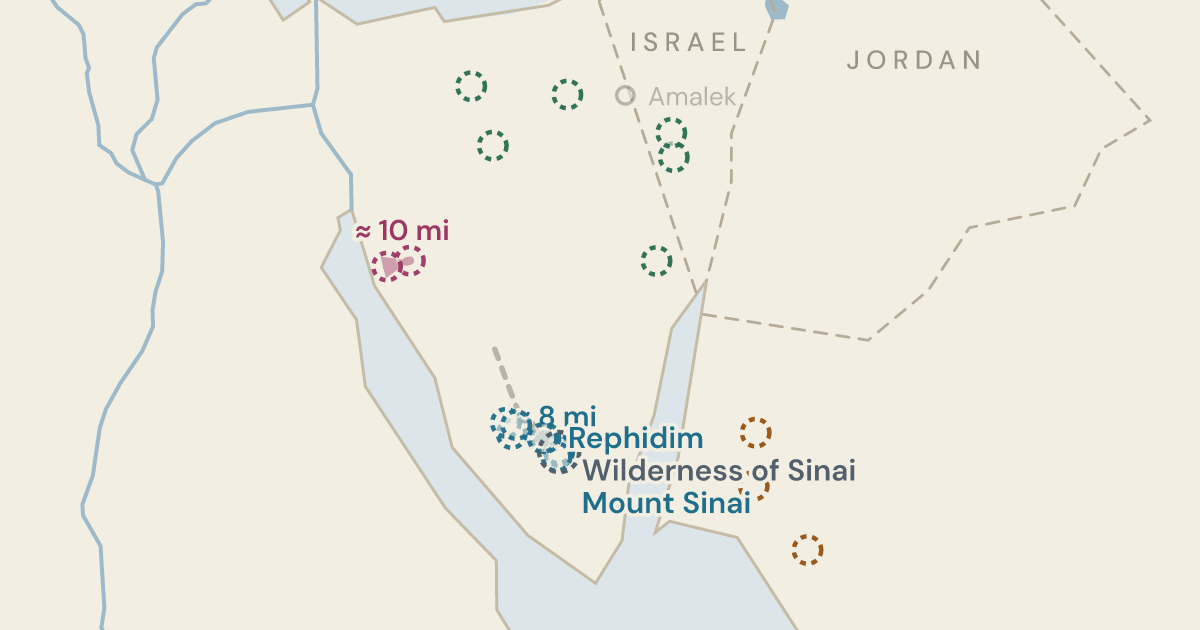
The opening verses of our chapter show God's faithfulness. They witness to the promise He gave Moses in Exodus 3:12: "And He said, Certainly I will be with you: and this shall be a token to you, that I have sent you. When you have brought forth the people out of Egypt, you shall serve God upon this mountain." Mount Sinai is a range of high hills. It is sometimes called Horeb, as in chapter 3. Horeb may be a more general name for the whole range, with Sinai as one of the peaks.
Room for a whole nation to encamp
The verse says they encamped in the wilderness. How much room did that wilderness give them, and how long did they stay?
The Israelites camped in the wilderness of Sinai, which must have been a large place, able to hold two million people. Comparing Exodus 19:1 with Numbers 10:11 shows that they stayed there nearly a year. Modern surveys of the mountains in this area have found a plain about two miles long and half a mile wide. It gave ample room for the people to gather. There they could hear the thunder and see the fire and smoke coming out of the mountain. The plain is now called er Rahah.
Grace all the way to this camp
They came from Rephidim, one more stop on a road that began in Egypt. One writer sums up God's dealings along that whole road in a single word.
The blood of the Passover lamb was the sign of their shelter from judgment. It was also the sign of their separation to God Himself. Then the crossing of the Red Sea brings out the song of salvation. And from the Red Sea to Sinai it was all grace. God dealt with them in grace. They murmured again and again, but they got the quails and the water without any reproach. It was perfect and unmingled grace.
What God's voice had said up to this camp
Israel already knew that voice. One writer asks what it had been saying to them, right up to the moment named in this verse.
Notice, it is "My voice" and "My covenant." What was that voice saying? And what did that covenant involve? Had the Lord's voice made itself heard to lay down the rules of a severe and unbending lawgiver? Not at all. It had spoken to demand freedom for the captives. It had spoken to provide shelter from the sword of the destroyer, to make a way for the ransomed to pass over, to bring down bread from heaven, and to draw water out of the hard rock. Such had been the gracious and clear words of the Lord's voice, up to the moment when "Israel encamped before the mountain."
The camp where God's dealings changed
The terms change at this camp. Writers read the arrival at Sinai as the opening of a new order.
A new dispensation is opened in these chapters. Up to the close of chapter 18, as pointed out before, grace reigned. It marked all God's dealings with His people. From this point on, the people came, with their own consent, under the strict requirements of law. Sinai is the expression of this way of dealing, and is linked with it for all time.
The change lies in what blessing now rests on.
We shall see the terms of God's proposal to them. The enjoyment of blessing and relationship now depended on their obedience to the word of God, on their faithfulness. It no longer rested only on the faithfulness of God, as it had during the period of grace.
Why the test at Sinai was right
Why would God propose terms of law at all? One writer answers from what Israel had already shown of themselves.
They left the ground of the grace of God, which they had in no way valued. Their conduct proved that His grace had not at all entered their hearts. It was therefore a perfectly righteous thing that God should propose terms of law. Had He not done so, one solemn question would never have come out into the open: can man stand before God on the ground of his own faithfulness?
Summary
- Brought. God led them from Rephidim to the exact mountain He had named to Moses at the bush — the arrival was His promise kept.
- Carried. From the Red Sea to this camp, all was grace: shelter, deliverance, bread, water, and no reproach for their murmuring.
- Camped. The plain before the mountain gave a whole nation room to stand, see and hear, and they stayed there nearly a year.
- Tested. At this camp blessing came to rest on their faithfulness, not on God's alone. That put man's own competence to the test.
- Marked. Sinai stays linked with this way of dealing for all time — a standing question over man's own faithfulness, set beside the grace that carried Israel there.