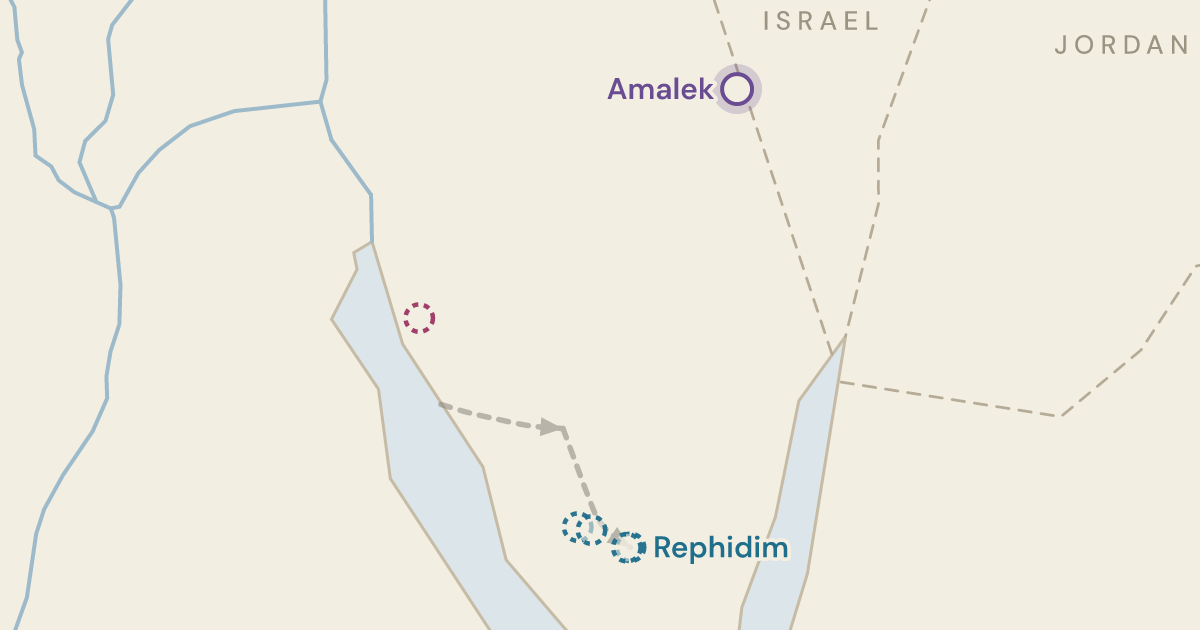
Exodus 17:8: The first battle of the wilderness, fought at the last camp before the mountain
Read it →Commentary on Exodus 17:8
At Rephidim God had just split a rock to give water to a complaining people. Then an enemy attacked them — why does attack follow so soon after mercy, and who is Amalek?
The Word "Then"
The word "Then" ties verse 8 to verse 7. One writer traces the attack back not to the water from the rock, but to what Israel had said just before.
Verses seven and eight give us not only the literal connection but also the moral connection. In verse seven Israel quarrelled and tested the Lord, saying, "Is the Lord among us or not?" The language of verse eight suggests a consequence. From this we can observe that the moral connection is not between the gift of water from the smitten rock and Amalek's attack, but between the unbelief of the people and Amalek's attack. God does not call to this conflict. He did not say, "Seek out Amalek and destroy him." Amalek seeks out Israel, and it was Israel's unbelief which exposed them to attack.
One writer names what that doubt costs.
Nothing gives the enemy more power than to doubt whether we are the children of God, or to doubt whether He is with us and for us.
Who Amalek Is
Amalek's family tree is the key to what he pictures.
Amalek was Israel's first foe after leaving Egypt. The Amalekites were descendants of Esau, and this, combined with the assault in the wilderness, gives us a clear clue as to what they represent. Esau, the firstborn, stands for what is natural. Jacob, the younger, suggests the sovereignty of grace, which sets the firstborn aside. It is the flesh which is the firstborn in us, and only as born again is faith present. "The desires of the flesh are against the Spirit." You may cultivate it, refine it, improve it, and whatever else, but it remains unchanged.
Commentators differ here. Others see Amalek as the enemy behind the flesh, not the flesh itself:
Amalek is everything that was contrary to God — the power of Satan. They were in conflict with Satan always.
The First Battle Israel Ever Fought
Until now Israel had only watched God fight for them. At Rephidim that changes.
Israel's conflict began when they stood in the full power of redemption. Until they met Amalek, they had nothing to do. They did not divide the sea or drown Pharaoh's armies beneath its waves. They did not bring down bread from heaven or draw water out of the hard rock. They neither had done nor could do any of these things — but now they are called to fight with Amalek. All the previous conflict had been between the Lord and the enemy. They only had to "stand still" and watch the mighty triumphs of the Lord's outstretched arm and enjoy the fruits of victory. The Lord had fought for them; but now He fights in them or by them.
The Tactics of This Enemy
Amalek did not fight like Israel's other enemies.
Each of Israel's foes has its own typical character and method of warfare. The Amalekites represent those carnal and sinful principles which seek now in the wilderness to hinder and injure us. Their way of fighting was mean and cowardly, quite unlike that of the scheming Philistine or the brave Jebusite. They "attacked those who were lagging behind… all who were feeble… when you were faint and weary." This foe lies in wait for every subtle and unfair advantage against our souls. God has sworn to destroy him, and He has commanded, "You shall blot out the memory of Amalek from under heaven; you shall not forget." Other foes might be spared, but not this one. There must be no truce, no quarter.
Where the Victory Comes From
The fighting happens in the valley. The hill decides it.
Joshua leads his warriors on the plain. Moses — with Aaron and Hur — goes up to the top of the hill. The fight below depends on the lifting up of Moses' hands above. Moses, seen this way, is a picture of Christ above in the value of His intercession. He leads His people in the power of the Spirit below. At the same time He maintains their cause by His intercession in the presence of God, and He secures for them mercy and grace to help in time of need. They therefore have no strength for conflict apart from His priestly intercession.
Grace Runs Above the Failure
The day at Rephidim held both a rebellion and God's answer to it.
Israel had tested God by their unbelief, saying, "Is the Lord among us or not?" Then Amalek came. But with the enemy came the God-given victory over him! Unbelief in God's faithfulness — God's answer of mercy. The enemy's attack — God's reply of victory. Such is the golden line of God's grace over man's sin, displayed in the glory of God in the wilderness.
Summary
- The door. Amalek comes right after Israel asks whether the Lord is among them — the attack follows the unbelief, not the mercy.
- The enemy. Amalek descends from Esau, the firstborn set aside. Commentators read him as the flesh, or as Satan's power working through it.
- His tactics. He strikes the stragglers, the feeble, the faint and weary — so God orders no truce with him at all.
- New orders. At the Red Sea the Lord fought for them; at Rephidim He fights by them, and Israel takes up the sword for the first time.
- The hill. Joshua leads the fight below. Moses' lifted hands above decide it — a picture of intercession, without which there is no strength for the fight.