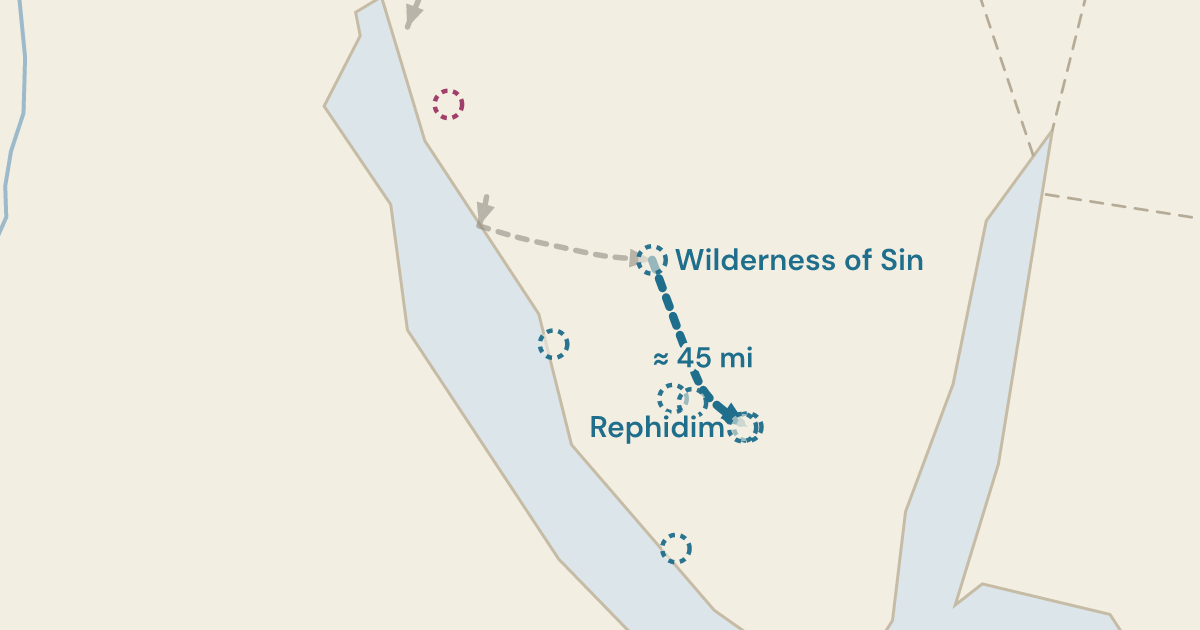
Exodus 17:1: Moved on by stages to a camp with no water, the last before the mountain
Read it →Commentary on Exodus 17:1
Exodus 17 opens with a march God Himself directed and ends at a camp with nothing to drink. Why would God's own guidance lead a redeemed people to a place with no water?
Guided into the Dry Place
The verse says the people moved at the Lord's command. One writer asks whether redemption means smooth going from then on.
No fear of enemies on the way: to faith they are powerless. Full confidence belongs to redemption. Is it then, as men would say, all plain sailing now? Not at all. It is the wilderness, and there is no water; and note this — it was by the Lord's command they pitched in Rephidim.
The Need and the Murmur
Another writer separates the need itself from what Israel did with it.
Moving on from the wilderness of Sin, they camped in due course at Rephidim, with two stations in between, Dophkah and Alush (Num. 33:12-14). At Rephidim they wanted water, so they murmured again. Now there was nothing wrong in being hungry in the wilderness of Sin, or being thirsty at Rephidim. These are natural conditions of the creature no longer in Paradise. But their failure was in murmuring, and in seeing Moses as the cause of their condition — that is, of being without water. God, who had led them through the Red Sea, was leading them still, for they moved on "according to the commandment of the LORD" (17:1). If God was leading, then their arrival at Rephidim must be right.
The Point of the Emptiness
Why bring a nation to a place with no supply at all? Because the absence is what makes room for the gift.
The wilderness was not part of His purpose, but it forms an essential part of His ways. It shows us that we have no resource of our own. It makes known the unfailing resources of divine power, grace and wisdom for every emergency of the wilderness path (see Deut. 8:2-6). Had they been able to get bread in the wilderness, there would have been no need to send bread from heaven. Had they found water, it would not have been necessary to bring water out of the rock. Everything was met by the fullness of divine resource. But God's provision is not measured by the needs of the wilderness. The need only gives Him the occasion. God displays His power in meeting the need, and also His grace in the overflowing abundance of His giving. … To be in the wilderness is not a condition of failure, but a consequence of redemption.
Short Memories
The manna had only just begun to fall.
If we did not know something of the humiliating evil of our own hearts, we could not explain Israel's astonishing insensitivity to all the Lord's goodness, faithfulness and mighty acts. They had just seen bread coming down from heaven to feed six hundred thousand people in the wilderness. Now they are "ready to stone" Moses for bringing them out into the wilderness to kill them with thirst. Nothing can exceed the desperate unbelief and wickedness of the human heart, except the superabounding grace of God.
One Answer to Three Questions
The same writer sets three anxious questions against one answer.
Here are the questions of the wilderness: "What?" "Where?" "How?" Faith has a brief but comprehensive answer to all three, namely, GOD! … We certainly need to remember, when we are in trial, that "no temptation has overtaken you that is not common to man. God is faithful, and he will not let you be tempted beyond your ability, but with the temptation he will also provide the way of escape, that you may be able to endure it" (1 Cor. 10:13). Whenever we get into trial, we may be confident that with the trial there is a way out. All we need is a broken will and a single eye to see it.
Water from the Last Place Anyone Would Look
The thirst is answered later in the chapter, and one writer reads that scene as a picture of Christ.
In Exodus 17 we do not have Christ given from above, the bread of God for us while we are in the world. We have the rock struck with Moses' rod, and the waters flow out abundantly. It was the last place where anyone would have looked for refreshing streams. But the rod of God strikes the rock, and the people drink of the waters it gave out. … The free gift of the Spirit of God to us in our thirst and weariness rests simply on Christ suffering for us. He came under judgment, the rod of God applied to that rock.
Summary
- Commanded. The route was God's, not a wrong turn — so the dry camp at Rephidim was exactly where His leading placed them.
- Emptied. Having no water was not a failure of the guidance; it was the emptiness that made room for a supply only God could give.
- Exposed. Thirst was no sin; murmuring was. The need did not create the unbelief, it revealed it — just after bread fell from heaven.
- Answered. To the wilderness questions "What? Where? How?" faith replies with one word: God — and every trial He permits carries its own way out.
- Supplied. The water came from a struck rock — the last place anyone would look. That is the pattern: Christ suffering, and the Spirit given freely to the thirsty.