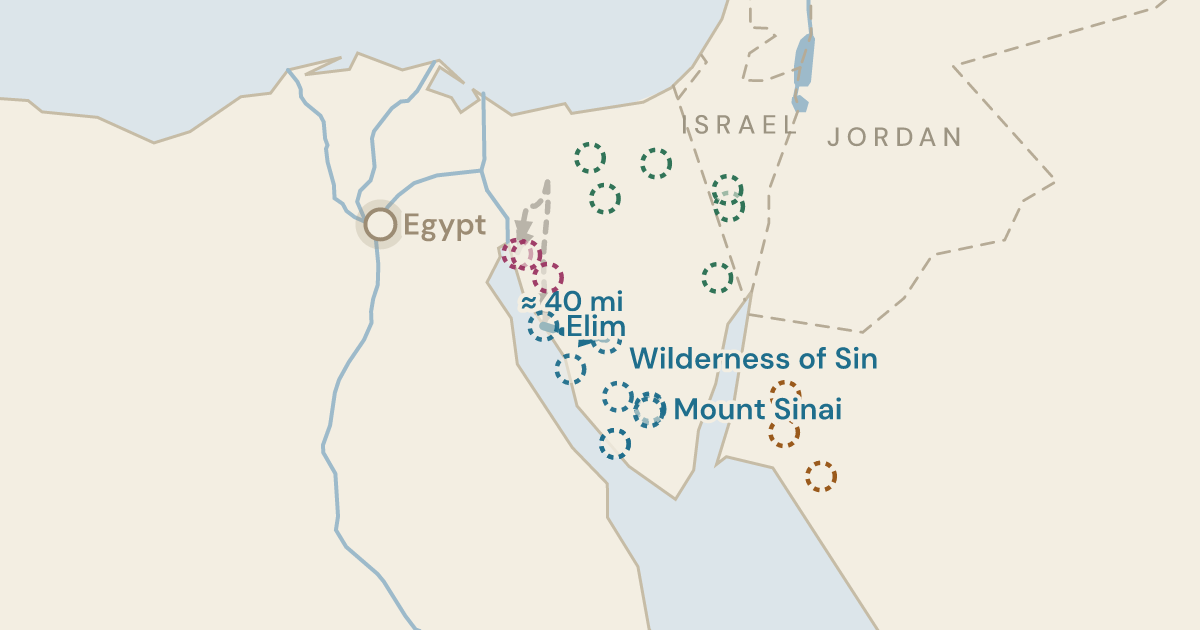
Exodus 16:1: Between Elim and Sinai — which places Sin only as well as it places Sinai
Read it →Commentary on Exodus 16:1
The verse fixes a place and a date. Israel is one month out of Egypt, camped in bare desert between the springs of Elim and Mount Sinai — and the place, the name and the date all explain what comes next: hunger, complaint, and bread from heaven.
The Stage Between Two Landmarks
Where Israel camped matters. The two place names on either side stand for two very different grounds.
Here we find Israel in a very marked and interesting position. It is still the wilderness, no doubt, but it is a most important stage of it: "between Elim and Sinai." Elim was the place where they had just tasted the refreshing springs of God's ministry. Sinai was the place where they came right off the ground of free and sovereign grace, and put themselves under a covenant of works. Here they are still the objects of the same grace that had brought them up out of the land of Egypt, and so God meets all their complaints at once with His supplies. When God acts in the display of His grace, there is no hindrance.
What Changed at Sinai
Up to this point, the story is about God's care for the people. From Sinai onward, it runs the other way.
Up till Sinai, it was what God was for them in His mercy and love. From that time, by their own act, the ground changed to what they were for God. This is the difference between grace and law, and it is what makes the journey between Elim and Sinai so full of interest. But whether under grace or law, the flesh remained the same, and took every opportunity to reveal its corrupt and incurable character.
A Desert Named for Thorns
The name of this desert carries its own meaning, and that meaning is a picture of the world the believer walks through.
Sin means "thorn," and a thorn is a failed attempt to bear fruit, which produces instead what is harmful and painful. In our Christian history too we find that the world through which we pass is a wilderness full of thorns, or in other words, "the sin which so easily ensnares us" (Heb. 12:1).
The Date Explains the Crisis
The fifteenth day of the second month is not a stray detail. It marks the point where the food they carried out of Egypt ran out.
By this time all that they could have brought out of Egypt had doubtless been eaten, and in the wilderness there was no visible source of supply. Sadly, the people were walking by sight. The wonders of the Passover night and the crossing of the Red Sea had happened within the month, yet they had forgotten the power of their God.
Another writer finds the same discovery in every believer: safe from judgment, but with the world now a desert.
It was a full month before the Israelites realised that although they had escaped the judgment, they had lost all Egypt's resources and its pleasures. For the believer in Christ the world becomes a barren desert. The wilderness lies before him, and he has yet to learn, with the Psalmist, that all his springs are in God. This discovery is painful and humbling. He humbled you and tested you (Deut. 8:2-3).
Where Murmuring Leads
Discontent does not stay still. Murmuring in this wilderness has a direction, and it has a cost.
May we learn that discontent and murmuring will soon land us in Sinai — take us out of the hands of God, and lead us to do the best we can for ourselves. How many a Christian is, in his own soul, "between Elim and Sinai"! He is doing the best he can for himself in this wilderness, because God has not satisfied him. But it cuts him off from fellowship with God. Complaining to God about His doings is not communion with Him.
God's Answer in This Place
God's answer to the murmuring is not a rebuke but bread. One writer reads that bread as Christ Himself.
And now how does God answer the murmurers? For forty years — the whole time of their wanderings in the wilderness — He gave them "manna." He puts Christ before us for the whole of our wilderness journey. Christ was always humbled, dependent and obedient. He was the only One who accepted everything in the wilderness path as from God His Father, without a single murmur. That is how God meets your murmuring and mine.
Summary
- Location. Israel camps between Elim, the place of God's refreshing springs, and Sinai, where they left free grace for a covenant of works.
- Footing. Before Sinai the question was what God is for His people. After Sinai, by their own choice, it became what they are for God. That is the line between grace and law.
- Name. "Sin" means "thorn" — a picture of a world that yields pain instead of fruit.
- Date. One month out of Egypt, the food they carried was gone and no supply was in sight. The discovery was humbling: all their springs were in God.
- Answer. Into that empty place God gave manna. It pictures Christ Himself — humbled, dependent, obedient, and never once murmuring.