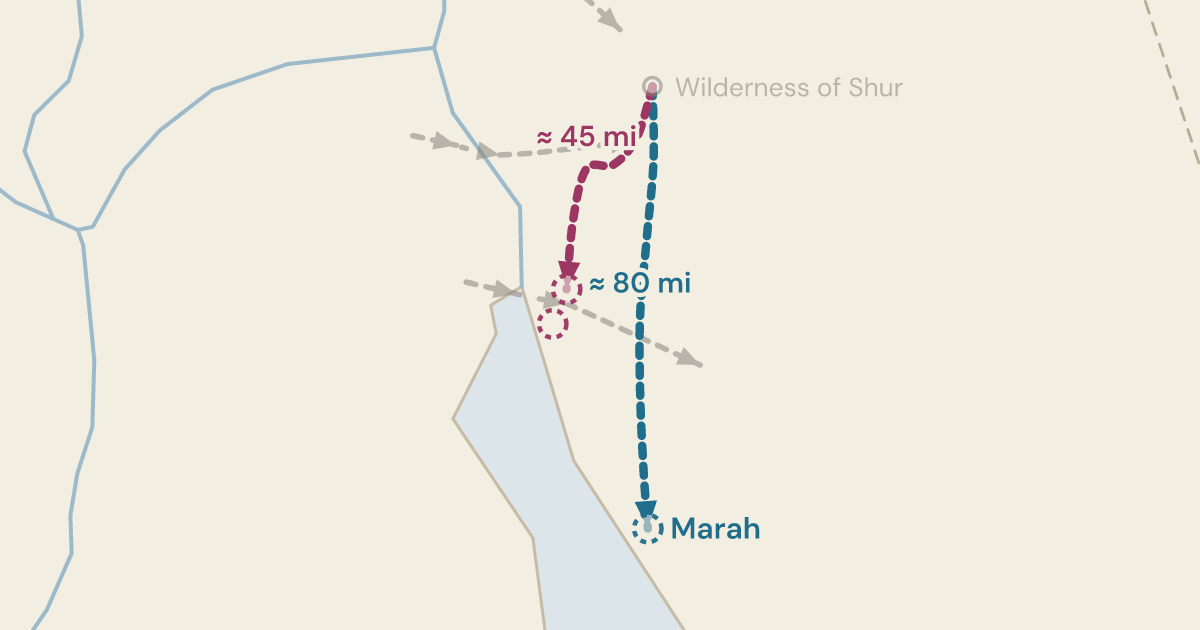
Exodus 15:23: The first water after the sea, and too bitter to drink
Read it →Commentary on Exodus 15:23
Israel has just come through the sea in triumph, and now they reach water they cannot drink — the place is named after the taste. Why did God lead a people He had just redeemed to a spring that could not refresh them?
The meaning of the name
The word "bitter" has appeared twice already in this story before it becomes the name of a place.
This is the third time the word "bitter" appears in this story. First the Egyptians made the lives of the Israelites bitter with hard slavery. That is recorded in chapter 1:14. Then in chapter 12:8 we read of the "bitter herbs" eaten with the Passover lamb. Now they find bitter water in the wilderness. This picture drives home the bitterness of sin. Sin enslaves people in bitter bondage. If we take the sacrifice of the Lamb of God as our own, we do so as people who must feel inwardly the bitterness of the judgement of death that it involves. In the world, which has now become a wilderness to us, bitterness still meets us. Water would normally speak of refreshment and life. But the world's water turns bitter to us, because its sweetest joys are spoiled by sin.
Why the water tasted that way
The taste had a physical cause, and one writer finds meaning in it.
The pools lie low by the shore, and the sea made the water salty then, as it still does. Notice that it is the sea itself that makes the bitterness of Marah. Now, if the sea stands for death, as we have seen, we can see how this shows the wilderness to be the place of death. It gives nothing for our thirst, and what is there only makes us thirstier. That is just what the wilderness is to us as a redeemed people. It is a place where the death we have passed through in Christ, as Israel passed through the sea, meets us and offers itself to our taste.
From song to complaint
Up to Marah, everything had gone in Israel's favour.
Up to this point everything seemed to be going smoothly for them. Heavy judgements fell on Egypt, but they left Israel untouched. The army of Egypt lay dead on the shore, while Israel stood in triumph. All this was well enough, but things soon changed. Songs of praise gave way to the sound of discontent.
What the desert is for
Israel was already redeemed when they reached Marah. So the hard road to Canaan, the land ahead of them, had another purpose.
It is the wilderness that tests how well we really know God and our own hearts... The discipline of the wilderness is needed. It is not there to give us a title to Canaan. It is there to make us know God and our own hearts, to bring us into the power of our relationship with Him, and to enlarge our capacity to enjoy Canaan when we get there.
Marah today
One writer names what the bitter pool looks like today.
A Christian learns the joy of God's salvation and sets out on the journey with a bright and eager step. Then trouble comes. Hard times set in. Business losses follow. Old friends grow cold. There is no work to be had, and his children have no bread. He finds something that seems to be the answer. It turns out to be "bitter water."... It is Marah for that soul.
Sometimes the trouble comes because of the new allegiance itself.
People sometimes think that those who turn to the Lord will have no more difficulties or troubles from then on. But it is not so. In fact, troubles often thicken around them for that very reason... These are hard experiences. They are the waters of Marah. They are so bitter that we could not drink them at all. We would only complain and be discontented if the tree were not at hand to cast into them.
The remedy God shows
God does not drain the pool or replace it. He heals it with a tree cast into the water.
What a beautiful picture this is of Him! In infinite grace He was cast into the bitter waters of death, so that those waters would yield nothing but sweetness to us for ever. We can truly say, "the bitterness of death is past," and nothing is left for us but the eternal sweetness of resurrection.
Summary
- Bitter. The name records the taste. The same word described Israel's slavery in Egypt and the herbs eaten with the Passover lamb. Now it names the water of a free people.
- Bitter because of the sea. The pools lay low by the shore, and the salt of the sea spoiled them. The death Israel had passed through met them again on the other side.
- Bitter enough to stop the song. Praise on the shore became discontent at the pool. The change showed what the singing had not.
- Bitter by design. The desert did not buy their title to Canaan. It was how they came to know God and their own hearts before they enjoyed the land.
- Bitter made sweet. God did not remove the pool; He changed it. It pictures the One cast into the waters of death, so that death now yields nothing but sweetness to us.