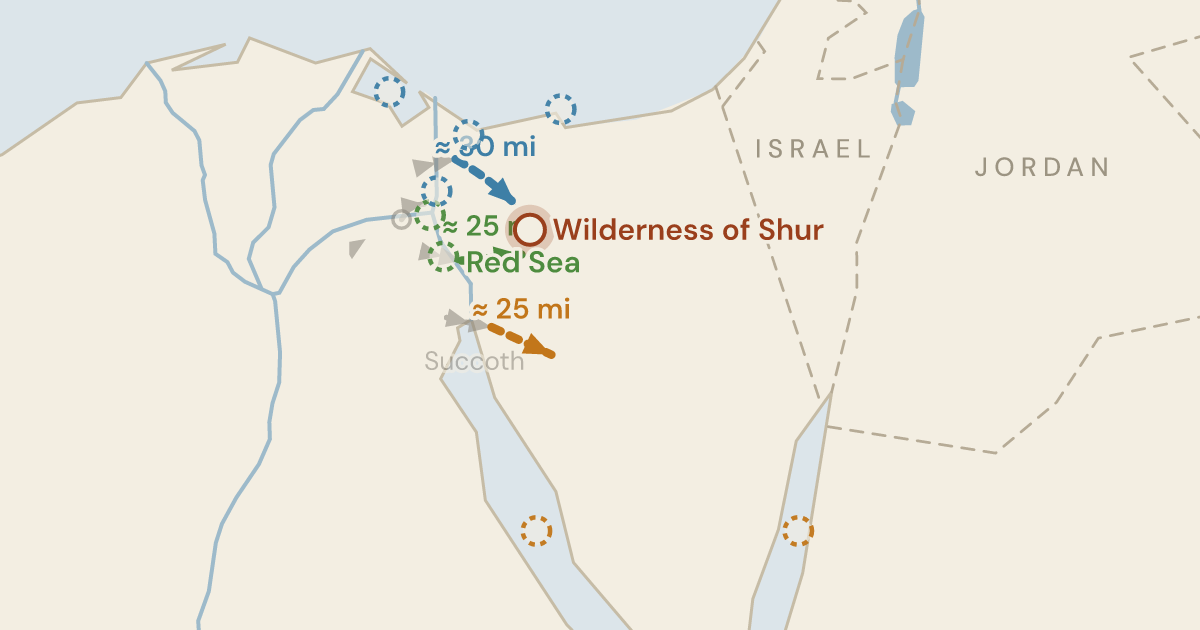
Exodus 15:22: Out of the sea into three days of wilderness, from whichever shore it was
Read it →Commentary on Exodus 15:22
Israel has just sung on the far shore of the Red Sea. The next thing recorded is a three-day march with nothing to drink. Why does God take a people He has just rescued into a place where they have nothing?
Redemption Opens Into a Desert
One writer separates what God has settled from how He deals with us on the road:
The work of redemption is perfect, so the wilderness is not necessary. The thief on the cross was fit to be with Christ in paradise, and so are we. God's purposes, as far as we are concerned, are redemption and the inheritance. The wilderness forms no part of them. But it does form part of God's ways. God tests us, so that we may know ourselves and know Him.
Led, Not Lost
Moses made Israel set out. The route was not their own idea, and the same pattern shows up later in the journey:
Their journeys were not planned by men. They were directed by God. Exodus 15:22 says, "Then Moses made Israel set out from the Red Sea, and they went into the wilderness of Shur." The same is said again later, when they left the wilderness of Sin: "All the congregation of the people of Israel moved on from the wilderness of Sin by stages, at the command (or mouth) of the LORD."
The desert takes its name from the land, and Israel did not walk into it unprepared:
A long wall of rock rises above the flatter ground near the sea. From it the desert they turned towards takes its name: the Wilderness of the Wall (Shur). There is no doubt that when they left the store city of Pithom they brought supplies of food with them, and of water too; a "three days' journey into the wilderness" had already been spoken of. Israel's way was to the Mount of God, so they journeyed south towards the Wilderness of Shur. They did not take the more direct road towards their promised land.
Three Days
The three days are not filler. One writer traces the phrase across Scripture:
The expression "three days" is always significant in Scripture. You can gather countless examples from a concordance. Very often the phrase goes with death. So here the three days mean the distance of death. In figure they had passed through death, and now they must learn it in practice. If God in His grace gives us a perfect standing before Him, and joins us with Christ in His death and resurrection, then all His ways with us aim to bring our practice into line with our new position.
Another writer adds the other side of it — resurrection — and what the journey settles for good:
The three days' journey is a fitting picture of exactly where the believer now stands: dead with Christ and risen with Him. Yes, the three days' journey, from death to resurrection, has separated you, my fellow traveller, for ever from Egypt, that is, the world.
Found No Water
The first joy of deliverance is real, but untested. Dry ground tests it:
Wilderness experience tests us. It shows how well we really know God, and how well we know our own hearts. Our Christian life opens with a freshness and a fullness of joy, and the sharp blast of the desert soon checks it. Then, unless we have a deep sense of what God is to us, above and beyond everything else, we are apt to break down and, in our hearts, turn back again into Egypt. We need the discipline of the wilderness. It does not give us a title to Canaan. It makes us acquainted with God and with our own hearts.
Empty Hands, Full Supply
Empty hands are where God's supply shows itself:
The wilderness shows us that we have no resource of our own at all. It also makes known the unfailing resources of divine power, grace and wisdom for every emergency of the wilderness path. If they had been able to get bread in the wilderness, there would have been no need to send bread from heaven. If they had found water, no one would have needed to bring water out of the rock. The fullness of divine resource met it all. But the needs of the wilderness do not measure God's provision; they only prompt it. God shows His power in meeting the need, and His grace in the overflowing abundance of His giving.
Summary
- Brought out. Redemption is finished and behind them. The desert ahead is not a sign that it failed. It is the road a redeemed people now walks.
- Brought by God. Moses made them set out, and every stage came at the LORD's command. God chose the empty place for them; they did not stumble into it.
- Brought through death. Three days is the distance of death. What was true for them at the sea must now become true in the way they live.
- Brought to nothing. No water is the test. It shows how much of God they know, and how much of Egypt still pulls at their hearts.
- Brought to supply. Lack does not set the size of God's giving. It only creates the occasion: bread from heaven, water from a rock.