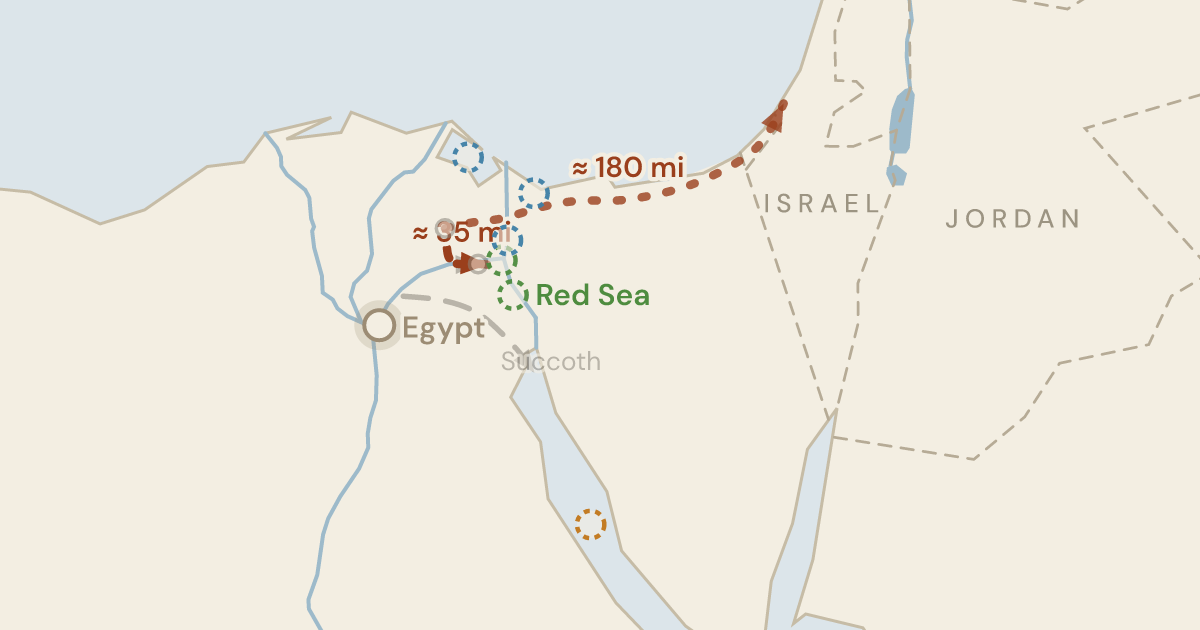
Exodus 13:18: The long way round, taken instead of the short road through Philistine country
Read it →Commentary on Exodus 13:18
Two roads ran from Egypt to Canaan, and God chose the longer one, turning His people back toward a sea they could not cross. Why would He take them the hard way, and why did they march out in ranks rather than flee like slaves?
God Chose the Road
The route was not an accident. God matched the path to the people who had to walk it.
If He leads His people out into the wilderness, He will undertake for them in every respect; He will expect nothing from them but obedience to His word. Notice, too, the tenderness He showed in choosing their path. He had regard for their weakness and timidity... it is sweet beyond words to notice that He determined the particular way by which He would lead them out of regard for their condition.
The same truth cuts both ways. What makes a road safe is that it is His road.
God chose their way for them, as He chooses the way for us. He was with His people, therefore He led them in His way. If His people are in His way He is with them and all is well. If we are not in His way He cannot be with us in the fullness of His power... He would not allow them to be tried beyond what they were able to bear.
What the Long Way Taught
The long road was a school. The short road could never have taught these lessons.
"The way of the wilderness" was a much longer route; but God had deep and varied lessons to teach His people, and they could only be learned in the desert... They could never have learned such precious lessons in "the way of the land of the Philistines." In that way they might have learned what war was, early in their career. But "in the way of the wilderness," they learned what flesh was, in all its crookedness, unbelief, and rebellion.
The same writer shows why God's ways with a believer can feel slow. The pace matches what the heart can bear to learn about itself.
The Christian, at the opening of his course, never knows his own heart; indeed, he could not bear the full knowledge of it; it would overwhelm him... But He graciously leads us by a roundabout route, so that our grasp of His grace may keep pace with our growing self-knowledge.
Turned Back Toward the Sea
The road did more than avoid the Philistines. It led into what looked like a trap: water ahead, desert around, Egypt behind.
There was a short path out of Egypt, by the way of the Philistines, with no sea to block them. Instead they are turned round by "the way of the wilderness of the Red Sea." In a new way they must learn deliverance from Egypt's rule, and out of its territory. They find themselves on the border of Egypt with the sea in front, the desert around, and all Egypt is poured out after them!
Shelter from judgment was not the whole story. The sea shows another side of the death of Christ.
In the deliverance of the Red Sea, we have a different aspect of the death of Christ. It is no longer that which merely shelters from judgment, but that which delivers from the power of the oppressor. Our Lord accomplishes this too. Through His death and resurrection He has opened the way for His people to pass out of slavery into the blessed liberty with which He makes them free.
Equipped for Battle
Israel did not stumble out of Egypt as a mob. One Hebrew word lies behind "equipped for battle", and its use elsewhere shows what it means.
The same word, chamushim, is translated "armed" where the Israelites crossed the Jordan. There they had plenty of time to arrange themselves in proper order... So the Israelites did not travel in disorder. The heads of each tribe would have control over it, and could arrange its march... It is clear that they marched in order. It was God who was bringing them out, and it would have been unworthy of Him to have them moving as a disorderly rabble.
Summary
- Chosen — God picked the road Himself. He measured it against His people's weakness and fear, not against the map.
- Spared — the near road meant war too soon. He would not have them tested beyond what they could bear. The detour was mercy, not delay.
- Schooled — the short way could have taught them what war is. Only the long way taught them their own hearts. God set the pace so their grasp of grace could keep up.
- Delivered — the road led to the sea on purpose. Shelter from judgment was one thing; the Red Sea broke Egypt's hold on them.
- Ordered — they left in ranks, not as a fleeing rabble. The God who was bringing them out would not have it otherwise.