Exodus 12:37: Six hundred thousand on foot, and the first stage of the road out of Egypt
Read it →Commentary on Exodus 12:37
The day after the Passover, Israel walked out of Egypt as a nation on the move. The verse names a starting point, a first stop, and a number. Each one says something about what God had just done.
From seventy to six hundred thousand
Jacob's family arrived in Egypt small enough to list by name. The size of the crowd leaving is the measure of what God had done in between.
We are given a list of sons and grandsons and told their number as 70. Exodus 12:37 shows the great increase that took place while they were in Egypt. It shows how God fulfilled His word about making them a great nation.
The figure here is a round one. A later count is more exact, and gives the size of the whole company.
Exodus 12:37 speaks of there being 600,000 men, besides children, at the exodus. Numbers 1:46 gives the number more exactly as 603,550 from twenty years old and upward who were able to go to war. That works out to a total of about two million men, women, and children, not counting the descendants of Levi.
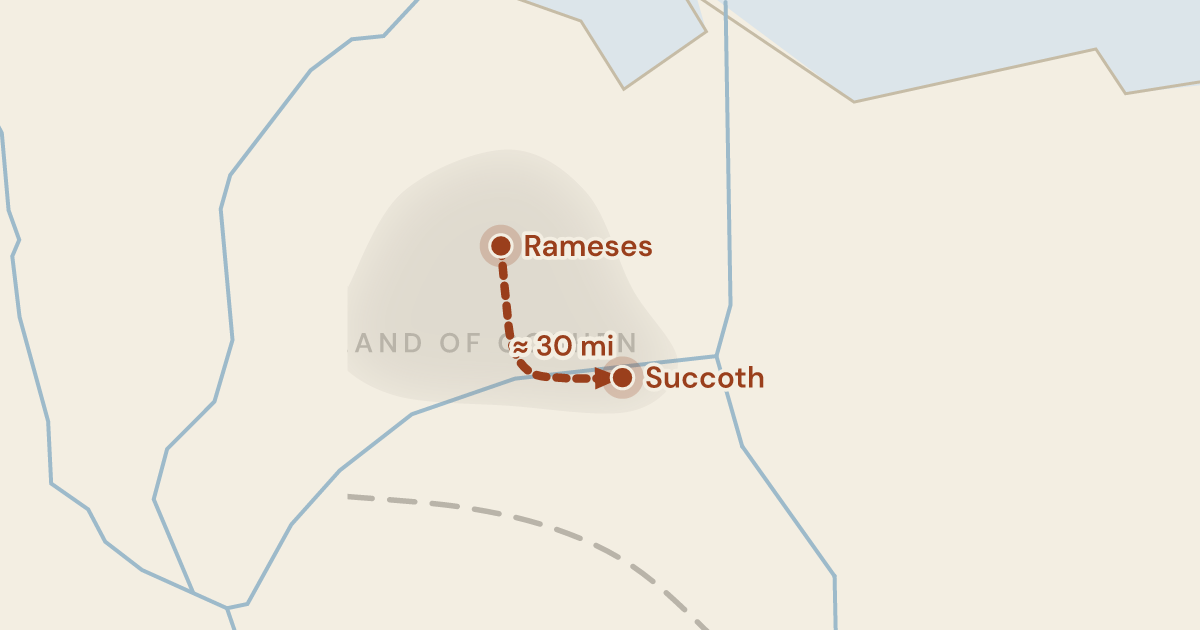
Rameses to Succoth
The two place names are not just map points. Their meanings mark the change of life that redemption brings.
From Rameses (city of the sun), the city of earthly splendour, they went to Succoth, which means "booths." Their character as pilgrims now comes out. The wilderness begins. Redemption by blood makes us pilgrims and strangers, for we are no longer of the world, though we are in it.
Another writer draws out the contrast between the two builders — one a king making a name for himself, the other a people living in tents.
Strikingly the first stage — all that is mentioned yet — is from Rameses to Succoth: from the king's city, built for the glory of his name, to the place of the "booths," or tents, that mark the wilderness.
Slaves turned into travellers
One line of text covers the emptying of a whole region of Egypt overnight.
An exodus was starting, the like of which had never been known. About 600,000 men, besides women and children, were now on the move. They were leaving the land of Goshen for ever, and changing their condition from slavery to freedom. Then all the flocks and herds of Israel moved too. Not a hoof was left behind. It was a migration unmatched before or since. To the Egyptians, when they woke up to it, what a change had taken place! Goshen was emptied. The taskmaster's job was gone.
Marching without weapons
The words "on foot" describe people carrying children, not weapons.
As the morning light dawns on Rameses, what do we see? Not a well-disciplined army able to meet its enemies, but six hundred thousand men on foot. They go out with no visible resources, burdened with the care of wives and little ones. May we not say, what a powerless, defenceless, easy prey they are to the wandering tribes of the desert? But no, dear reader; a blood-bought people, truly powerless in themselves, is going out — but not alone. The LORD was among His people.
Who was actually leading
Moses is named nowhere in this verse, and commentators note that the task was far beyond him.
Picture six hundred thousand men, besides women and children, springing into action to leave the country. The sight must have been astounding! There has been nothing else in all history like it. The responsibility for leading this company of over two million rested on Moses. Did he feel capable of it? Not at all. He felt helpless, but he knew that God's power was enough, and God had spoken clearly: He would deliver Israel.
The same writer, looking back on the full list of Israel's camping places, asks why the crowd held together at all.
It is amazing that God brought so huge a company, with their livestock and other possessions, through that long period of travel by the hand of one chosen leader! Why did they not scatter and go wherever each one pleased, as people normally would? The only answer is the overruling power of God.
Summary
- Promise. Seventy people went into Egypt; roughly two million came out. The number in this verse is God keeping His word to make them a great nation.
- Power. Slaves became a moving nation in a single night. Goshen stood empty, and not one animal stayed behind.
- Pilgrimage. They moved from Rameses, a city of earthly splendour, to Succoth, which means "booths." Redemption by blood makes a people strangers in the world they still live in.
- Powerlessness. Six hundred thousand on foot, burdened with wives and children, were an easy target — yet they did not go out alone.
- Preservation. Moses felt helpless before the task. That a company this size held together at all has one explanation — the overruling power of God.