Esther 1: A feast in Susa for an empire from India to Cush
Read it →Ahasuerus, the Persian king the Greeks called Xerxes, rules a hundred and twenty-seven provinces from India to Cush, and Esther 1 opens by naming the two ends of that reach. From his throne in Susa the citadel he feasts the army of Persia and Media for half a year, then the whole city for a week. When Queen Vashti refuses to be paraded before his guests, the seven princes of Persia and Media advise him to put her away by a law of the Persians and the Medes that cannot be repealed, and the decree goes out to every province in its own script.
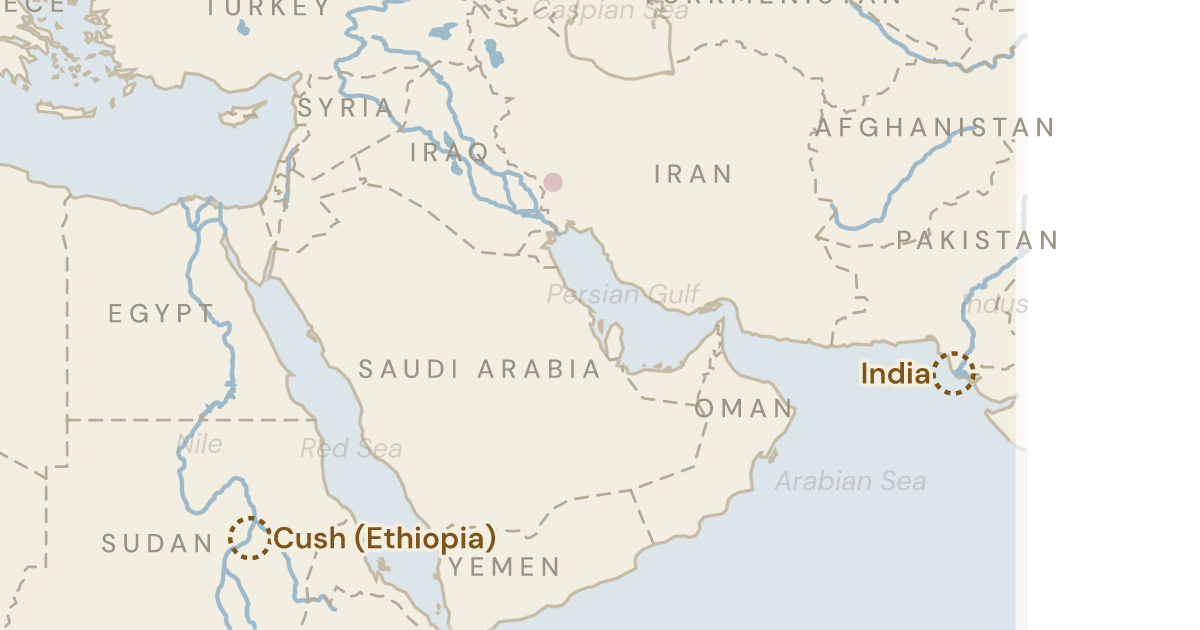
Regions on this map
Verses 2 and 5: the king's throne and the palace garden where the feasts are held.
The winter capital of the Persian kings, on the plain of Elam below the Zagros, and the stage for the whole book. The ESV's “Susa the citadel” is the fortified royal quarter on its mound, set apart from the city around it. All 500 votes put it at modern Shush, in Iran's Khuzestan.
Today: Shush, Khuzestan, Iran
Verses 3, 14, 18 and 19: the ruling people, whose army, princes and law the chapter names first.
The Persians' own country, Persis, on the plateau north-east of the Gulf: modern Fars, where Cyrus's Pasargadae and Darius's Persepolis stand. Esther names it with Media as the two peoples who rule the empire. The gazetteer files one point for it, at Ecbatana, because it reads the name as the Medo-Persian empire rather than the homeland; the outline is the homeland.
a country, not a site: the one point on record is Ecbatana, which the sources use for the Medo-Persian empire as a whole. The outline of Persis is editorial
Verses 3, 14, 18 and 19: named every time beside Persia, the second people of the empire.
The Medes' country in the north-western Zagros, around their old capital Ecbatana, now Hamadan. Cyrus took it into his empire, and Esther always names it beside Persia, as the junior partner whose law is bound with Persia's.
a country, not a site: the one point on record is Tell Hagmatana, Ecbatana's mound at Hamadan, which stands for the whole land. The outline is editorial
Verse 1: the two ends of the hundred and twenty-seven provinces, east and south.
The southern edge: Cush, the Nile kingdom above Egypt's southern border, which the ESV calls Ethiopia. It is not modern Ethiopia but northern Sudan, where Meroe was the capital.
a country, not a site: the one point on record is Meroe, the capital of Cush, standing for the whole kingdom
The eastern edge of the empire: not the subcontinent but the Indus valley, Darius's satrapy of Hindush in what is now Pakistan. Esther marks the reach of the king's rule by naming it as one end.
a country, not a site: the one point on record is on the lower Indus, standing for the whole satrapy
Esther 1, verse by verse
- Esther 1:1Now in the days of Ahasuerus, the Ahasuerus who reigned from to over 127 provinces,
- Esther 1:2in those days when King Ahasuerus sat on his royal throne in , the citadel,
- Esther 1:3in the third year of his reign he gave a feast for all his officials and servants. The army of and and the nobles and governors of the provinces were before him,
- Esther 1:5And when these days were completed, the king gave for all the people present in the citadel, both great and small, a feast lasting for seven days in the court of the garden of the king's palace.
- Esther 1:14the men next to him being Carshena, Shethar, Admatha, Tarshish, Meres, Marsena, and Memucan, the seven princes of and , who saw the king's face, and sat first in the kingdom):
- Esther 1:18This very day the noble women of and who have heard of the queen's behavior will say the same to all the king's officials, and there will be contempt and wrath in plenty.
- Esther 1:19If it please the king, let a royal order go out from him, and let it be written among the laws of the and the so that it may not be repealed, that Vashti is never again to come before King Ahasuerus. And let the king give her royal position to another who is better than she.