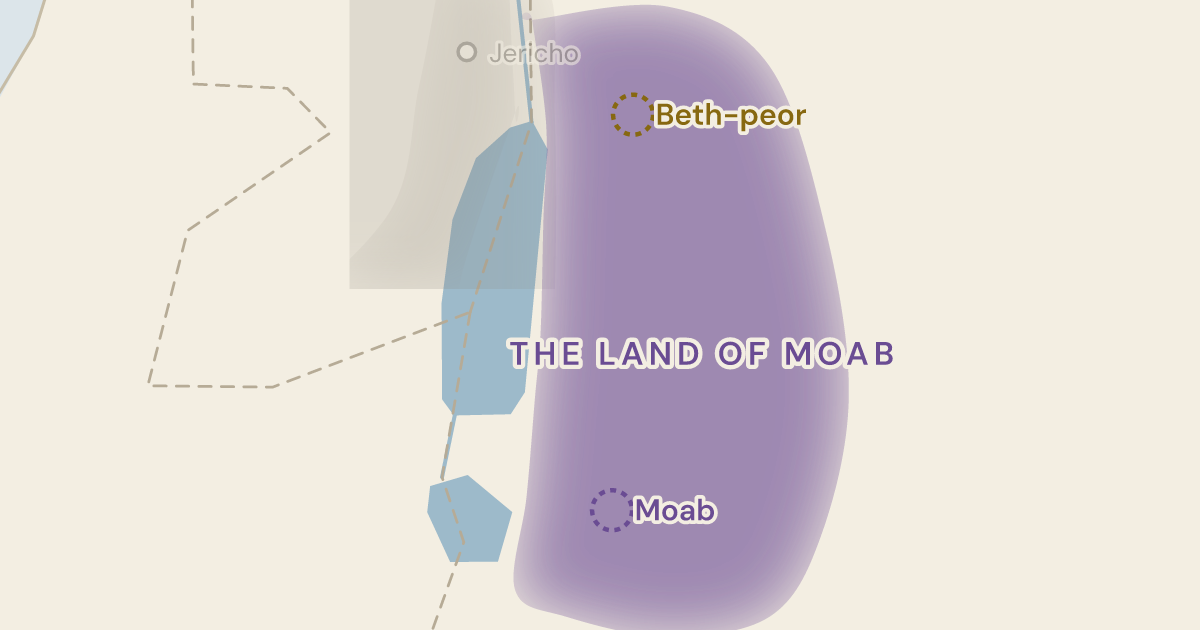
Deuteronomy 34:6: Buried in a valley in Moab, opposite Beth-peor, and nobody has found the place since
Read it →Commentary on Deuteronomy 34:6
Deuteronomy ends with a burial that no one attended. Israel's leader is laid in a valley in Moab, at a place God never revealed. Two questions press on every reader: why did God bury him personally, and why did He hide the grave?
God Himself at the graveside
Moses died alone on the mountain. The verse never names who buried him. The same "he" who told him to climb laid him in the ground. One writer shows how far this is from an ordinary funeral:
But did he die the death of all men? Did Moses die as a fool dies? No, it was the Lord Himself who put him to sleep; the dead may bury the dead, but the Lord buried Moses... He showed His care in another way, but He cared for the body of Moses as much as He had cared for the body of Enoch. They were to be equally children of the resurrection... The Lord Himself buried that body with the sure and certain purpose of raising it to glory.
Why the grave was hidden
A known tomb would have drawn crowds. One writer gives a reason for hiding it, and marks it as his own thought rather than something Scripture states:
Well, I suppose it was so that it should not become an object of superstition to the Jews, like the bronze serpent. We do not find that in the word, it is just my own mind about it. The Jews might have made pilgrimages to it. The Lord buried him, and "no man," etc.
The irony is sharp: the people who fought Moses while he lived would have worshipped him once he died.
As soon as he was dead, the same devil that stirred them up against Moses when he was alive — oh, what would he not have given for that dead body! The dead body would have been made a relic... So we can easily understand why it was that the Lord buried the body Himself.
What the New Testament adds — and what it withholds
Something happened at this grave before the burial, and only the New Testament records it:
Before the Lord buried him, there was this contention between Michael the archangel and the devil about Moses' dead body. Even if God allowed Satan to know the place, He stepped in so that Michael should guard that grave and block every effort of the devil to get hold of that dead body. So we have the two facts: what Jude tells us here, and the account in Deuteronomy 34 of the Lord burying Moses — which He never did for any other man.
That is where the record stops. Another writer warns against guessing past it:
We know absolutely nothing about how Michael reasoned with the devil about the body of Moses. Guesses have been endless, especially about the mysterious statement in Deuteronomy 34:6. But it is one of God's secrets, and no one can get inside it.
Government and grace meet at one grave
Moses died outside the land he had led Israel toward. One writer names the reason:
It was the government of God that, with stern decision, kept Moses out of the Promised land, much as he longed to enter it. He spoke rashly with his lips. He failed to glorify God in front of the people at the waters of Meribah.
Yet God's government was not the whole story:
But, as we have said, Moses was the subject of grace, as well as of government; and truly that grace shines with special brightness on the top of Pisgah. There God let His honoured servant stand in his Master's presence and, with clear eye, look out over the land of promise... and see it, not just as land Israel held, but as land God gave.
The lawgiver laid to rest
One writer sees a picture in the fact that God buried him:
Moses was the instrument through whom the law was given, and the Lord buried him. No doubt this hints that one day the Lord would put away the law, with its curse, as we learn in the New Testament.
The grave was not the end
The hidden valley is not the end of the story:
It is the Lord who buries Moses, and after a time He brings him out (as we have seen) in the glory of the Lord Jesus on the mount of transfiguration. We find there, not Joshua, the one who led Israel into the land, but Moses, the one to whom this was denied.
Summary
- Buried by God — the dead may bury the dead, but the Lord Himself laid Moses in the valley.
- Hidden by God — an unknown grave means no shrine, no pilgrimage, no relic to worship.
- Contested by Satan — Michael disputed with the devil over the body, and what happened beyond that stays God's secret.
- Governed by God — one rash word kept Moses out of the land; God's love does not cancel His government.
- Raised by God — the Lord who buried him brought him out again in glory on the mount of transfiguration.