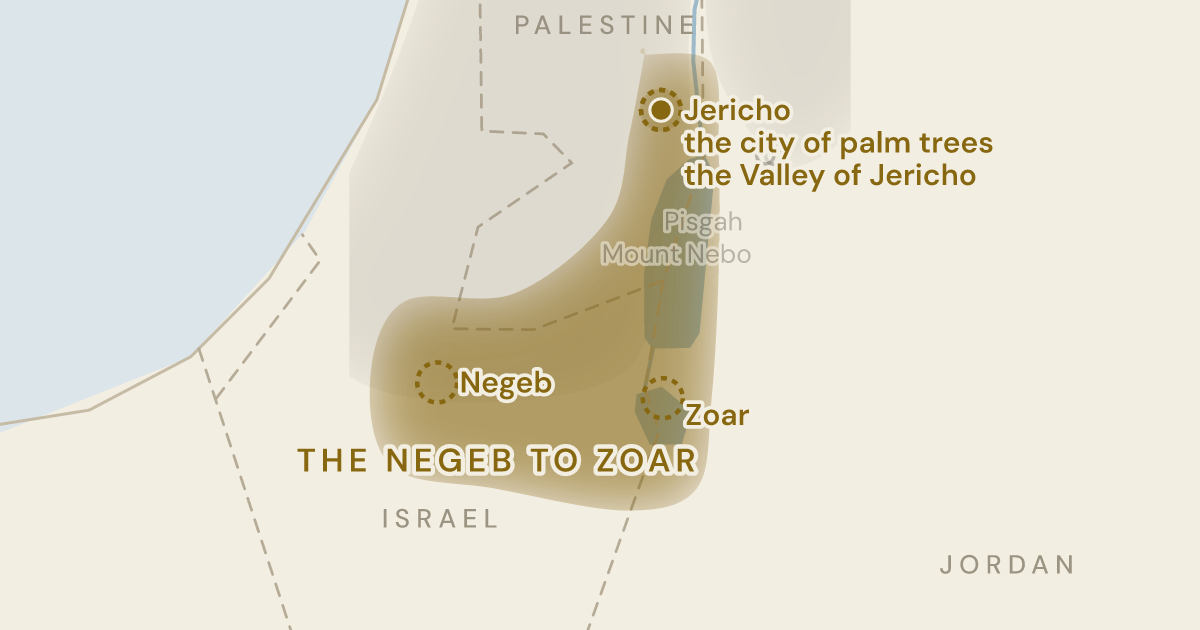
Deuteronomy 34:3: The view comes round to the south, and ends at the foot of the mountain he stands on
Read it →Commentary on Deuteronomy 34:3
Verse 3 closes the sweep of land God showed Moses from the top of Pisgah. The view drops to the south, then to the valley of Jericho with its palms, and ends at Zoar. Why walk a man through every corner of a land he was not allowed to enter?
A View No Eye Could Have Reached
The mountain's own name describes what happened on it.
Moses climbed to the top of Pisgah, which means "survey." There God showed him all the land of Gilead as far as Dan at the far north of the land... as far as the Western Sea (the Mediterranean). The south of the land was included too, and the plain of the valley of Jericho, which was much closer. All of this view would not normally be visible from that point, but God made it visible to Moses on this one occasion.
Seen From God's Side
God did not show Moses a land already fought over and half-won. He showed it as He had already assigned it, tribe by tribe.
It was part of His government to chasten his fault: His grace to Moses remained entire. Suppose Moses had entered the land — which the ways of God made impossible. What grief it would have been for him to see the unfaithfulness of His people, their slighting of His law, their imperfect conquest of the enemy, their readiness to turn back to wickedness and idolatry even in that land! Can that be compared with the blessedness of looking down on the land from beside the Lord? He did not see it in the hands of man, imperfectly rescued from the Canaanites. He saw God Himself already calling it the land of this tribe and of that, and so turning His servant's heart to the time when no Canaanite would be in the land.
Another writer weighs what Moses gained by this view.
Here indeed is "the goodness and severity of God." How wonderfully good of God, in patience and love, to point out to Moses the different parts of the land! He showed him all the east of Jordan and the northern lands, and moved on through the rest until He reached the south and the lands around the Dead Sea. Looking back, Moses would realise that it was much better to look over the land from Pisgah's heights with God than to tread the land on his own feet.
Why Jericho Is Called the City of Palm Trees
The verse gives Jericho a second name: the city of palm trees.
CITY OF PALM-TREES. A name given several times to Jericho because of the palms that grew there.
That tree carries a settled meaning in Scripture.
The palm tree is, in Scripture, the figure of the righteous, taking its name from the uprightness that makes the comparison so easy. Perhaps no point is more worth mentioning, says Dr. Howson, than the springiness of the palm's fibre, and its determined growth upward, even when loaded with weights.
Zoar, Where the View Ends
Zoar, the last place named, has a history of its own.
Zoar was one of the five cities of the plain in Canaan. It was the only one that survived when they fell under the judgement of God. It was formerly called BELA. Lot fled to it when Sodom was destroyed, but was afraid to stay there.
The Man on the Height, Alone With God
One man, one mountain, one companion — one writer reads the whole scene as a picture.
The earth no longer acknowledged Moses. Israel knew him no more. The whole wilderness lay behind him, and the Lord alone is his company on the hill that overlooked the land of promise. What an expression of the place of the church, or heavenly glory, the whole of this is! On high with the Lord, Moses looks down on the earthly inheritance. He sees the place of the tribes of Israel — Gilead and Dan, Naphtali, Ephraim and Manasseh, with all the land of Judah to the sea, the south too, and the valley of Jericho, with the city of palm trees as far as Zoar!
Not Our Own Position
Commentators differ on how closely the believer's standing matches Moses' on that mountain. One draws a sharp contrast.
Moses stood on Mount Pisgah and looked at the land he was not to enter with Israel. That is not the kind of view the Christian now gets of the glories of Christ and the heavenly land. Through grace we have the right to look at heaven and glory, not as at a distance from us, but as in them. We are not like Moses, who saw a better thing than he owned.
Summary
- Survey — Pisgah means "survey." The sweep from Dan down to the south, the Jericho valley and Zoar was more than any eye could take in. God made it visible.
- Gift — Moses saw the land not as Israel would wrestle it from the Canaanites, but as God was already parcelling it out tribe by tribe.
- Grace — One scene holds goodness and severity: God kept Moses out, then walked him through every region Himself.
- Palms — Jericho carries a second name here, the city of palm trees; the palm stands for the righteous, growing upward even under weight.
- Nearer — Moses viewed a better thing than he owned; the believer is not left gazing from a distance, but brought in.