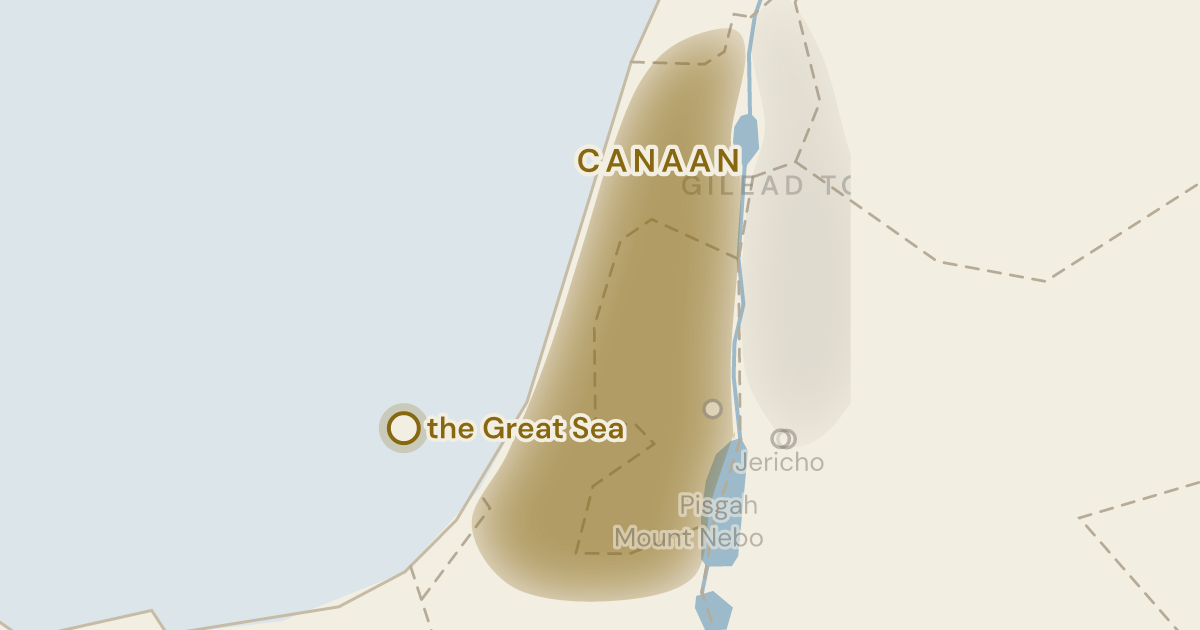
Deuteronomy 34:2: The view turns west, across the river he will not cross, to the sea
Read it →Commentary on Deuteronomy 34:2
Moses stands on Pisgah, and God walks him across the map tribe by tribe — Naphtali, Ephraim, Manasseh, Judah, out to the sea. None of it was conquered yet, so why show all of it to the one man God had barred from entering?
Land named before Israel won it
The sweep is wider than any eye could take in from one spot.
He went up to the top of Pisgah, which means "survey." There God showed him all the land of Gilead as far as Dan (v.1), at the far north of the land. He showed him all Naphtali, Ephraim and Manasseh and Judah, as far as the Western Sea (the Mediterranean). These were the possessions God had purposed for these tribes. Normally this whole view would not be visible from that point, but God made it visible to Moses on this one occasion.
Seen as God gives it, not as Israel took it
Canaanites still held these territories, yet God named them tribe by tribe.
God's own hand leads Moses to the top of Pisgah. From there he sees the land of promise in all its magnificence — not just as Israel later held it, but as God had given it from the start.
Had he gone in, the view would have been a poorer one.
God's ways made it impossible for Moses to enter the land. Had he entered, what grief it would have been to see the unfaithfulness of the people! He would have watched them make light of the law, leave the conquest of the enemy unfinished, and turn back to wickedness and idolatry even in that land. Can that compare with the blessedness of looking down on the land from beside the Lord? He did not see it in the hands of man, only half rescued from the Canaanites. Instead God Himself was already calling it the land of this tribe and of that, and so giving His servant's heart a view of the time when no Canaanite would be in the land.
Government kept him out; grace took him up
One rash speech kept Moses out of the land. Two dealings of God stand side by side here, and neither cancels the other.
It was grace that brought Moses to the top of Pisgah and showed him the land of Canaan from there. … It was better to see the land of Canaan in company with God than to enter it in company with Israel. And yet we must not forget that this rash speech kept Moses out of the land. God, in government, kept Moses out of Canaan. God, in grace, brought Moses up to Pisgah.
A lesson in how to read Scripture
How Moses looked at the land becomes a lesson in how to read the Bible.
Moses looked from Pisgah on the distant land. He would not have looked at it rightly unless he saw it as the inheritance of Israel, though at that time the Gentiles held it. As it stood then, it was the Amorite's land. In the counsels of God it was Immanuel's land. That is how Moses surveyed it, and that is how we should survey Scripture.
Our own place on the height
One writer turns the same view on the reader.
God did not let Moses go in. He does take him, however, to the top of Mount Pisgah, and there his eye can range over the whole territory. … All the inheritance of God's people is a future inheritance. But where do we find that inheritance described? Where do we see it spread out in all its beauty, fertility and perfection? In the precious Word of God. And so these Scriptures are our present inheritance. We can enter them now by faith and already enjoy the reality they unfold to us.
Another writer warns that admiring from a distance can take the place of entering.
There is often a great deal of looking from far off, a great deal of mere admiration — and it is not untrue admiration. The view from Pisgah captivates the heart. People see the land that the Lord our God cares for, the land His eyes rest on continually, but they do not enter it or live in it.
Summary
- Cause — One rash word shut Moses out of Canaan. God's government took its course even with His own servant.
- Gift — The same God walked him to the summit and showed him the land. Grace gave what government refused.
- Reach — Gilead, Dan, Naphtali, Ephraim, Manasseh, Judah, the sea. It was more than one eye could hold, and God made it visible for this one occasion.
- Title — God names the tribes before Israel wins a single field. Moses saw the land as God gave it, not as Israel would later hold it.
- Result — Faith reads Scripture from Pisgah and sees the inheritance as God describes it. The danger is admiring the view and never living in the land.