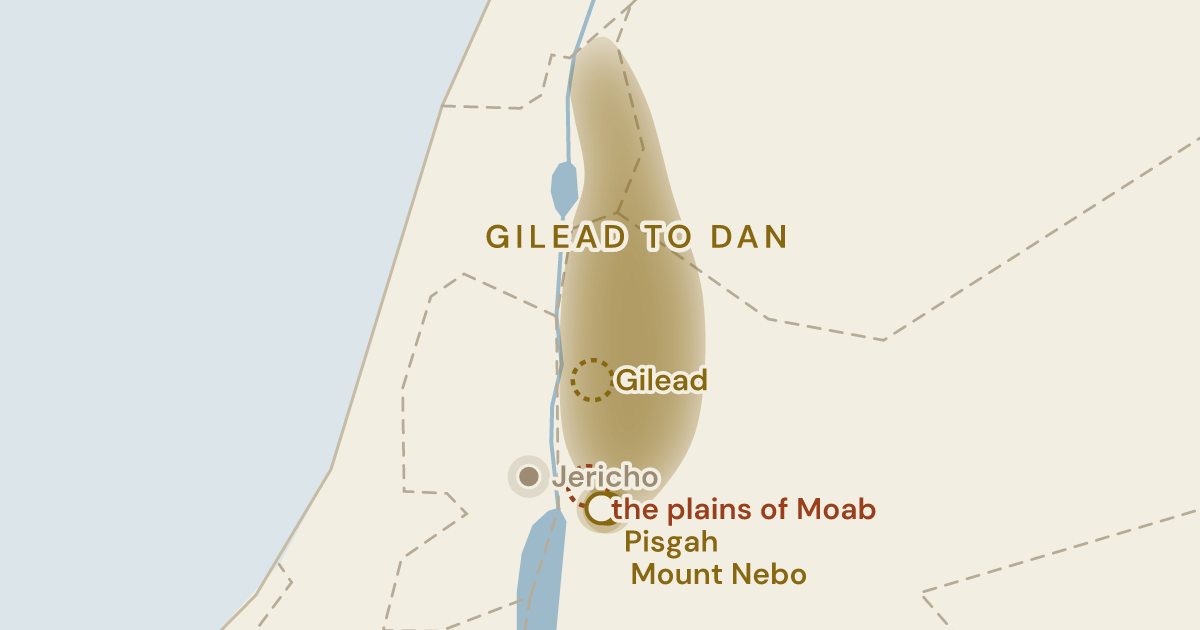
Deuteronomy 34:1: The last climb, and the land shown to him from Gilead to Dan
Read it →Commentary on Deuteronomy 34:1
Moses climbs away from the camp for the last time. Before he dies, he looks at a country he will never walk in. Two questions follow. Why did God keep Israel's leader out of the land? And why did He take such care to show him what He was refusing him?
Chosen place, directed eye
Moses did not pick his own lookout. God arranged the mountain, the climb and the sight itself.
The Lord Himself gave Moses the sight of the distant land, from the mountain the Lord Himself had led him to. Moses did not choose where to stand, and he did not direct his own eye. The Lord did it... Suppose Moses had stood on lower ground than Pisgah, where God had guided him. He would not have seen all the land. If God had not directed his eye Himself, he would not have told Gilead from Judah, or the city of palm trees from Zoar.
The name of the place fits what happened there. What Moses saw went past normal eyesight.
He went up to the top of Pisgah, which means "survey." There God showed him all the land of Gilead as far as Dan (v.1), at the far north of the land. God showed him all Naphtali, Ephraim and Manasseh, and Judah as far as the Western Sea (the Mediterranean)... All of this wide view would not normally be visible from that point, but God made it visible to Moses on this one occasion.
Why the leader stopped at the border
The work Moses was given had a limit built into it.
Looking at this loved and honoured man in his official role, it is very plain that it was not his part to lead the people of Israel into the promised land. The wilderness was his sphere of action... His ministry was tied to man's responsibility under law and to the government of God, so it could never lead the people into the enjoyment of the promise. That was left for his successor. Joshua, a picture of the risen Saviour, was God's chosen instrument to lead His people across the Jordan and plant them in the inheritance God gave them.
Kept out, yet given more
God upheld the law without loving Moses any less.
God could not pass over the fault of Moses without weakening the authority of law. There was righteousness in the ways of God, but this did not hinder in the smallest degree the perfectness of His love to Moses... Suppose Moses had entered the land — which the ways of God did not allow. What grief for him to see the unfaithfulness of God's people, their contempt for His law, their half-finished conquest of the enemy... Can that compare with the blessing of looking down on the land beside the LORD? He did not see it in the hands of man, half rescued from the Canaanites. Instead, God Himself was already calling it the land of this tribe and of that.
One writer sees a picture in the scene itself.
The earth had now stopped claiming Moses. Israel knew him no more. The wilderness was all behind him, and the Lord alone is his company on the hill that overlooked the land of promise. What an expression this whole scene is of the place of the church, of heavenly glory! On high with the Lord, Moses looks down on the earthly inheritance: the place of the tribes of Israel, Gilead and Dan, Naphtali, Ephraim and Manasseh, with all the land of Judah to the sea.
The warning carried in one word
What cost Moses the land was small. That is why it is worth weighing.
Let us remember that it was a little thing, an unadvised word that occasioned to Moses the loss of Canaan. And let us remember too that the New Testament presses the governing of the tongue on us more than almost anything else. "By your words you will be justified, and by your words you will be condemned." (Matt. 12:37.) Seeking to exalt ourselves is rebellion against God.
Beyond Nebo
Centuries later Moses stands inside the land after all — and his attention is elsewhere.
His government could not allow Moses to enter the land, but His grace let him see it all — a sight entering the land would never have given him, and one no Israelite who entered would see. More than this, the New Testament shows Moses in the land (Matt. 17:1-3). His interest is not fixed on the land at all. It is fixed on the Lord Jesus, transfigured before his eyes.
Summary
- Cause. One hasty word at the waters of strife closed the Jordan to Moses. God's government spares no one, not even His most honoured servant.
- Gift. The God who refused him the land led him up the mountain and showed it to him. Grace ran alongside government; it did not cancel it.
- Reach. From Pisgah, whose name means "survey," Moses saw more than any eye could take in on its own, and more than any Israelite who crossed over would see.
- Result. He saw the land as God gives it, not as men would half-conquer it — a better sight than his feet could have found.
- End. Nebo was not the last word. The man kept out of Canaan stands in the land at last, on the mountain with the transfigured Christ.