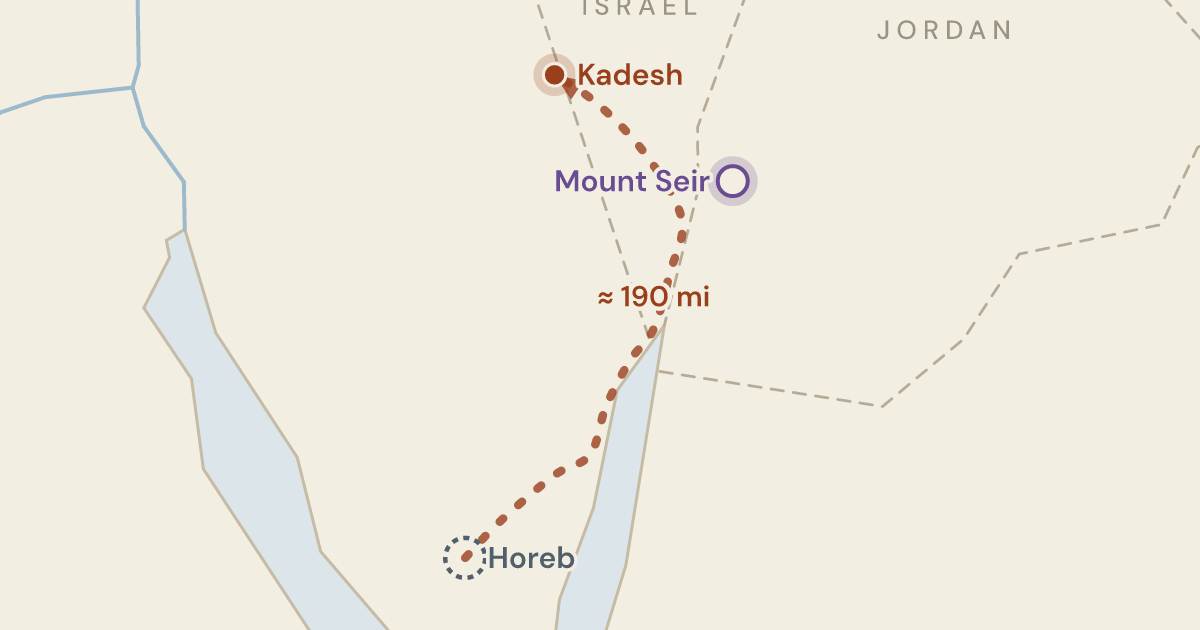
Deuteronomy 1:2: An eleven days' walk, stated at the start of a book about a forty-year one
Read it →Commentary on Deuteronomy 1:2
Moses opens his final speeches with a note about distance. Horeb to Kadesh-barnea, at the southern edge of the promised land, is an eleven-day walk. The people listening to him had taken forty years, and that gap is the point of the verse.
Eleven Days, Forty Years
The verse breaks into the introduction with a travel measurement. Readers have long felt the sting in it.
We would call the reader's attention to verse 2. It is certainly a very remarkable parenthesis. "It is eleven days' journey from Horeb by the way of Mount Seir to Kadesh-barnea." Eleven days! And yet it took them forty years! How was this? Alas! we need not travel far for the answer. It is only too like ourselves. How slowly we get over the ground! What windings and turnings! How often we have to go back and travel over the same ground again and again. We are slow travellers, because we are slow learners. We may feel inclined to wonder how Israel could take forty years to finish a journey of eleven days. But we have much more reason to wonder at ourselves. Like them, we are held back by our unbelief and slowness of heart. But there is far less excuse for us than for them, since our privileges are so much higher.
after-note: DELETE
Why the Eleven Days Became Forty
Kadesh-barnea was where the order came to go in, and where the people said no.
It was when Israel was in Kadesh Barnea that God told them to enter the land of Canaan and Israel refused (Num. 13:26). So this Scripture makes a point: if Israel had obeyed the Lord, they might have entered the land only eleven days after leaving Mount Horeb. Because they disobeyed, the time stretched to about forty years... This tells believers today that our wilderness history does not have to be long. But we are selfish by nature, so God has to put us through the trial of hard circumstances. That is how we learn that obedience is the only way of blessing.
The Wandering Was Never the Plan
The delay belongs to Israel's record, not to God's intention for them.
God's purpose then was to bring them out and to bring them in... Their sad forty years' aimless wandering in the wilderness was no part of God's purpose. Wilderness testing comes in as part of God's ways and His dealings with us. It is there so that we may learn what we are, and learn His grace and goodness... But His purpose for Israel was to bring them out of Egypt and bring them into Canaan, for He had set His heart upon them. Little more than an eleven days' journey would have been enough for this, if they had truly been set on going in.
Starting the Story at Horeb
Moses begins his review at Horeb, the mountain where the law was given. One writer sees meaning in that choice.
The purpose of the statement, "It is eleven days' journey from Horeb by the way of Mount Seir to Kadesh-barnea," is obvious. It is a silent comment on the twisting path we make for ourselves. Undoubtedly other thoughts are present too. In his review, Moses rightly begins with Horeb. There the people had put themselves under a legal covenant. We may say this accounts for the character of much of their later journey.
The Name and the Promise
The destination's name carries its own commentary. Behind the whole journey stood an older promise, and one writer shows how Israel was to take hold of it.
"From Horeb to Kadesh-barnea" (the "sanctuary of the wanderer") is the first stage of the journey as Moses tells it. It is a history of unbelief and rebellion. That history serves only to show how useless it is to oppose the power of God. But first we have the land set before them... according to the promise to their fathers... as the last passage shows, God would fulfil this promise to them in stages, as they had faith to lay hold of it and make it their own — and they had not faith. Yet grace will not be defeated in the end, and the promise will not be left unfulfilled. The same is true of the better promise of a heavenly land, which we are told to make ours now — and how little we do.
Patience in the Delay
If the forty years expose the learner, they also reveal something about the Teacher.
It is very humbling to be so slow in learning. But it is very gracious of Him to take such pains with us, to make us sure. We have to bless Him for His way of teaching, as for everything else. We bless Him for the wonderful patience with which He sits down with us over the same lesson, again and again, so that we may learn it well.
Summary
- Distance — Horeb to Kadesh-barnea is an eleven-day walk. The verse states it, and the forty years lose every excuse.
- Refusal — the delay traces to one moment at Kadesh-barnea, where God said go up and the people would not.
- Detour — the wandering formed no part of God's purpose, which was to bring them out and bring them in.
- Name — Kadesh-barnea, the "sanctuary of the wanderer" — God's holiness and Israel's straying in one place-name.
- Patience — the slow road humbles the traveller, yet grace is not defeated. The Teacher sits down over the same lesson until we learn it.