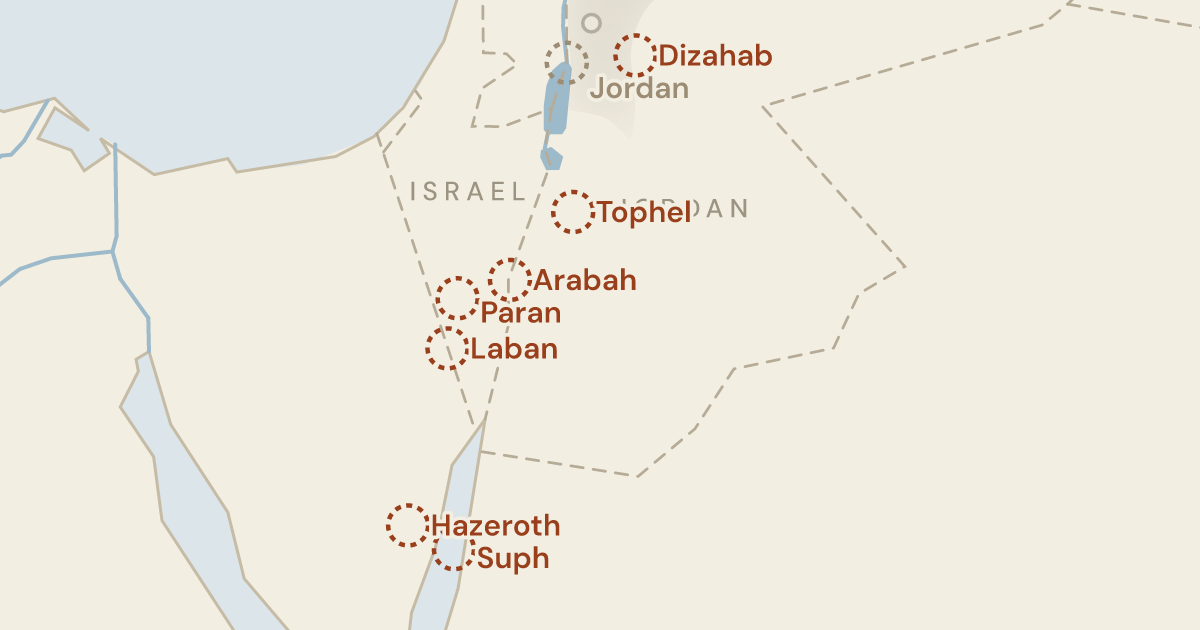
Deuteronomy 1:1: Where the last speeches were given, fixed by six landmarks nobody can agree on
Read it →Commentary on Deuteronomy 1:1
Israel is camped east of the Jordan. Forty years of wandering lie behind them, and the promised land lies just across the river. The opening line of Deuteronomy fixes who is speaking, to whom, and where. Everything in the book flows from that setting: a nation about to enter the land, and a string of place names that map the past.
Whose Words
The very first phrase sets this book apart from the books before it. There the refrain is that the LORD spoke to Moses. Here the words are Moses' own.
What marks this book out is its opening sentences. They make Moses' words the subject: no longer the LORD's words through him, and not, strictly speaking, the law itself, but Moses explaining the law and pressing it home. All this sits in a frame of circumstances that set it off and impress you with its importance.
That does not make the book any less the word of God. Deuteronomy itself forbids adding to or taking from what Moses commands:
So in Deuteronomy we find, "These are the words that Moses spoke to all Israel" (Deut. 1:1), and then, "You shall not add to the word that I command you, nor take from it, that you may keep the commandments of the LORD your God that I command you" (Deut. 4:2). Is it true? If so, the commandments in the last four books are the word of God, and so is the history — the two cannot be separated. If not, there is no revelation in the Pentateuch at all. The whole must stand or fall together.
Not The Law Repeated
The book's Greek name suggests a repeat. One writer warns against reading it that way:
True, the Greek title of the book means the law a second time. That might seem to suggest it is only a recap of what has gone before. But we may be sure it is not. Indeed it would be a very grave mistake to think so. The book has its own specific place. Its scope and object are as distinct as possible. The great lesson it teaches from first to last is obedience. Not obedience in the bare letter, but obedience in the spirit of love and fear.
The tone matches the moment. One writer describes the change of voice this brings:
It is rather a talk given by the lawgiver, before the whole nation gathered to hear him. It deals with their past history — their travels, fortunes, and conduct — as well as with their laws, ordinances, and hopes. It is full of affectionate appeal, earnest encouragement, and holy, serious warning. You hear the father speaking rather than the lawgiver, urging as well as directing the people in the way of obedience and blessing.
To All Israel
The address is to the nation as a whole, and that shapes the book.
The book urges obedience again and again, and the spirit of it in the heart. So it speaks directly to the people as a whole, about the land they hold and the responsibility that goes with it. Teaching by types and pictures is less common here; moral teaching fills the book, with prophecy too, mostly at the close.
The Map Of Places
The verse pins down the location with unusual care.
The inspired writer takes care to give us, in the most exact way, all the bearings of the place where these words were spoken in the hearing of the people. Israel had not yet crossed the Jordan. They were right beside it, opposite the Red Sea, where God had displayed His mighty power so gloriously nearly forty years before. The account describes the whole position in such detail that we see how fully God entered into everything that concerned His people. He was interested in all their movements and in all their ways. He kept a faithful record of all their camping places.
(Where the ESV reads "opposite Suph," older translations read "over against the Red Sea.") Commentators are cautious about the other names. One notes that they cannot be stops on the road from Sinai, even though two match known camping places and two more resemble them; in the end, little can be said about them for certain.
Which Side Of The Jordan
Some have used the phrase "beyond the Jordan" to argue Moses could not have written the book. That argument rests on the translation:
The English translation here is grammatically fine. The Hebrew word can rightly be translated "on this side" or "on that side." By itself it settles nothing about whether the place is east or west of the Jordan… So anything built on the meaning of this word, to discredit Moses as the real writer of Deuteronomy, must fall to the ground.
Summary
- Words — the book gives Moses' own addresses rather than fresh law dictated to him. Yet Deuteronomy 4:2 treats them as commands no one may add to or cut down.
- Speaker — Moses speaks as a father, not just as a lawgiver, appealing and encouraging as well as directing.
- Audience — "all Israel" hears it, so the whole nation carries the responsibility to obey in the land.
- Place — the detailed geography is not filler. It shows a God who kept a faithful record of every camping place.
- Purpose — not the law a second time, but obedience pressed home in the spirit of love and fear.