After he had buried his father, Joseph returned to Egypt with his brothers and all who had gone up with him to bury his father.
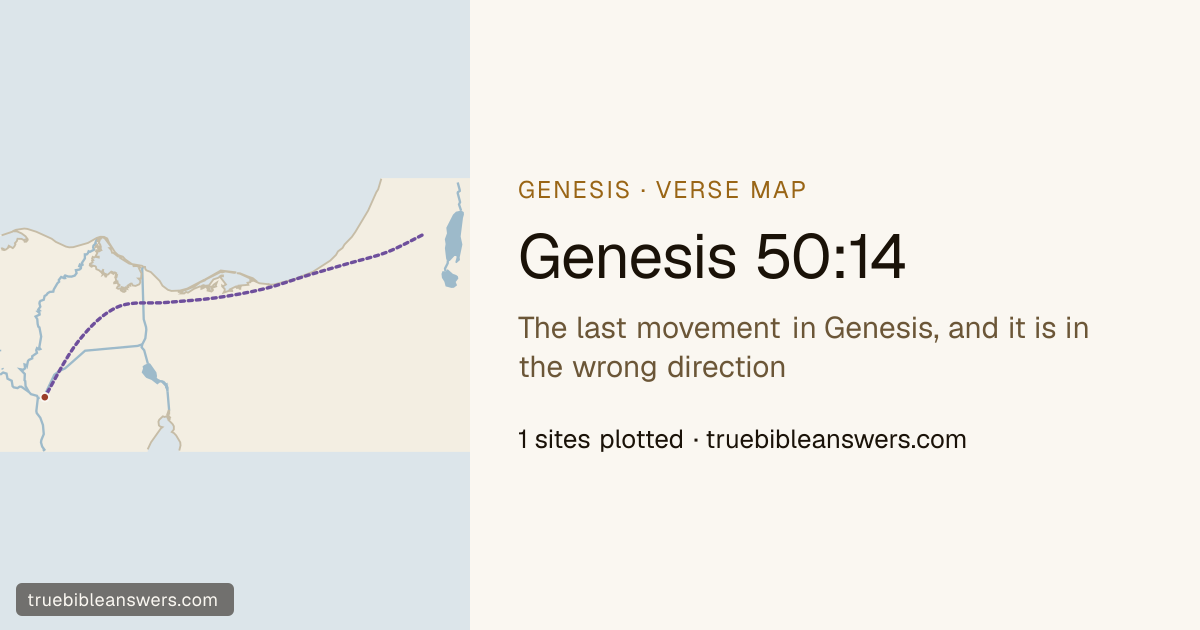 Open map →The last movement in Genesis, and it is in the wrong directionGenesis 50:14 · 1 place plotted
The burial in Canaan is over, and the whole company turns back to Egypt. This verse closes Jacob's funeral and sets Joseph down again in the land where one last test waited for him.
A promise carried out
Joseph's journey started with an oath taken at his father's bedside. Carrying it out weighed on him, high as he stood in Egypt.
J. G. BellettJacob, his father, when dying, had made him swear that he would bury him in the land of Canaan. When Joseph comes to act on his oath, he seems to me to feel this, that he was about to venture on a serious and risky matter. He clearly sets himself to a business which had its special difficulties. He was high at court, and the strength and wealth of Egypt were under his hand. But still he hesitates about burying his father in Canaan, and gets Pharaoh's close relatives to speak for him.
Why would so small an errand carry any weight? Because of what Canaan and Egypt each stood for.
J. G. BellettWas it not a small thing for so great a man to do? Yes; but asking to be buried in Canaan was, in some sense, putting a reproach on Egypt. It seemed to say, after all, that the Canaan of poverty and low esteem was better than the Egypt of honour and wealth.
The grave that marked them out
The funeral showed Joseph at the height of his influence. The grave told a different story about his family.
F. B. HoleJacob's funeral showed the extraordinary place of power and influence Joseph had reached. Pharaoh readily gave his permission. All Jacob's sons joined Joseph in it, and so did many important people of Egypt. It was recognised in Canaan as a great mourning of the Egyptians. Even so, his body was laid in the grave that bore witness that these men of faith were still strangers and pilgrims.
How far the Egyptians came
Everyone who had gone up with Joseph came back with him. So how far into the land did the Egyptian escort travel?
J. N. DarbyThey went to Atad, and Joseph went on to Canaan. "Beyond the Jordan" can only be understood according to the standpoint of the writer. Verse 13 would show, I think, that Jacob's sons carried him and buried him in Machpelah. That was not Atad, and not all the people of verse 9 went over.
Living in Egypt, belonging elsewhere
Joseph goes back to his post and dies there. Yet he arranged for his bones to leave.
William KellyHe had been exalted in Egypt. Yet he made the sons of Israel swear a solemn oath: when God visits them, as He surely will, they will carry up his bones from there. He had served God in Egypt, but to him it was always the strange land. He lived there, ruled there, had a family there, and died there at a hundred and ten years old, fuller of honours than of years. Still, he feels that Egypt is not the land of God. He knows that He will redeem His people from it and bring them into Canaan… Earthly honours did not settle him down in Egypt.
What waited for him back home
Joseph came home to brothers who had never opened their hearts to him.
W. T. P. WolstonSeventeen years have gone by… Joseph's brothers lived in Goshen. He had lavished his love on them, but after all they did not know his heart… There had not been any real confession on their side. No wonder they were not perfectly at ease. They thought it was all right as long as their father lived, but when he passed away matters had to be settled.
Their message put Joseph on trial.
F. B. HoleBack in Egypt, one last test confronted Joseph. His brothers sent him a message which showed that they had never quite trusted his generous attitude towards them. They felt it was too good to be really true, and suspected it was a kindness put on for the sake of his old father, Jacob.
Going back in heart
One writer reads the road from Egypt to Hebron as a picture of the heart's own journey.
F. A. HughesAtad means "a thorn bush," and they reached the place as they journeyed from Egypt to Hebron. As we move in our affections along the path from man's world to the sphere of divine purpose, do we not need to face the exercise of Atad's threshing floor? We need to realise how frail the flesh is, and how unsuited it is to the presence of God. … There would be less "returning to Egypt," either in mind or in ways, and a deeper appreciation of what Hebron stands for.
Summary
- Oath. Joseph treated his father's dying wish as serious and risky. He carried it out from the top of Egypt's court.
- Grave. Burying Jacob in Canaan put a quiet reproach on Egypt. The tomb marked these men as strangers and pilgrims.
- Return. Joseph went back and stayed. Egypt was always the strange land to him, and its honours never settled him there.
- Test. One last trial waited in Egypt. His brothers suspected his kindness was only a show for their father.
- Warning. The heart can return to Egypt too. Face Atad's threshing floor, and what Hebron stands for grows dearer.