So Israel took his journey with all that he had and came to Beersheba, and offered sacrifices to the God of his father Isaac.
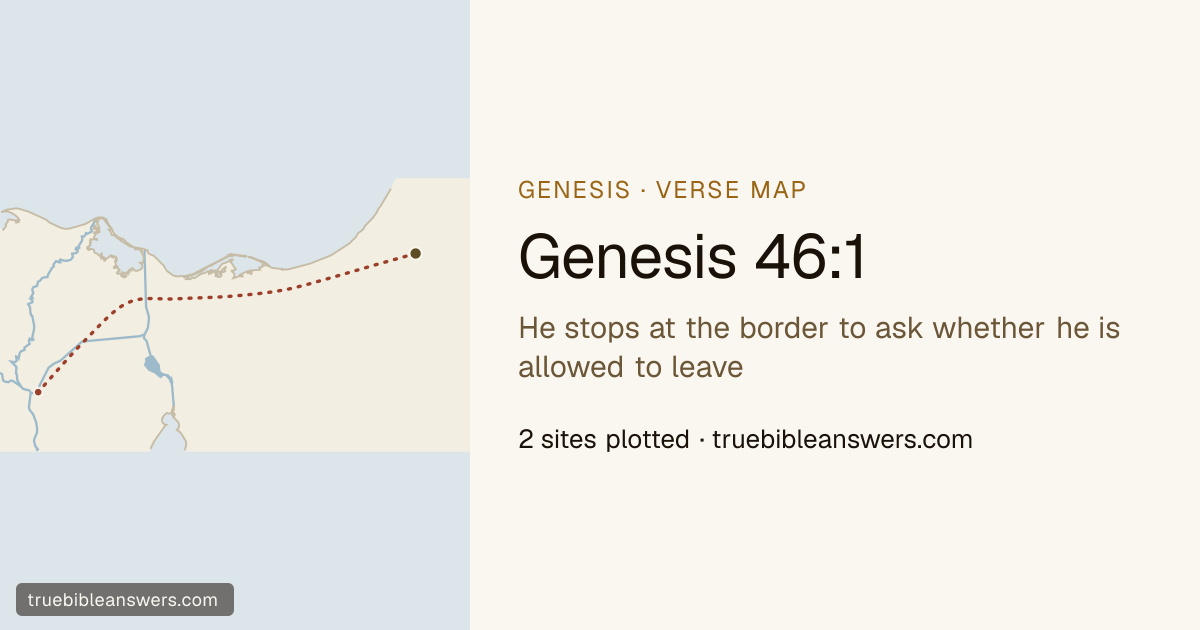 Open map →He stops at the border to ask whether he is allowed to leaveGenesis 46:1 · 2 places plotted
Joseph is alive in Egypt, and the old man sets out with everything he owns — but he does not head straight for the border. He stops at Beersheba, the last town in the south, and offers sacrifices to the God his father Isaac had worshipped.
The name that opens the verse
The record does not call him Jacob here. Commentators note that the name changes with the man. His heart had failed through unbelief. Then his faith revived — and the man who acts on it is called Israel.
F. B. HoleThe way in which Jacob's new name of Israel is introduced in the record is worthy of note. Jacob's heart had fainted because of unbelief, and then his spirit revived. But when his faith had revived, it is Israel who said, "It is enough." Again, at the start of Genesis 46 the faith in his heart turns into action. It is Israel who gathers his possessions together and sets out, stopping at Beersheba to sacrifice to the God of his father Isaac. In all this he was acting in a way that suited his new name, "Prince of God," better than his old one, "Supplanter."
Why he stopped at all
He had set out for Egypt at once, on natural feeling alone. The stop shows a different mind at work in him.
J. G. BellettNature had acted in Jacob at Mamre, as soon as he believed the report about Joseph, and set him at once on the road to Egypt. But now his spiritual senses have woken up, and they are challenging what nature had decided and how it acts. This is very common. The believer now feels a holding back where the father had felt none. Jacob had not talked with the Lord about this journey when he set out. But the mind of Christ in him, his conscience in the Holy Spirit, so to speak, is now taking the lead. It goes back over what nature had judged, and weighs it in the light of the Lord.
Something came back to him at that spot — a word God had once spoken to his father.
J. G. BellettMany years before this the Lord had said to Isaac, "Do not go down to Egypt" (Gen. 26:2). He said it to Isaac in a time of famine, like this one. Jacob remembers this as soon as he reaches Beersheba. That was the last place in the south of the land, on the road to Egypt. From there he could look out over the very country Isaac had been warned not to enter.
The place and its name
Beersheba was not a random stopping point. Its name carried the memory of what God had sworn.
L. M. GrantOn his way he stopped at Beersheba, which means "the well of the oath." The name shows that he remembered the promise of God he was leaning on. It is good to see him offering sacrifices there.
It also held his own history, including the worst of it.
G C WillisHere Jacob had deceived his father and stolen his brother's blessing. But now he offered sacrifices to the God of his father Isaac. Now he knew God's only way to deal with sin. He remembered his cheating, his faults and his sorrows. But at Beersheba he remembered even more deeply that through a sacrifice God could be merciful, righteous and kind. He knew God's grace; and that the God who was for him in the past, would be for him in the future.
The sacrifices themselves
Scripture does not say what animals he brought. But the plural word tells us something, and so does the timing.
C E StuartWe are not told how many sacrifices he offered, or what kind. Clearly he did not give with a stingy hand, for he must have killed more than one animal that night. Yet, though blood flowed freely, it seems he brought no drink-offering on that occasion. He sacrificed at Beersheba before God spoke to him; he raised up the pillar at Bethel after God had appeared to him.
So the sacrifices trace back to a change inside him.
J. G. BellettAll this accounts to me for Jacob's sacrifices at Beersheba to the God of his father Isaac. And all this has great moral meaning in it. It was a mighty stir in Jacob's soul, and it was very acceptable to the Lord... This waking up in Jacob pleased the Lord so much that He came to him at once with words of comfort.
Leaving to arrive
The verse begins with movement, and the movement costs something.
Hamilton SmithTo reach Joseph, Israel had to make the journey (Gen. 46:1). He had to leave behind everything he naturally loved. And so with ourselves, if we are to reach Christ where He is, we must forget the things that are behind.
Summary
- Journey — The man who sets out is called Israel, the name of faith in action, not Jacob the supplanter.
- Halt — Affection started the trip; conscience reviewed it. At the edge of the land, a word once given to Isaac about Egypt came back to him.
- Place — Beersheba, "the well of the oath," held both God's promise and Jacob's old deceit; he met both at an altar.
- Sacrifice — More than one animal died that night, and Jacob worshipped before God had spoken a word to him.
- Answer — That stirring in his soul was very acceptable to God, and He came at once with words of comfort. Reaching Joseph still meant leaving everything familiar behind.