So ten of Joseph's brothers went down to buy grain in Egypt.
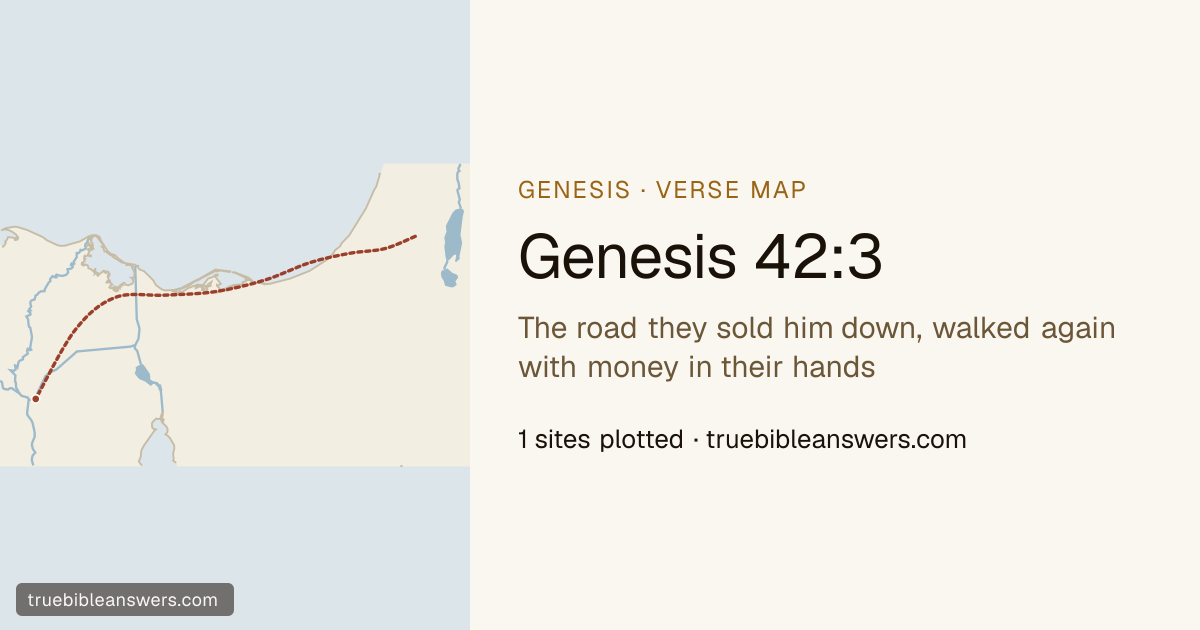 Open map →The road they sold him down, walked again with money in their handsGenesis 42:3 · 1 place plotted
Famine spreads beyond Egypt, and Jacob's household runs out of food. Ten of his sons set out for the one place with grain, not knowing that the man in charge of it is the brother they sold.
Awakened By Need
While there was plenty, Joseph's family showed no interest in him. One writer marks what changed when the food ran out.
Hamilton SmithDuring the days of plenty the world paid little heed to Joseph. Of his brothers we hear nothing; they were wholly indifferent to him. When the shortage set in, however, need woke up. "The land of Egypt was famished" (v. 55), and Jacob and his sons faced starvation and death (Gen. 42:1-2). The need calls forth a cry for bread. The Gentiles have to learn, and the brothers discover, that no one can meet the need except the one they once scorned and rejected.
No Help In One Another
Before the ten move, their father asks why they stand looking at each other. The question exposes how useless they are to each other.
Hamilton SmithUnder the stress of famine Jacob has to say to his sons, "Why do you look one upon another?" They are in desperate plight, and this much they realise, there is no help in one another. If help is to come it must be from one outside themselves. So the ten brethren come to Egypt and present themselves before Joseph.
The Direction Of The Journey
The verse does not say they travelled; it says they went down. One commentator reads that direction as part of the lesson.
L. M. GrantThe famine reaches to Jacob's land. God makes him and his sons feel the distress of famine, until they hear that Egypt has plenty of food for sale. So Jacob orders his sons to take a trip there to buy food (v. 2). Joseph's ten brothers then "went down" (v. 3). This shows that Israel must be humbled to receive blessing from God.
No Supply Apart From The Supplier
They want grain, not Joseph. But only one man can hand out that grain, and he is the brother they got rid of.
W. T. P. WolstonThey heard that there was grain in Egypt. They heard that there was deliverance to be had if they could only get it, and they were perishing. They heard there was salvation. They felt their need, and felt they would like to be saved, but they could not get salvation without going to the saviour. They could not get deliverance apart from the deliverer. They could not get food in their hunger except from Joseph — the despised one, the one they had hated, the one they had cast out and sold. But God had raised him up to have every resource in his power, everything that could meet their need.
The Wrong Plan
Their errand is to buy. Money in hand is the wrong approach to a brother whose heart is full of love toward them.
Hamilton SmithThey have indeed come to the right person, but they have come with a wrong plan and with a wrong plea. Their plan is to buy, and their plea, "We are honest men" (v. 11). As yet they know neither the love of Joseph's heart, nor the evil of their own hearts. They must learn that Joseph is too rich to sell to his own, and that they have nothing in themselves to plead. Their money will not buy grain, and they have no merit by which to claim it… Love is a giver when worthlessness has nothing to plead.
Ten, Not Eleven
Benjamin stays home, kept back by a father still carrying an unhealed wound. Yet the gap in the party does not slow God down.
William KellyOur chapter opens with the perplexity of the sons, and their father's proposal that they should go down into Egypt for supplies. Only Benjamin must not go, in case harm came to him as it did to his brother Joseph. That burden, though unspoken, always weighed on his heart. How little he could foresee that before long Benjamin must go too! But God was working out His good and holy design, slowly but surely. Man's will or intelligence had nothing to do with bringing it all to pass according to His word.
Why The Road Ahead Is Hard
Joseph is now able to give them everything they need. One writer explains why he does not simply hand it over.
F. B. HoleHe was now highly exalted among the Gentiles and acting as saviour of the world, but his brothers needed his bounty as much as others. They had, however, by their own wicked actions, shattered all the links that once bound them to him. Those links could not be rightly restored except by severe dealings — dealings very painful, yet designed to work in them a real repentance. The terrible famine, whatever else it might do, was designed to play a part in bringing about that desirable end.
One writer traces where this road ends.
J. N. DarbyHis brothers had once rejected him, when he was one of them. Now famine forces them to come. The path of repentance and humiliation brings them at last to own him in glory.
Summary
- Famine starts it. Plenty left them indifferent to Joseph. Hunger turns their faces toward him.
- Down, not across. The words "went down" mark the journey as a humbling. God humbles Israel before He blesses them.
- Outside themselves. There is no deliverance apart from the deliverer, and he is the brother they cast out.
- Buying fails. They arrive with money and a claim to be honest men. They must learn that the one they wronged is too rich to sell to his own.
- Repentance, then reunion. Ten brothers, a father's fear, a Benjamin kept at home — and behind it all God, working toward the day they own their rejected brother in glory.