Then they journeyed from Bethel. When they were still some distance from Ephrath, Rachel went into labor, and she had hard labor.
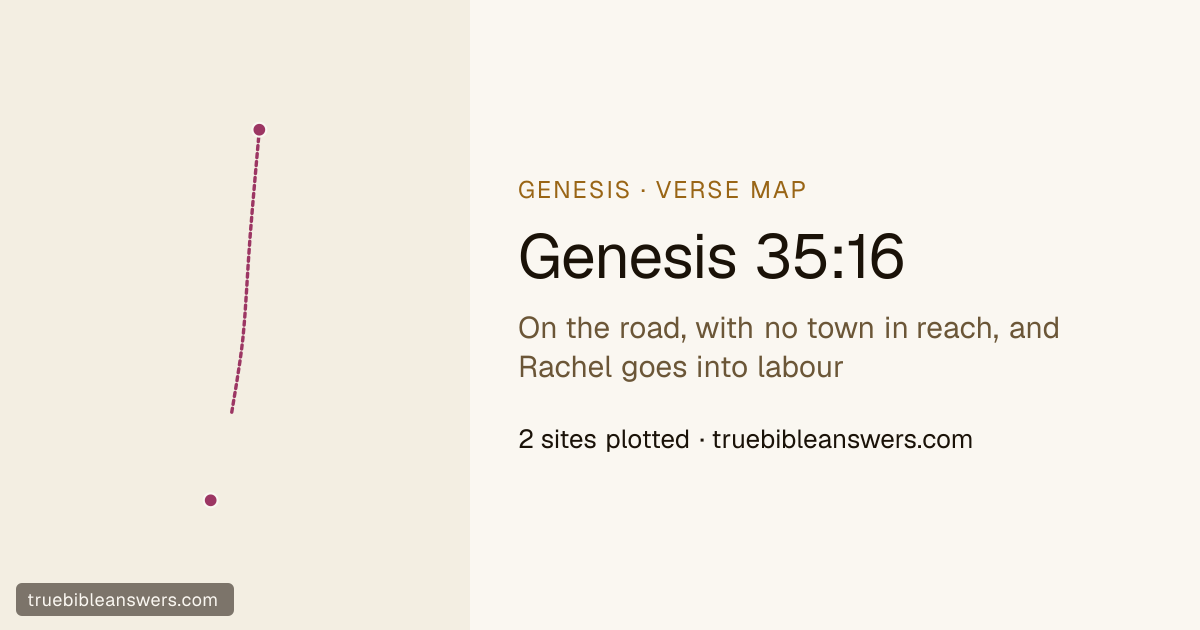 Open map →On the road, with no town in reach, and Rachel goes into labourGenesis 35:16 · 2 places plotted
Jacob has just met God at Bethel, and now he is on the road again. Rachel's labour turns dangerous while Ephrath is still some distance ahead — so why does the deepest sorrow so often follow the highest moment?
Leaving Bethel
One writer traces what follows each stage of Jacob's moving on.
The Bible TreasuryIt was good for Jacob to be at Bethel: that seemed to be his right place. But "they journeyed from Bethel." At once the heaviest sorrow of his life fell on him: his dearly loved Rachel died. He journeys again (v. 21), and then comes the terrible wickedness of Reuben. He journeys again, and then comes his father's death. Then he lived in the land where his father was a stranger, and we read of the long series of troubles connected with Joseph.
Commentators differ on how to read that departure. Another writer reads Bethel as the point where a new kind of journey begins.
L. M. GrantSince Jacob had reached Bethel, this becomes the starting point of a journey of a different kind. It is the same with a believer today: his path becomes different when he comes to value the truth of the house of God as he should. There are still trials. But he now looks at them with calm submission, instead of scheming in the flesh about how to meet them. Jacob journeys (v. 16), and near Ephrath (which means "fruitfulness"), Rachel goes into labour.
Hard labour and God's government
The hard birth was not just bad luck. One writer links it back to Rachel's own history. She had stolen her father's household idols and hidden it from Jacob.
William KellyThe moral government of God, now along the way, fails no more than His grace from beginning to end. Rachel had greatly sinned and kept her husband in the dark, when he unknowingly said that the guilty one should not live. Her theft was not only a sin against her father, but in what she stole, a serious insult to God. And we have no evidence that she judged herself properly, either soon or ever. It is plain that Jacob in time became aware of idols in his household, and God's call to Bethel laid the sin of it on his conscience. To take his beloved away was a chastening, not to her only but to him also.
Jacob's silence
The account records no word of complaint from Jacob. One writer sees that silence as the mark of a changed man.
Leslie M. GrantRachel's death was certainly one of the most painful lessons that Jacob had to learn. It went deep into his soul, and yet in his history nothing is said about how Jacob felt about it. He mentioned it a long time later to Joseph... He felt it. Yet I think we now see in Jacob a submitted heart. He recognised that it had come from the hand of God, and he bowed to it. He had learnt his lesson, learnt to submit to God.
Ephrath, which is Bethlehem
The verse names the spot with unusual care, and the name matters. Reference works note that Ephrath was the old name of the town: "Apparently it was originally called EPHRATH, Gen. 35:16, 19... It is once called BETH-LEHEM EPHRATAH, that is, the fruitful, for the ruler of Israel was to come from there. Micah 5:2." Jacob had no way of knowing what he was standing on.
William KellyJacob set up a pillar of thanksgiving at Bethel, in the place where God talked with him. He never thought that so soon afterwards he would set up another pillar, this one of sorrow, on Rachel's grave. But he bows to the hand of chastening: the Lord disciplines the one He loves, and chastises every son whom He receives. Jacob could not know, since God had not yet revealed it, that the King of Israel would be born near this very Ephrath. That King is the pledge and picture of great David's greater Son, whose goings forth are from of old, from everlasting.
The place of later weeping
Rachel's roadside grave became a fixed landmark of grief. Long afterwards, when Jacob rehearsed this loss to Joseph, he still could not see the whole of what that ground would carry.
F. B. HoleHis faith could not grasp the distinction that was still to come to the place, for centuries had to pass before prophecy pointed to that spot as the birthplace of the great Ruler in Israel, whose goings forth have been from the days of eternity. It was to be the place where there was not only a mourning for Rachel, but also where there should be a great mourning, "Rachel weeping for her children," according to Matthew 2:18.
Summary
- Road — the sorrow begins with a move: "they journeyed from Bethel." Writers differ over what it means. Was Jacob drifting from the place God gave him, or starting a new stage of the walk?
- Labour — the hard birth falls under God's moral government, which "fails no more than His grace." It chastened Jacob as much as Rachel.
- Silence — Scripture records no complaint from Jacob. He felt the blow, yet took it from God's hand.
- Pillar — the man who raised a pillar of thanksgiving at Bethel soon raised a pillar of sorrow on a grave. He did not know what that ground would mean.
- Ephrath — the road where his hopes seemed to close ran on to the birthplace of Israel's King.